Game development is moving beyond the engine
AI is accelerating how studios create and modify games, but faster builds do not automatically create faster learning. Extending the development pipeline to players connects each build to useful signals and validated decisions.
 Playruo Editorial TeamUpdated October 13, 20264 min read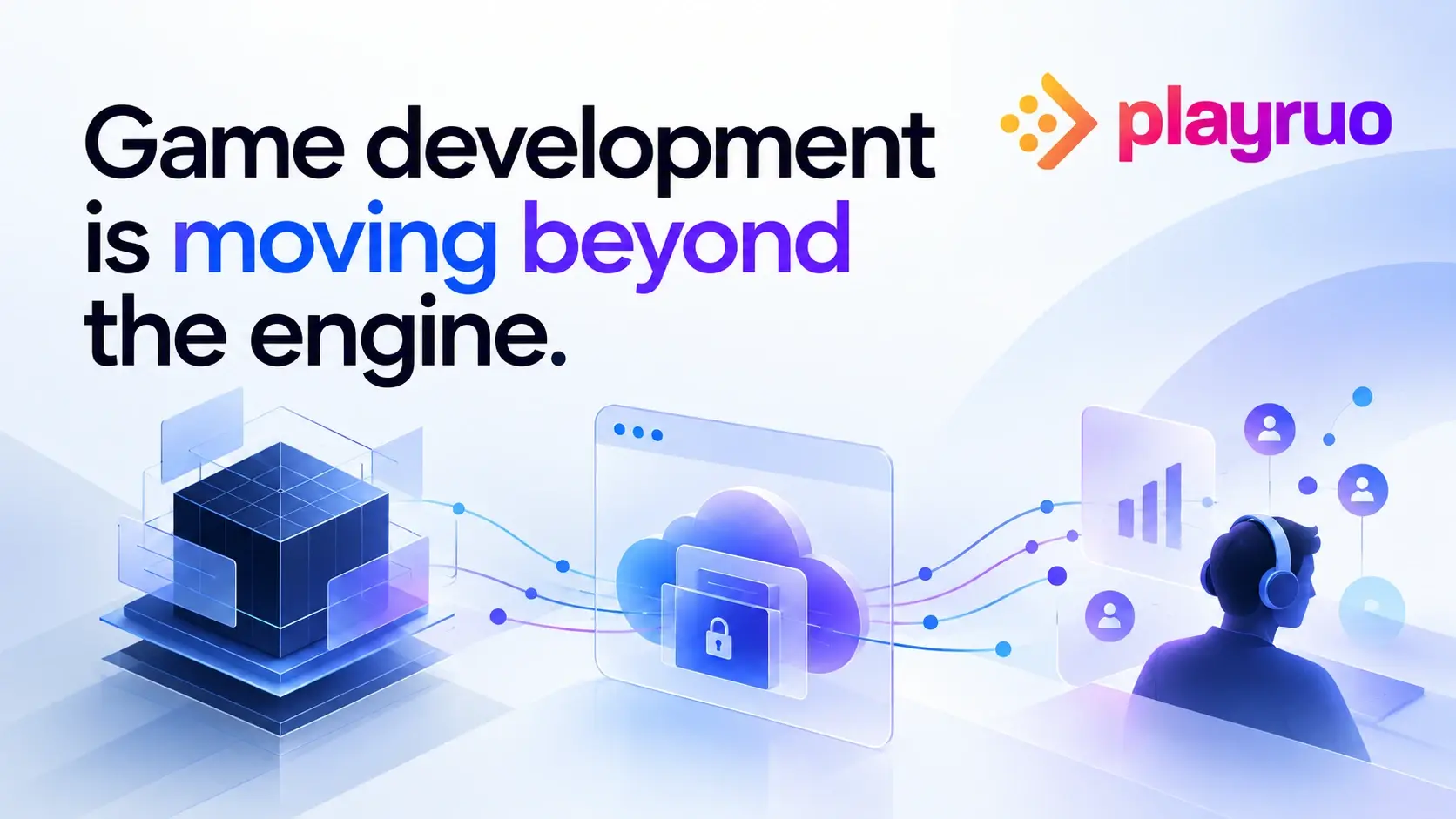
Key takeaways
- AI can accelerate build creation and modification without guaranteeing faster learning.
- Decisions validated through player feedback provide a useful measure of iteration.
- Controlled browser access can extend the development pipeline from builds to players.
The next iteration breakthrough is between the build and the player.
For decades, game development technology has focused on shortening the distance between an idea and a playable build. Engines transformed rendering, world building, collaboration and deployment. Now AI is compressing that distance again.
With Unreal Engine 5.8, Epic introduced an experimental MCP server that allows AI agents such as Claude Code or Cursor to interact directly with Unreal Editor: creating actors, configuring lighting, manipulating assets and running actions inside the development environment.
The direction is clear: creating and modifying a playable build is getting dramatically faster. Which makes the next bottleneck increasingly visible: what happens after the build is ready.
Someone still has to play it.
The overlooked bottleneck: build → player
For many PC teams, putting a new build in front of external players still means packaging it, distributing it, asking people to download and install it, checking hardware compatibility, managing access and troubleshooting issues.
That creates friction between two moments that should be closely connected: the build and the player signal. And as AI accelerates what happens inside the engine, that friction matters even more.
Faster builds do not automatically create faster learning. The real iteration loop is:
build → player → signal → decision → next build
If teams can modify a game dramatically faster, the value increasingly shifts to how quickly those changes can reach real players and become validated decisions.
| Step | Outcome |
|---|---|
| Work inside the engine | A playable build |
| Player access to the build | Observations and feedback |
| Analysis of that feedback | A decision for the next iteration |
Iteration should be measured in learning
Game teams do not win because they create more builds. They win because they make more good decisions before launch. So the real unit of iteration is not the build itself. It is a validated decision.
Yet access to players is still often treated as something outside the development workflow. It should not be. If development technology helps teams create and modify games faster, then getting those games in front of the right players is a natural extension of that stack.
What if the build became the test environment?
Imagine a different workflow. A studio produces its native PC build. Instead of distributing it to hundreds of machines, that build becomes accessible through a controlled browser experience.
No port. No alternative version. No modification of the original build.
Players can access the game without owning the right gaming hardware, while the studio controls who can play, when and for how long.
The distinction here matters: streaming is only the transport layer. The actual value lies in turning an unreleased build into a secure, repeatable player-access workflow: infrastructure, authentication, access control, session management, observation, session analytics and security.
The value is not in moving pixels. It is in removing everything between a build and a useful player signal.
The development pipeline should extend to the player
This is the layer Playruo has been building. Playruo enables supported native PC builds to become secure, browser-accessible experiences without requiring studios to modify the game.
And playtesting is only the first use case. The same underlying infrastructure can support:
internal reviews → external playtests → publisher reviews → press & creator previews → playable discovery
Different audiences. Different objectives. One underlying question: how quickly and securely can you put the game in front of the right person?
As AI removes more friction inside the engine, the next iteration bottleneck moves outside it. The next breakthrough may therefore happen between the build and the player.
The development pipeline should not stop at the build. It should extend to the player.
At Playruo, that is the layer we are building: helping games succeed, from playtesting to launch.

FAQ
Sources
| Source | Notes |
|---|---|
| Epic Games: Unreal MCP documentation | Primary documentation for experimental Unreal MCP, compatible AI clients and editor tool capabilities. Reviewed 13 October 2026. |
| Epic Games: Unreal MCP is now available in UEFN | 20 August 2026. Confirms Unreal MCP shipped with Unreal Engine 5.8; UEFN-specific beta features are not attributed to Unreal Editor. |
| Playruo technology | First-party description of unmodified supported PC builds, server-side execution and browser delivery. Reviewed 13 October 2026. |
| Playruo remote playtesting | First-party remote playtesting workflow, consistent server hardware and security controls. Reviewed 13 October 2026. |
| Playruo press previews | First-party description of controlled browser access and session logs. Reviewed 13 October 2026. |
| Playruo playable marketing | First-party description of browser demos and playable discovery. Reviewed 13 October 2026. |
Related resources
More Playruo guidance connected to this topic.