AI can clone your game. Why are you still distributing playtest builds?
Studios are restricting demos over AI cloning concerns. Learn how secure remote PC playtesting protects game builds and improves session visibility.
 Playruo Editorial TeamUpdated October 21, 20267 min read
- Studios are restricting demos and playtests over AI cloning fears
- AI is making game cloning and reverse engineering more accessible
- The hidden security risk of distributing playtest builds
- How can studios protect their games from AI cloning during playtests?
- Playruo: secure PC playtesting with full control and visibility
- The next playtest needs a new security standard
Key takeaways
- Studios are restricting public demos and playtests over AI-assisted cloning concerns.
- Keeping game binaries in the cloud reduces local build exposure; it cannot prevent imitation of visible gameplay.
- Controlled browser-based playtests can preserve player access while providing session visibility.
TL;DR: Concerns about AI-powered game cloning are already pushing studios to cancel public demos and restrict playtests. As AI makes reverse engineering more accessible, distributing unreleased PC game builds creates avoidable security risks. Playruo enables secure remote playtesting without distributing game files, while giving studios full visibility and control over who plays, when, and for how long.
Studios are restricting demos and playtests over AI cloning fears
In October 2026, two gaming companies made headlines for the same reason: they feared their upcoming games could be cloned before launch.
Digital Sun, the studio behind Moonlighter, scaled back the public playtest of its upcoming game ReVamp, moving to a more restricted Discord-based test.
The studio cited concerns about games being reverse-engineered, cloned and published before their original creators could bring them to market.
Meanwhile, Alliance Arts cancelled the public demo of Drunken Goddess Reflux, originally scheduled for October 19.
The publisher warned that AI and other development tools could enable imitators to rapidly reproduce the game's presentation and gameplay, potentially releasing competing versions before launch.
It also cited difficulties in managing the planned restrictions on publishing and streaming gameplay footage. Instead, it opted for a closed playtest.
These decisions concern perceived risks, not reports that either game had already been cloned.
Game studios are starting to cancel public demos to protect their games. But what if they didn't have to?
AI is making game cloning and reverse engineering more accessible
Game cloning isn't new. What's changing is the technology available to potential imitators.
Take REA (Reverse Engineer Anything), an open-source project that enables AI agents to investigate software behavior and analyze applications, including native binaries.
Tools like REA illustrate a significant shift: tasks that once required substantial reverse-engineering expertise can increasingly be assisted by AI. REA is an example of AI-assisted software analysis, not evidence that an entire game can be cloned automatically.
For unreleased games, there are two distinct threats:
- Cloning from gameplay: reproducing visible mechanics, visuals or game concepts based on trailers, screenshots or playable access.
- Reverse engineering a build: inspecting locally available executables, assets and software behavior to understand how the game works.
AI can assist both activities. Distributing a build introduces the additional risk of exposing the underlying game files.
AI is making copying easier. Why make accessing your game files easier too?
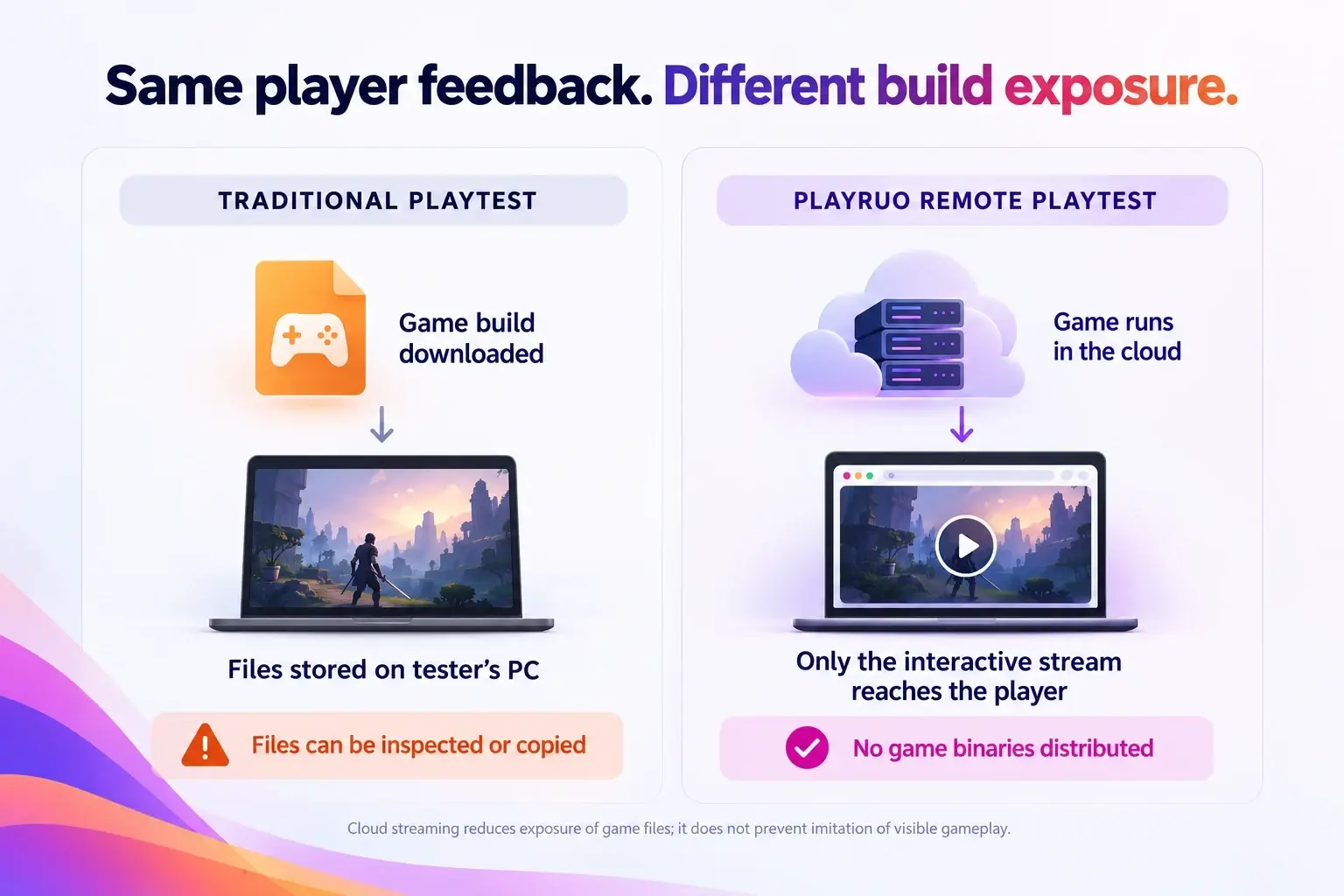
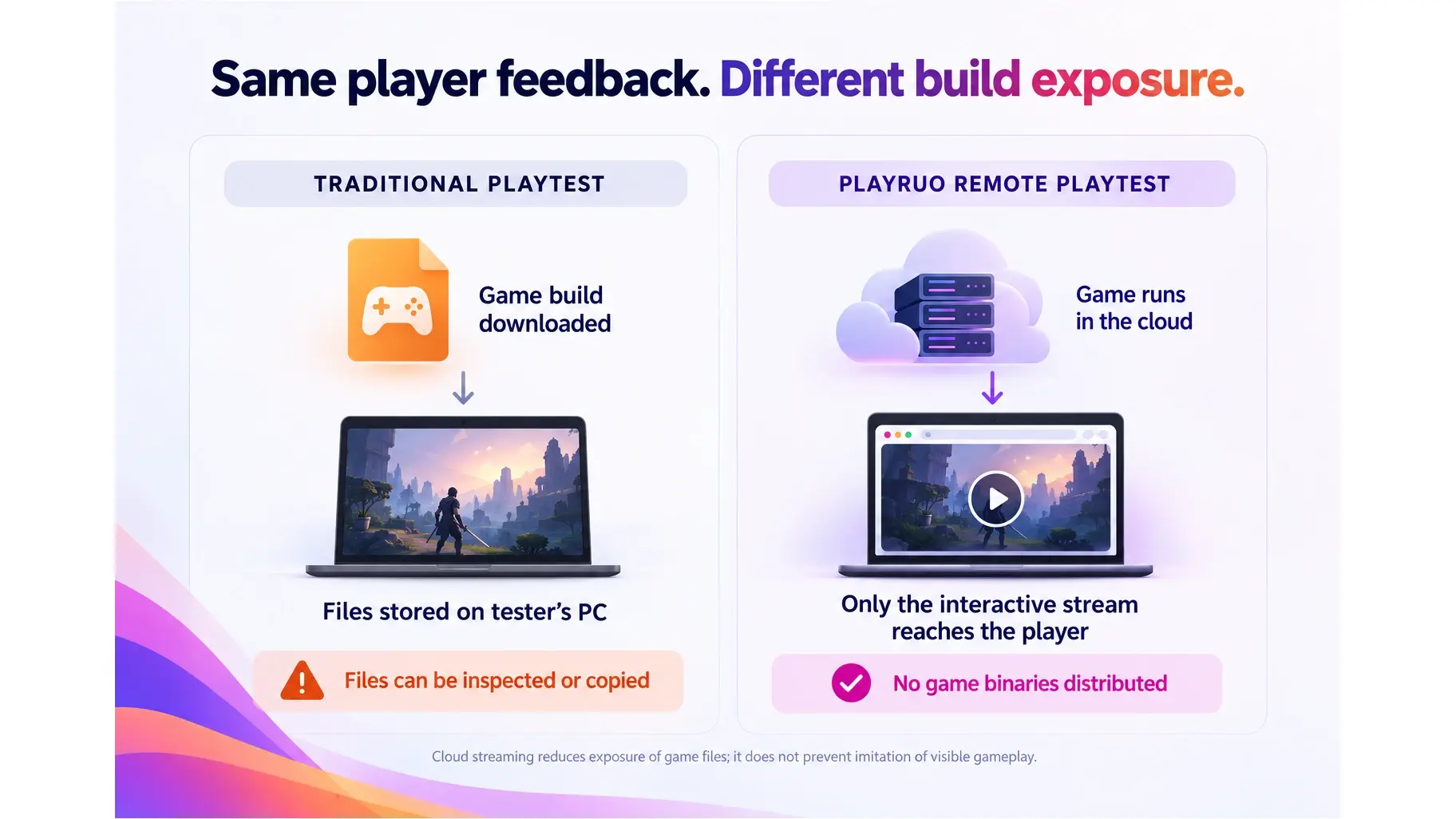
Same player feedback. Different build exposure. Cloud streaming reduces exposure of game files; it does not prevent imitation of visible gameplay.
| Question | Locally installed playtest build | Playruo browser-based playtest |
|---|---|---|
| Where does the game run? | On the tester’s device | On secured cloud infrastructure |
| Are game binaries delivered to the tester? | Yes, for local installation | No local game build is delivered |
| Can visible gameplay still be imitated? | Yes | Yes |
How can studios protect their games from AI cloning during playtests?
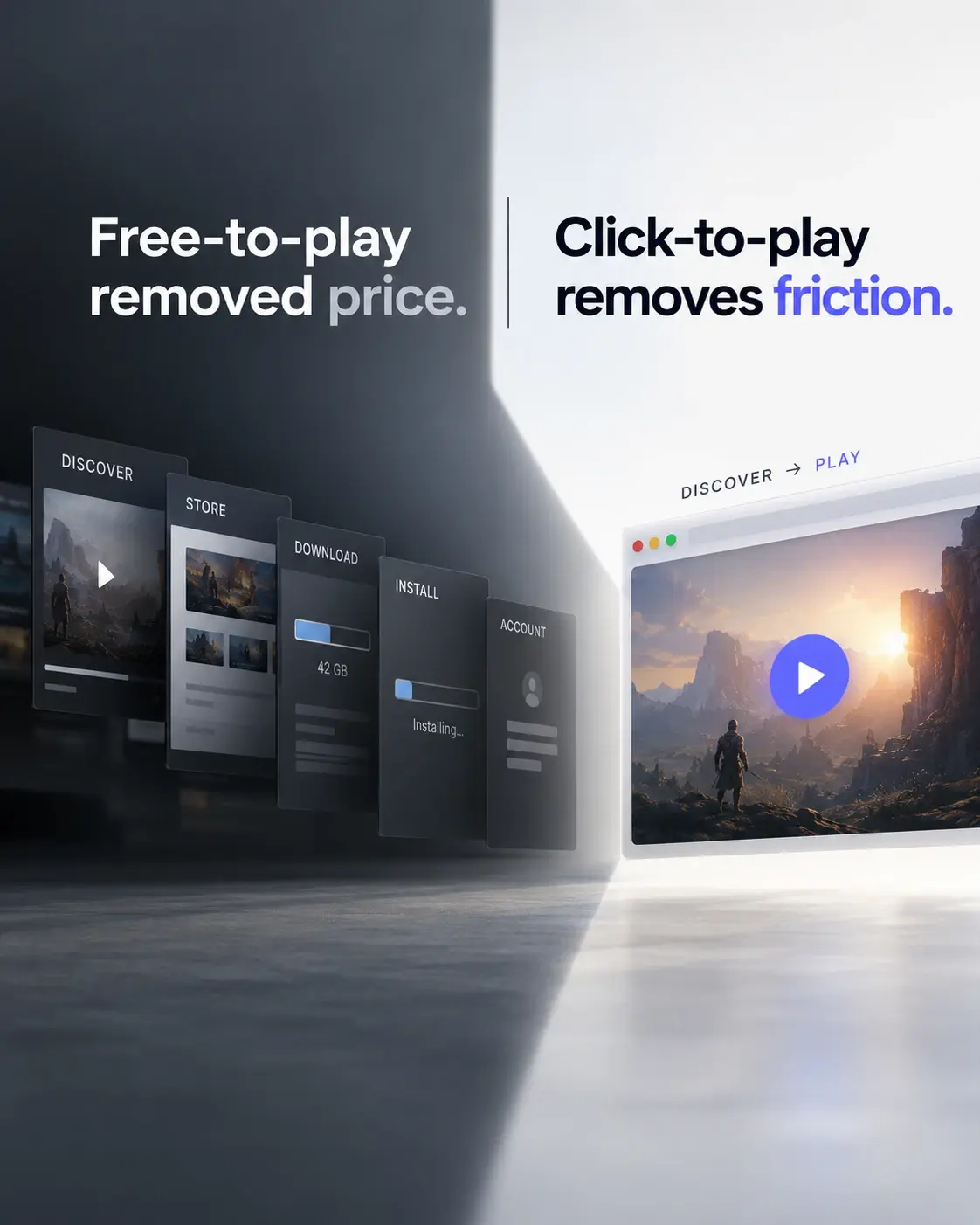
One effective way to reduce the risk of build exposure is straightforward: stop distributing game binaries when local installation isn't necessary.
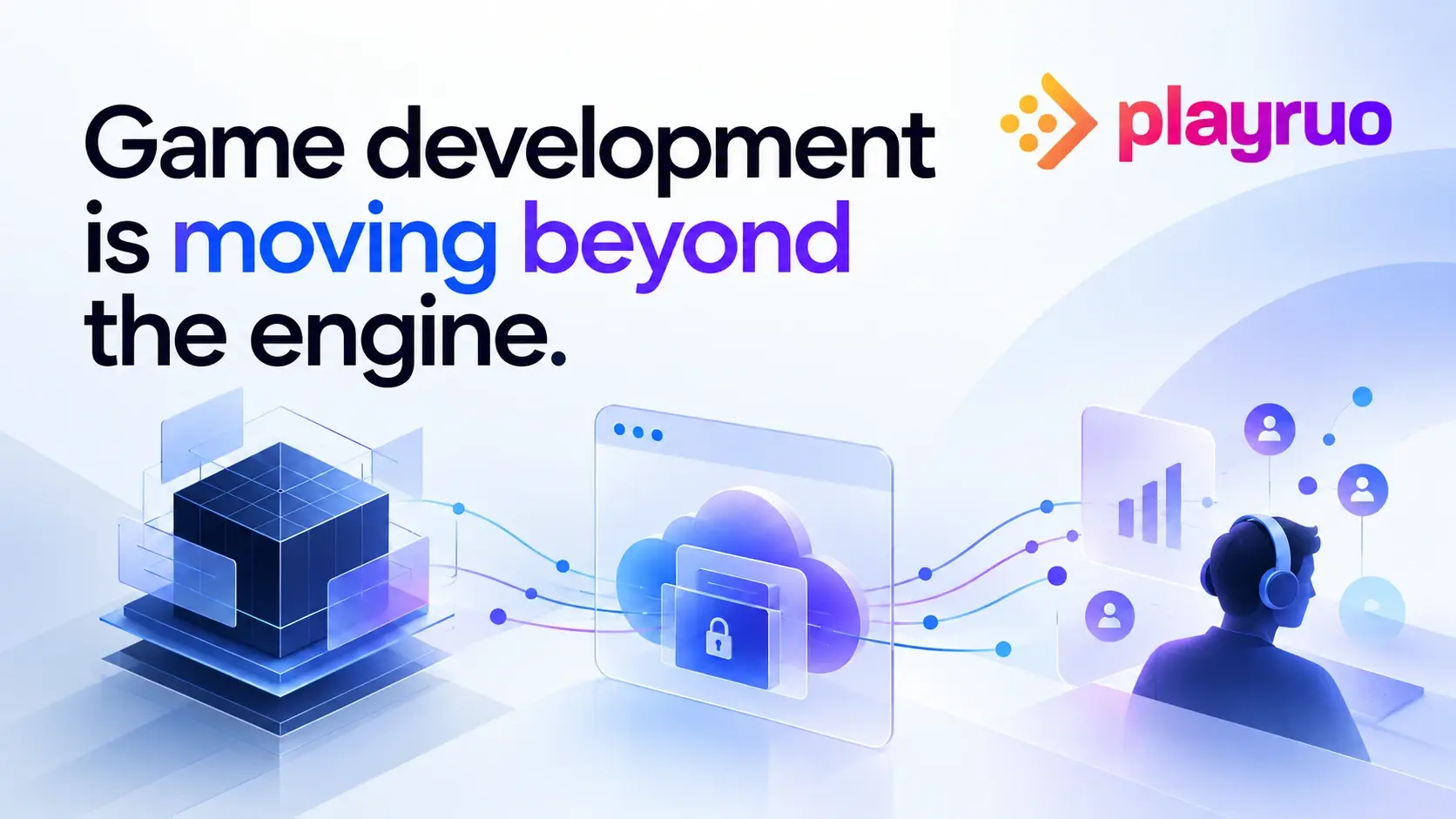
With secure cloud-based remote playtesting, the game runs on remote infrastructure while participants interact with it through their browsers.
Players experience the real PC game, but the original executable and asset files remain in the cloud.
This doesn't prevent someone from imitating gameplay they can observe. However, it removes the need to provide testers with locally installed game binaries, reducing opportunities for file extraction and reverse engineering.
And studios can keep collecting valuable feedback without restricting their audience to a handful of participants.
Let players experience your game. Don't give them its files.
Playruo: secure PC playtesting with full control and visibility
Playruo is a secure remote playtesting platform for PC games that allows studios and publishers to test unreleased games with external players without distributing game builds.
Games run on secured cloud infrastructure and stream directly to players' browsers, with no installation or game modification required.
Beyond protecting the build, Playruo gives studios something equally valuable: control and visibility over every playtest session.
- Keep game files secure. Game binaries remain in the cloud, with no local build distribution.
- Control who can play. Restrict access to whitelisted players and require authentication before launching a session, with optional NDA gating.
- Know who played and for how long. Track individual participants, session activity and playtime.
- Watch players live. Use Playruo's Control Room to monitor gameplay sessions in real time.
- Record gameplay sessions. Capture sessions for later review, analysis and sharing with development teams.
- Keep access under control. Set time limits, revoke sessions and apply individual watermarking for additional security and traceability.
These capabilities make remote playtesting not just more secure, but also easier to manage and more informative.
And the technology is already proven at scale.
In 2026, Playruo supported a remote playtest of CONTROL Resonant for Remedy Entertainment, involving more than 400 players across Europe and North America, without distributing game binaries to participants.
The result: access to relevant players at scale, while keeping the unreleased game build under control.
The next playtest needs a new security standard
AI is accelerating game development. It's also changing the risks of exposing unreleased games.
Studios shouldn't have to choose between protecting their intellectual property and collecting valuable player feedback.
With secure remote playtesting, they can do both, while gaining greater control and visibility over every session.
Your game should be playable. Your build shouldn't have to be downloadable.
Planning your next confidential PC playtest?
Protect your build with Playruo's secure remote playtesting →

FAQ
Sources
| Source | Notes |
|---|---|
| Game Developer: ReVamp playtest | 19 October 2026. Reports Digital Sun replacing a broad public ReVamp playtest with a more restricted Discord test over cloning concerns. No claim that the game had actually been cloned. |
| Alliance Arts: Drunken Goddess Reflux demo announcement | Official announcement, 16 October 2026. Public demo planned for 19 October cancelled in favor of closed sessions. Cites both managing posting/streaming restrictions and concerns about rapid imitations using AI or other tools. |
| REA: official project repository | Primary documentation for agent-assisted analysis of software behavior, applications and native binaries. Does not establish automatic cloning of an entire game or involvement in the two studios' decisions. Checked 21 October 2026. |
| Steamworks: Steam Playtest | Official participation/access controls. An access key is not the game build itself; local binary exposure depends on the selected testing workflow. Checked 21 October 2026. |
| Playruo: secure remote playtesting | First-party streaming and access-control workflow. The additional session features and CONTROL Resonant example were supplied in the Playruo editorial brief and directly confirmed for public use on 21 October 2026. |
| Playruo: technology | Supported native PC builds, server-side execution and browser delivery without changing the game code. Checked 21 October 2026. |
| Playruo: monitoring live sessions | Operational guide, Monitor live sessions section, for real-time observation and session analytics. Checked 21 October 2026. |
Related resources
More Playruo guidance connected to this topic.