How Tara Gaming reduced its AAA playtest costs by 3x with Playruo
 Playruo Editorial Team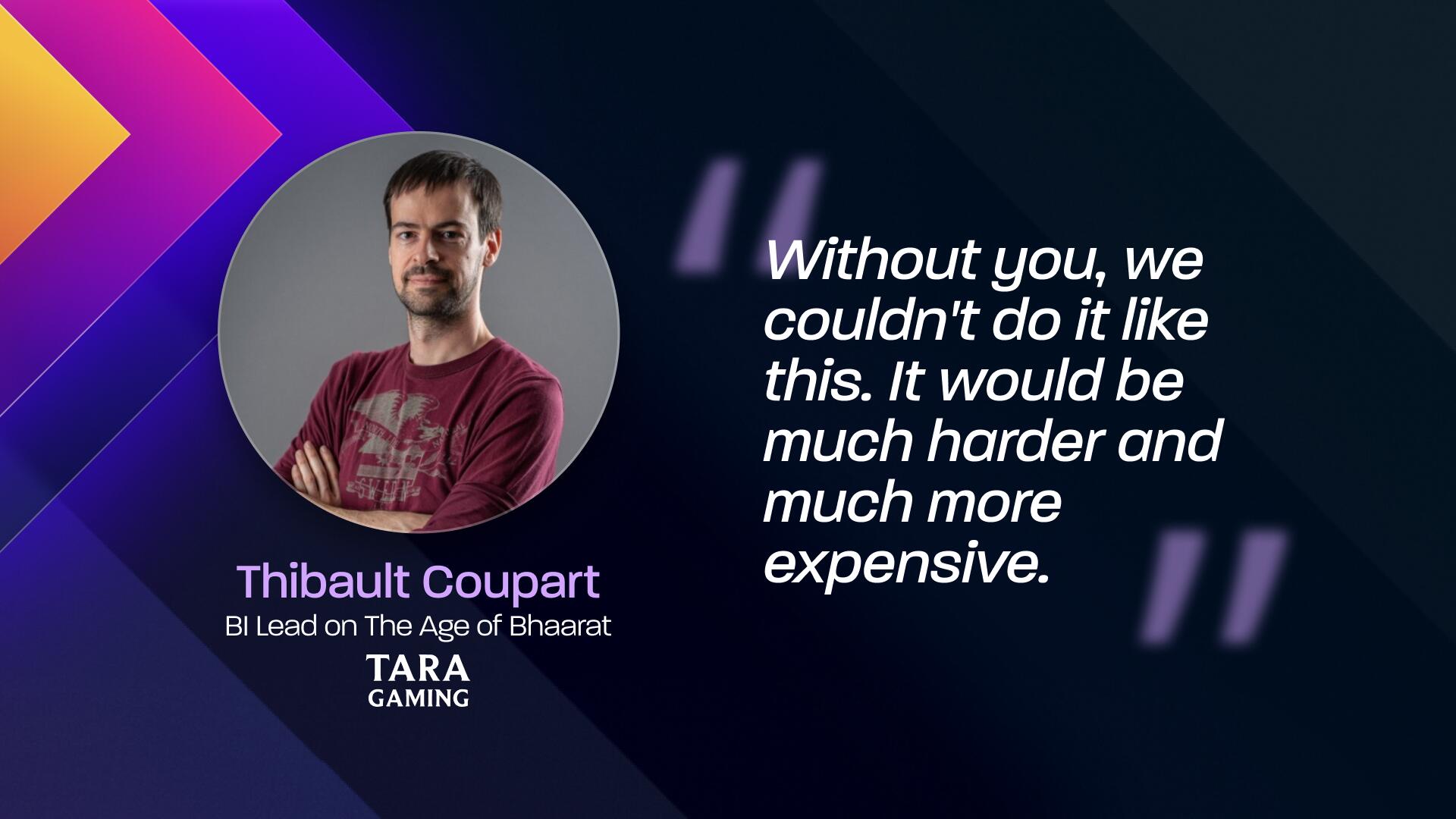
The challenge: external-grade playtests with a lean internal team
Since 2025, Tara Gaming has used Playruo to run remote playtests for its AAA PC game The Age of Bhaarat without sending local builds to testers. Across four playtests, the team built a workflow that let a small internal research setup keep control of analysis while offloading the hardest operational layer: secure remote access to in-development builds.
That mattered because Tara Gaming did not want to recreate a specialized playtest infrastructure in-house for a recurring but still milestone-based need. The goal was not just to let people play the game. It was to run studies that felt credible enough to support real production decisions.
Without you, we couldn't do it like this. It would be much harder and much more expensive.
For a game in development, that standard is high. A useful playtest needs a stable enough setup, enough participant compliance to collect feedback, and enough structure to compare what players said with what they actually did. Tara Gaming wanted that level of rigor without building a full lab operation around it.
Why previous playtest setups were no longer enough
Before Playruo, Tara Gaming mainly had two options:
In-person tests were time-heavy and locally constrained
Before Playruo, Tara Gaming had already run in-person sessions. Those tests had value, but they also created overhead. Organizing them took time, and the tester pool skewed heavily local. That made it harder to study broader player reactions for a game intended to speak to an international audience.
Fully outsourced lab setups were more complete, but much heavier
The other route before Playruo was a more traditional outsourced playtest lab. That model covered more of the process end to end, but it also came with much higher cost and less flexibility for a lean internal team that still wanted to own research interpretation.
Compared with a traditional fully outsourced lab setup, Tara Gaming estimates that the Playruo model reduced the outsourced portion of each study by roughly 3x once tester recruitment is accounted for, while the team kept research and analysis in-house. The point was not that both models were identical. It was that Tara Gaming could avoid paying for an operational stack it did not need to rebuild every month.
That logic fits a broader shift in games research. Remote studies are no longer a second-tier fallback. In some usability contexts, remote and lab studies can perform within single-digit gaps on task completion, which helps explain why more teams now treat remote methods as production-grade rather than provisional (Source: MeasuringU 2021). Xbox Research has also documented worldwide virtual playtesting workflows for games, showing how remote play research has matured operationally (Source: Microsoft Developer Blog 2023).
The approach: secure remote playtests with Playruo
Tara Gaming did not hand off the whole playtest process. Instead, the company split the workflow in a practical way:
Tara Gaming kept the research layer in-house
The internal team handled the research design and analysis. That included building the questionnaire, reviewing responses, and combining survey data with gameplay analytics to spot where player perception diverged from actual performance.
That combination mattered a lot for interpretation. A player might say the combat felt too hard, while the session data shows a healthy win rate. In that case, the issue may be about perceived frustration, feedback clarity, or feel rather than actual tuning.
Playruo handled the secure access and cloud delivery layer
Playruo made it possible to give testers browser-based access to the build without distributing a local version. For Tara Gaming, that lowered exposure compared with sending builds directly to players' machines. It also removed the need to maintain a private distribution stack for each study.
Playruo for Playtest works as a charm and has a direct impact on team efficiency! As a game developer where logistics can be complicated, Playruo is an important tool for us.
The operational flow became relatively consistent:
A repeatable session workflow
- The build was usually frozen around 5 days before the session.
- The questionnaire was typically finalized 1 to 2 days before launch.
- Testers received access with a play window of roughly 48 hours.
- Players were asked to complete at least 30 minutes of play.
- Survey completion happened at the end of the session, with reminders built into the flow.
That structure helped Tara Gaming stay lean while still producing studies that felt methodical. It also aligned with the type of remote game playtesting workflow many studios now favor when they need speed, reach, and tighter build control. For a broader look at that model, see the definitive guide to remote game playtesting.
What changed: prep time, international reach, and build control
The biggest shift was not a single feature. It was the way several constraints eased at the same time.
Preparation time was cut in half
Tara Gaming says Playruo roughly cut playtest preparation time in half, while still delivering an equivalent or arguably better result thanks to international reach and a more repeatable process.
We cut the organization time in half, for an equivalent or arguably better result.
That gain came from reducing coordination load, simplifying build access, and tightening the survey handoff at the end of each session.
International testing became practical
Before, in-person testing mostly meant local audiences. With Playruo, Tara Gaming could run remote sessions with international players instead of relying mainly on a local participant base. For a game with broader commercial ambitions, that changed the quality of the feedback pool.
Cloud hardware absorbed the reality of an in-development build
One playtest exposed a common problem in game development: the build was not well optimized yet. Instead of canceling the study or waiting for a long optimization pass, Playruo easily scaled server power so the session could still run under perfect conditions.
That flexibility mattered because development builds often prioritize content and fidelity before performance. Tara Gaming did not need perfect optimization to keep learning.
Streaming held up for real-time combat testing
A few testers mentioned slight latency, which is expected in a streamed setup. For Tara Gaming, that did not prevent meaningful feedback on a real-time combat experience: the sessions still produced reliable survey responses, actionable analytics, and usable design insight.
The model stayed lean without feeling lightweight
Tara Gaming settled into a typical study size of around 10 testers, with the first playtest running closer to 20 to 25. That smaller format still produced enough data to support a meaningful review when combined with analytics and surveys.
| Area | Before Playruo | With Playruo |
|---|---|---|
| Prep time | About 1 month | About 2 weeks |
| Tester reach | Mostly local audiences | International remote access |
| Build delivery | In-person or heavier external setups | Browser-based remote access |
| Build exposure | Risky when local distribution is involved | Secured exposure than sending local builds |
| Study format | More coordination-heavy | Easy and repeatable remote sessions |
| Typical session size | Varied | Unlimited possibilities |
| Handling unoptimized builds | Harder to accommodate quickly | No more hardware or optimization constraints |
| Analysis model | Constrained by setup choice | In-house analysis plus analytics and surveys |
For teams comparing methods, this is also where the distinction between cloud playtesting and traditional lab testing becomes concrete. The tradeoff is not lab versus no rigor. It is often a choice between where rigor lives in the workflow. This breakdown of cloud playtesting vs. traditional lab testing maps well to what Tara Gaming described.
What already made the workflow actionable
For Tara Gaming, the value was not a single tool in isolation. It was the ability to combine secure build access, gameplay analytics, and player feedback in one repeatable workflow the team could use across milestones.
The important thing is to respect the standard expected from a AAA studio in terms of playtest quality.
That workflow gave Tara Gaming something practical: a way to test heavy in-development builds with external players, keep the analysis layer in-house, and produce results that could feed both design decisions and publisher-facing materials.
For Tara Gaming, the effective stack was three current layers working together:
What the team used to make decisions
- Secure build access for external testers across regions
- Analytics to measure player behavior and outcomes
- Surveys to capture perception, friction, and self-reported experience
Together, those layers gave Tara Gaming a repeatable way to run external-grade playtests without building a full playtest operation in-house.
For a lean team working on a large game, that was the real win. If you want the underlying platform view, Why Playruo and technology give more context on how that model works in practice.

FAQ
Sources
| Source | Notes |
|---|---|
| Playruo playtests overview | Public product context for secure remote playtesting. |
| Playruo technology overview | Public context for browser-based delivery and cloud infrastructure. |
| Xbox Research on worldwide virtual playtesting | Public reference for remote playtesting workflows in games. |
| MeasuringU on unmoderated testing | Public context for remote and unmoderated research methods. |
Related resources
More Playruo resources connected to this story.