Remote game press previews: the complete guide
Physical press events cost €50,000 to €100,000 and reach a few dozen journalists. Cloud-streamed previews reach hundreds across 30+ countries for a fraction of the cost, with full analytics and zero leak risk. Here's how to run one.
 Playruo Editorial TeamUpdated July 15, 202623 min read
Why physical press previews don't scale anymore
E3 shut down permanently in December 2023. That wasn't a surprise to anyone who had been watching attendance figures collapse for years, but it closed the book on an era that many publishers had built their entire comms calendars around. The mega press event is over, and what's replacing it isn't a single alternative: it's a fragmented, expensive, and increasingly unworkable set of options.
The economics tell the story clearly. A 30-second slot at Gamescom Opening Night Live costs €115,000 (Source: reported via industry sources, 2024). A self-organized physical press event runs €50,000 to €100,000 once you factor in venue, travel, catering, build stations, support staff, and logistics.
18,965 games were released on Steam in 2024, up 32% from 2023 (Source: SteamDB 2025). Journalists aren't acquiring more hours in the day to cover them.
62% of game journalists receive 11 to 50 pitches daily (Source: Big Games Machine 2024 Survey). The math is brutal: most physical press events are competing for a journalist's attention against dozens of other requests landing in their inbox the same morning.
Virtual events aren't just cheaper in theory. They're cheaper by a documented margin: virtual events reduce costs by 35 to 75% compared to in-person equivalents (Source: Markletic 2024, 3,960 respondents). The savings aren't marginal rounding errors. They're the difference between running three previews a year or running ten.
I couldn't see myself inviting journalists from around the world to gather in one place to test our game. So why not bring the game where they are?
That framing cuts to the core of the shift. The question is no longer whether remote previews are acceptable. The question is why publishers are still defaulting to physical events when the alternatives have matured enough to deliver a better result.
Current methods and their limits
When publishers move away from physical events, three methods dominate: Steam keys, downloadable builds, and hosted events. All three have real problems, and none of them gives you what a modern PR campaign actually needs.
Steam keys
Steam keys are the path of least resistance. You generate keys, distribute them, and hope journalists redeem and play. The problems start immediately: you have no visibility into whether the key was redeemed, whether the journalist launched the game, how long they played, or what level they reached.
Keys are redistributable. A journalist can forward one to a friend, sell it, or post it publicly. There's no watermarking, no session data, and no way to restrict the experience to the build version or content you want reviewed. Once the key is out, your control is gone.
Downloadable builds
Downloadable builds via Dropbox, custom FTP servers, or build delivery platforms solve the platform dependency but introduce a different set of problems. A 25GB download on a slow connection is already an ask. Variable hardware configurations at the journalist's end mean the experience you carefully tuned on your dev machines may not be what the journalist sees.
Builds can be copied, shared, or archived. Session data doesn't exist. If a build leaks, you have very limited tools to trace it back to its source.
67% of journalists want review copies three or more weeks before launch (Source: Big Games Machine 2024 Survey). That's a long window of exposure for any downloadable build circulating across dozens of journalist machines.
The security problem
The security risk isn't theoretical. The Insomniac Games breach in December 2023 leaked 1.67 TB of data, including a playable Wolverine build (Source: BleepingComputer 2023). The Game Freak breach in October 2024 leaked approximately 1 TB of data including unannounced game information (Source: BleepingComputer 2024).
Neither of these was a press preview context specifically, but the underlying vulnerability is identical: once a build exists as a file somewhere, that file can travel. For the specific risks and mitigations, securing unreleased game builds covers the threat model in detail.
Physical events
Physical events are the most controlled option but cap your reach at a few dozen journalists per event. You control the hardware, the build, the experience, and the environment. You also spend €50,000 to €100,000, constrain participation to journalists who can travel, and spend months coordinating logistics.
For a major release from a major publisher, that investment may be justified. For most releases, it isn't.
| Method | Reach | Cost | Security | Analytics | Journalist experience |
|---|---|---|---|---|---|
| Steam keys | Global (unlimited) | Near zero | Low: redistributable, no tracking | None | Inconsistent: depends on journalist hardware |
| Downloadable builds | Global (with caveats) | Low to medium | Low: files can be copied or leaked | None | Variable: hardware-dependent, long download |
| Physical events | Limited: dozens of journalists | High: €50,000 to €100,000+ | High: controlled environment | None | Controlled but constrained by location |
None of these methods gives PR teams analytics. None of them lets you see who actually engaged with your game, for how long, and what content they reached. That absence of data makes it nearly impossible to improve your preview strategy based on evidence.
Cloud streaming: the press preview alternative
Cloud streaming solves the three core problems with current methods: cost, security, and analytics. It does this through a fundamentally different architecture, one where the game never leaves your infrastructure.
How it works
Your game runs on a remote server. That server encodes the video and audio output and streams it to the journalist's browser via a low-latency protocol. The journalist's keyboard and mouse inputs get captured and sent back to the server, where the game responds in real time.
No file is downloaded to the journalist's machine. No build exists locally. Nothing can be copied, extracted, or leaked from the journalist's end.
Proven at scale
Ubisoft demonstrated the model in 2020. Using Parsec's streaming technology, they delivered over 1,500 remote press demos reaching journalists in 30+ countries (Source: Parsec/Ubisoft Case Study 2020). That campaign reached a geographic footprint that no single physical event could match.
The cloud gaming market reached $6.4 billion in 2024, growing 20% year over year (Source: Stratview Research 2025). Publishers who dismissed cloud streaming as a consumer product feature are now looking at it as a serious B2B infrastructure tool.
These use cases are perfect for game streaming technology because they're timeboxed, give developers full control, and don't require a special IP-protection build.
One hidden cost in press preview workflows is engineering time spent preparing a sanitized, NDA-ready build that strips sensitive content. With server-side streaming, you control what the journalist can access through session configuration, not through a separate build engineering effort.
For publishers who want to understand the broader cloud gaming infrastructure that powers these sessions, the B2B cloud gaming guide covers the technical architecture and deployment models in detail.
How to run a remote press preview step by step
The operational lift of a remote press preview is substantially lower than organizing a physical event. Where a physical event requires months of venue coordination, hardware procurement, travel logistics, and on-site staffing, a cloud-based preview requires days, sometimes hours.
[Image placeholder: Remote press preview workflow diagram, seven steps from build upload to post-session data collection]
Here's how the workflow runs in practice.
Step 1: Upload or connect the build
Depending on your distribution infrastructure, this means connecting via Steam keys, a launcher integration, or a direct build upload. The game gets deployed to cloud VMs configured to your specifications.
Step 2: Configure the environment
Set the hardware tier (CPU, GPU, RAM), operating system, driver versions, and display settings. For platforms like Playruo, this configuration is handled automatically based on your build requirements. That removes the variable hardware problem that plagues downloadable build distribution.
Step 3: Set access controls
Define the parameters of access: password protection, time window (for example, access opens Monday at 9am UTC, closes Friday at 6pm), geographic restriction if needed, session duration limits, and concurrent session caps. These controls mean that even if a journalist shares their access link, you can limit the damage.
Step 4: Brand the experience
Configure a custom landing page with your game's visual identity, a pre-demo video if you want to set context, embargo guidelines, and any instructions specific to the preview build. This is the first touchpoint and it should feel like part of your marketing campaign.
Step 5: Send journalist invitations
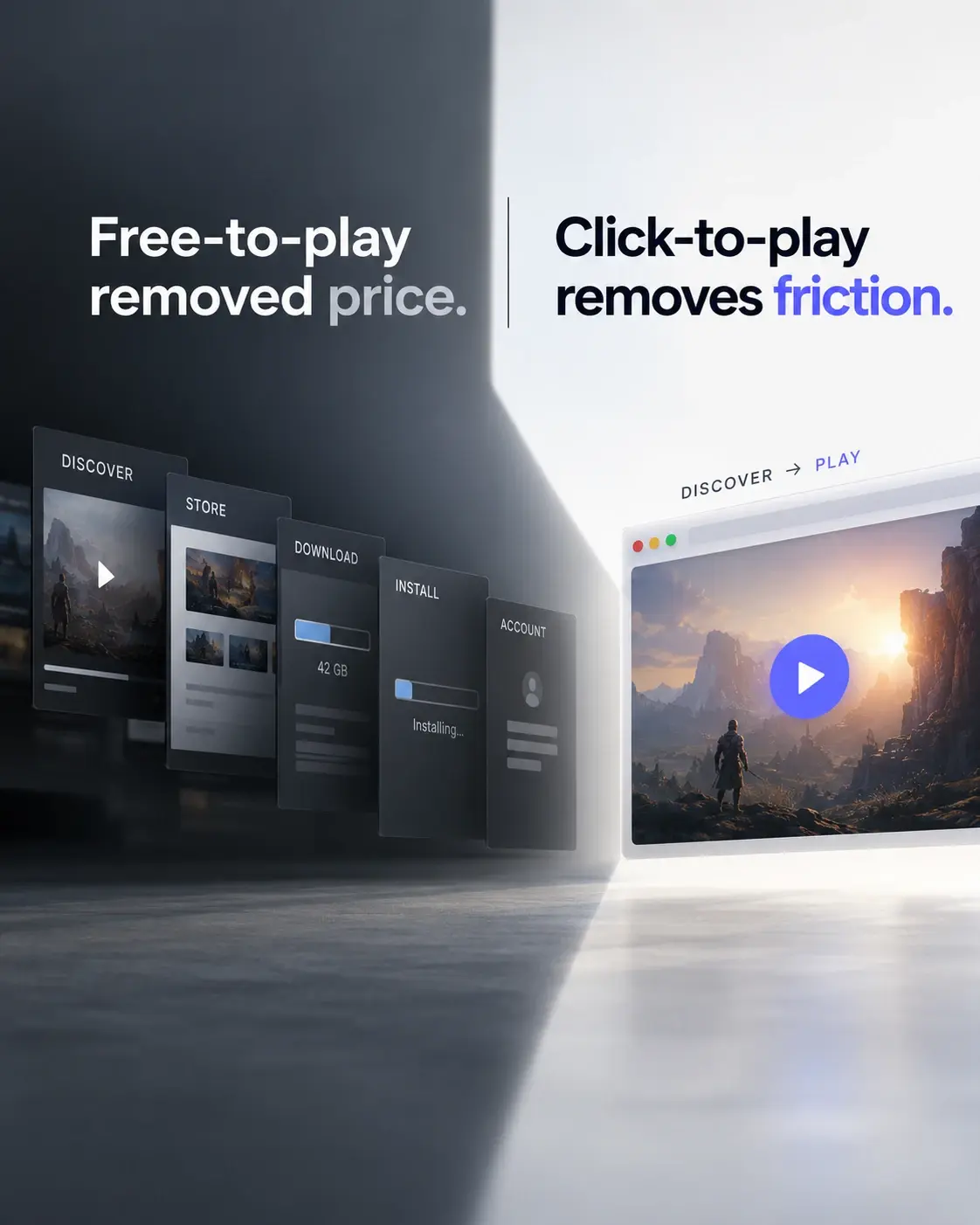
Each journalist receives a personalized, unique link. One click opens the game in their browser. No account creation, no app download, no hardware compatibility check.
Step 6: Monitor sessions live
During the preview window, you can see who is playing, how long they've been in session, and what's happening. If something goes wrong, you can intervene. If an embargo appears to be at risk, you can revoke access immediately.
Step 7: Collect post-session data
After a session ends, you have full analytics: session duration, completion of preview content, geographic data, timestamps, and play patterns. You can redirect journalists to embargo materials, press kits, or a feedback survey automatically at session end.
For the full operational guide with platform-specific configuration details, how to set up a remote press preview covers the process from build preparation through post-preview reporting.
Playruo allowed us to present Empire of the Ants to journalists from all over the world, and the experience was excellent. Playruo has been an invaluable asset to our communications strategy, and a new tool we'll be using for future projects.
Microids took this a step further at Gamescom 2024. During their stand showcase, they shared a 15-minute demo link on social media. Journalists and attendees who couldn't get to Cologne played the same demo remotely, extending the reach of a physical event globally without additional infrastructure cost.
Cloud previews aren't just a replacement for physical events. They're an amplifier.
If you want to understand how journalists experience this workflow from their side, the journalist's perspective on game demos is worth reading before you design your preview structure.
Security and embargo management
Cloud streaming is the most secure game distribution method available to publishers today. The security case isn't a feature claim: it's an architectural consequence of how the technology works.
No files leave your infrastructure
When a journalist plays a streamed game, no game files exist on their machine. They receive a video feed. The game assets, the build, the level data, the audio files: all of it stays on your server.
A journalist can screenshot their screen or record their monitor with an external camera, but they can't extract the build. They can't copy, archive, or distribute the game itself. Contrast this with any method that involves file distribution, where the moment the file leaves your infrastructure, your control over it ends.
Security layers
The security stack on top of that architectural foundation includes several layers:
Encrypted virtual machines with strict game isolation. The game process runs in a kiosk environment that prevents data extraction, file copying, or external access during execution. No command line access, no file browser, no clipboard sharing.
Per-journalist forensic watermarking. Every journalist's session is watermarked uniquely, embedded in the video stream itself. If a recording surfaces publicly, you can trace it to the specific session that produced it.
Access controls that actually work. Password-protected sessions, geo-restriction, time-window access that opens and closes automatically, session duration caps, concurrent session limits, and instant revocation. If a journalist breaks an embargo, you cut their access in seconds, not hours.
Complete session logs. Full audit trail of who accessed what, when, for how long, and from where. This isn't just a security feature: it's the evidence chain you need if you're pursuing an embargo violation.
Why NDAs alone aren't enough
NDAs are difficult to enforce retroactively for press embargos. The legal process of pursuing an NDA violation against a journalist is expensive, slow, and damaging to the relationship with the outlet regardless of outcome (Source: Game Developer). The deterrent effect of an NDA depends entirely on the journalist's willingness to self-enforce.
The Shadow and Bandai Namco Elden Ring preview partnership illustrates what minimal security looks like at scale. The partnership used shared login credentials for access control (Source: Shadow 2023). That's the most rudimentary approach possible, one that provides no per-journalist accountability and no ability to trace a leak to its source.
For a complete threat model, securing unreleased game builds covers both the risks and the technical mitigations. For embargo logistics across regions and outlets, the embargo management guide covers the operational details.
Measuring press preview success
Cloud previews give PR teams data they've never had access to before. This isn't a minor upgrade in reporting capability. It's a categorical change in what you can actually know about your preview campaign.
The Steam key data gap
With Steam keys, your data endpoint is key redemption. You know a journalist activated the key. You don't know if they launched the game, how long they played, which level they reached, or whether they completed the preview content you specifically wanted them to experience.
You're basing coverage follow-up on an experience you can't verify actually happened.
What cloud streaming analytics provide
A post-preview report for a cloud-streamed event gives you:
- Session count: How many journalists actually played, not just how many received access.
- Average session duration: The single most useful signal for engagement quality. A journalist who played for 90 minutes is more likely to write substantive coverage than one who played for eight.
- Completion rate: What percentage of journalists reached the end of your preview content. If it's low, you know something about pacing, bugs, or the length of the preview window.
- Geographic distribution: Which regions showed the most interest. This feeds directly into regional marketing allocation decisions.
- Timestamps and play patterns: When journalists are playing, whether they're returning for multiple sessions, and where they're spending time within the experience.
- Device and connection data: What journalists are playing on and whether technical quality varied by region or connection type.
Turning data into decisions
This data feeds directly into launch marketing decisions. If your EU journalists averaged 75 minutes of playtime and your US journalists averaged 35, that's a signal worth investigating before you allocate your launch marketing budget.
If 80% of journalists completed the first two levels but only 40% reached level three, that's a pacing problem your design team needs to know about before launch.
For a complete framework for tracking and acting on press preview analytics, measuring press preview metrics covers the reporting structure in detail.
Playruo vs alternatives for press previews
The press preview streaming market has several players, each with different architectural choices and target use cases. Here's how the main options compare for publisher-side press preview workflows.
| Feature | Playruo | Parsec | Shadow | Steam keys |
|---|---|---|---|---|
| Latency | 8ms | >35ms | >35ms | N/A (local) |
| Browser-based (no install) | Yes | No: requires Parsec app | No: requires Shadow app | No: requires Steam client |
| Per-journalist watermarking | Yes | No | No | No |
| Session analytics | Full: duration, completion, geography, timestamps | Basic session data | Limited | None |
| Access controls | Password, geo-restriction, time window, instant revocation | Password, basic session limits | Password | None after key distribution |
| Setup time | Hours | Days to weeks | Days to weeks | Minutes (with no controls) |
| Pricing model | Usage-based | Per-seat subscription | Per-seat subscription | Per-key (Steam cut applies) |
Latency matters for accuracy
The latency gap is the most important differentiator from a journalist experience standpoint. Playruo's 8ms glass-to-glass latency is below the threshold of perceptible input lag for most game genres (Source: Playruo). Above 35ms, fast-paced action games and anything requiring precise timing start to feel noticeably imprecise.
For a press preview where you want a journalist's experience to represent the retail product accurately, the latency floor matters.
Browser access removes friction
When a journalist receives a Playruo link, they click it and play. No app install, no account creation, no compatibility check.
Parsec and Shadow require the journalist to install a client application before they can access anything. That's a non-trivial friction point when you're sending access to 50 journalists with varying technical comfort levels.
Built for publishers
Playruo is built on VLC and FFmpeg technology, purpose-built for publisher use cases. The feature set reflects actual publisher workflows rather than consumer gaming features adapted for B2B use.
Nacon has used Playruo for press sessions across EU and US markets for three titles: Hell is Us, Styx: Blades of Greed, and GreedFall 2. That multi-title, multi-region deployment demonstrates the platform as operational infrastructure rather than a one-off experiment.
One platform, multiple use cases
The same infrastructure that runs press previews also handles remote playtesting and game demo distribution methods. For publishers running multiple products simultaneously, a single platform that covers all three use cases reduces vendor overhead significantly.
For a deeper look at the product, why Playruo covers the decisions behind the platform. For a full feature-by-feature breakdown, press preview tools comparison is the current reference.
For case studies: the Nacon case study covers the multi-title EU/US deployment, and the Ubisoft case study covers how a top-tier publisher approaches remote previews at scale.
Sources

Sources
| Source | Notes |
|---|---|
| Parsec / Ubisoft case study | Ubisoft remote demo program scale and geography. |
| Big Games Machine 2024 journalist survey | Survey of 150+ game journalists. |
| SteamDB via Tweaktown 2025 | Steam release volume growth in 2024. |
| Markletic virtual event statistics 2024 | Virtual events cost reduction benchmarks. |
| Gamescom Opening Night Live pricing 2024 | Industry reporting around ONL slot pricing. |
| BleepingComputer Insomniac breach | December 2023 breach including a playable Wolverine build. |
| BleepingComputer Game Freak breach | October 2024 breach and leaked internal files. |
| Stratview Research cloud gaming market | Cloud gaming market size and growth. |
| Game Developer on NDAs | Analysis of NDA enforceability in games. |
| Parsec playtesting / QA use cases | Official Parsec positioning for B2B research workflows. |
| Shadow / Bandai Namco partnership | Elden Ring press preview program example. |
| Playruo technology | Playruo technical specs and streaming claims. |
Related resources
More Playruo guidance connected to this topic.