Cloud gaming for game publishers: the complete B2B guide
Consumer cloud gaming streams games to players. B2B cloud gaming serves publishers: press previews, remote playtesting, playable ads, and demo distribution, all from a single infrastructure. This guide covers every use case, platform criteria, and ROI benchmark for 2026.
 Playruo Editorial TeamUpdated July 10, 202625 min read
- Why B2B cloud gaming is not consumer cloud gaming
- The B2B cloud gaming market in 2026
- Four use cases across the game lifecycle
- How B2B cloud gaming works
- What to look for in a B2B cloud gaming platform
- Playruo vs alternatives: a platform comparison
- ROI by lifecycle stage
- Getting started with B2B cloud gaming
Why B2B cloud gaming is not consumer cloud gaming
Consumer cloud gaming and B2B cloud gaming share a technology stack. That's where the similarity ends.
GeForce NOW, xCloud, and PlayStation Now give players access to games they already own, streaming from remote servers to their screen. The publisher has no meaningful control over that experience. They can't restrict who plays, log individual sessions, watermark the stream, or revoke access mid-session.
B2B cloud gaming inverts that model entirely. The publisher controls the infrastructure. They decide who gets access, for how long, from which regions, and what data gets collected. An unreleased build never leaves a secured server environment. Journalists, testers, or demo players connect to a session and play; the actual game files stay put.
This distinction matters because publishers routinely say "we just need secure streaming" when evaluating platforms. Consumer services technically stream games securely. But they don't offer per-session forensic watermarking, session-level analytics dashboards, time-window access controls, or white-label interfaces. Those aren't premium add-ons in B2B cloud gaming; they're the core product.
On latency, the gap is meaningful. GeForce NOW and xCloud both exceed 35ms glass-to-glass (Source: Playruo internal benchmarks, self-reported). For casual or turn-based genres, those figures are playable. For action games being evaluated by press, or for playtesting sessions where input latency affects feedback quality, they're a liability.
Playruo's published benchmark is 8ms glass-to-glass, equivalent to one frame at 120Hz (Source: Playruo technology page, self-reported). The underlying architecture, including QUIC transport and adaptive codec selection, is what drives that number. For full technical context, see Playruo's streaming architecture.
| Dimension | B2C cloud gaming | B2B cloud gaming |
|---|---|---|
| Primary audience | Consumers / players | Publishers, developers, agencies |
| Pricing model | Monthly consumer subscription | Usage-based or enterprise licensing |
| Security features | Platform-level DRM only | Per-session watermarking, encrypted VMs, kiosk environment, access revocation |
| Analytics | None available to publishers | Session duration, completion rate, geography, timestamps, per-user data |
| Primary use case | Game library access | Press previews, playtesting, marketing demos, demo distribution |
| Access model | Open to all subscribers | Controlled: password, geo-restriction, time window, whitelist |
| White-label capability | None | Branded landing pages, custom domains, in-session UI |
| SDK/porting required | Publisher opt-in required | None: runs existing builds as-is |
The B2B cloud gaming market in 2026
The commercial case for B2B cloud gaming rests on two pressures colliding: a distribution market that's getting harder to crack, and an infrastructure market that's growing fast enough to attract serious capital.
The cloud gaming market reached $6.4 billion in 2024, growing 20% year-over-year, and is projected to reach $19.7 billion by 2032 (Source: Stratview Research 2025). The B2B segment specifically is growing at 28% or higher CAGR, outpacing the overall market (Source: Mordor Intelligence 2026). Infrastructure players are following the money: Google pivoted Stadia technology to an enterprise product called Immersive Stream for Games before shutting down entirely, and Xsolla launched its Cloud Gaming Trials product in August 2025. When companies that size make B2B bets, it signals where the growth is.
On the supply side, the volume problem is acute. Steam shipped 18,965 games in 2024, up 32% from the previous year (Source: SteamDB via Tweaktown 2025). Of those, 79% went mostly unplayed (Source: Kotaku 2024). Publishers aren't struggling to build games; they're struggling to get those games in front of the right people at the right moment.
The cost side is equally pressured. User acquisition costs rose 12% year-over-year while user growth expanded just 2% (Source: AppsFlyer 2025). The gaming industry spent approximately $25 billion on UA in 2025 (Source: AppsFlyer 2025). Spending more to reach fewer incremental users isn't a sustainable curve, and it's pushing publishers to reconsider where they invest.
Controlled distribution via cloud, whether for press, testers, or public demos, reduces spend per qualified contact. Steam wishlist conversion data clarifies the stakes: the median conversion rate for games with 25,000 or more wishlists is 0.15x (Source: GameDiscoverCo 2025). That means a 100,000-wishlist game converts roughly 15,000 buyers. Anything that expands demo exposure directly affects that conversion math.
Four use cases across the game lifecycle
The strongest argument for cloud gaming infrastructure from a publisher's perspective isn't that it solves one problem better. It's that the same infrastructure solves four different problems across the entire lifecycle of a game.
Pre-launch: press previews
Giving press early access to an unreleased build is one of the highest-impact activities in a launch campaign. It's also one of the most logistically complicated.
Nacon used Playruo to run press sessions for three titles simultaneously: Hell is Us, Styx: Blades of Greed, and GreedFall 2, across EU and US markets. Each journalist received a time-limited access link. Playruo logged each session individually. No build left the server environment.
Microids took a different approach for Empire of the Ants at Gamescom 2024. They shared a 15-minute demo link on social media during their Gamescom stand, while journalists experienced the first hour of the game in separate virtual sessions with the Microids team. The logistics of a physical event (travel, staffing, booth costs, scheduling conflicts) collapsed into a URL.
The operational workflow for this kind of preview is covered in detail in the article on remote press previews.
Production: remote playtesting
Remote playtesting solves a problem that in-person labs can't: hardware variability. When testers bring their own machines or come to a lab with inconsistent configurations, the feedback is contaminated. A bug that looks like a design flaw might be a driver conflict.
Cloud-hosted playtesting removes that variable. Every tester plays on an identical server configuration. The test surface is controlled.
Beyond consistency, cloud testing expands the available pool. Geographic and logistical constraints disappear. NDA protection, watermarking, and access controls are built into the session infrastructure rather than bolted on afterward.
Playruo for Playtest works as a charm and has a direct impact on team efficiency! As a game developer where logistics can be complicated, Playruo is an important tool for us.
The full methodology for structuring cloud-based sessions is covered in the article on cloud-based playtesting.
Launch: playable ads and marketing demos
A trailer shows a game. A playable demo lets a potential buyer form their own opinion. That distinction matters more as trailer fatigue increases and players become more skeptical of curated footage.
Browser-based playable demos can launch directly from ad banners, livestream overlays, publisher websites, or game launcher pages. No download, no account creation, no install. The player clicks once and is inside the game within seconds.
This format is particularly effective for mid-funnel audiences: players who've seen a trailer, might be interested, but haven't committed to a wishlist. Giving them a five-minute hands-on moment at that stage is qualitatively different from showing them another piece of video content.
We realized Playruo unlocks limitless possibilities for maximizing player engagement
The full breakdown of this use case is in the article on playable ads for PC games.
Post-launch: demo distribution and re-engagement
The same infrastructure that powered PR previews months before launch can run public-facing demos after launch. A browser-based demo embedded on a publisher website or Steam page gives players an immediate entry point: try the game, then convert to purchase.
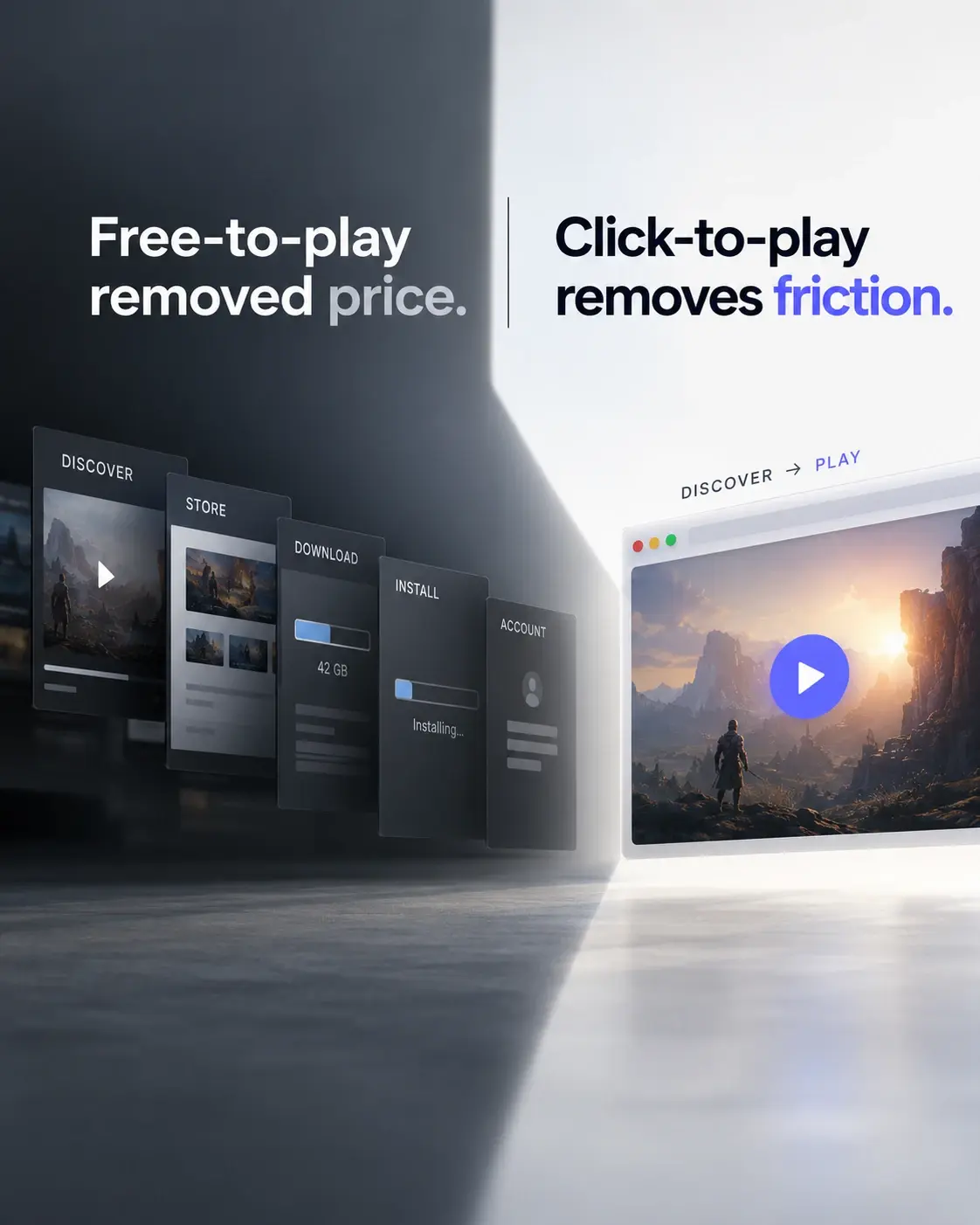
Demo downloads have a friction problem. A 25GB demo requires a download decision, installation time, and available disk space. Many players who might have converted never start the process. A browser-streamed demo removes every one of those barriers.
Post-launch, cloud demos also support re-engagement campaigns. A sale event or content update is an opportunity to push a new audience to a playable experience, not just a price cut. The conversion path from streamed demo to purchase is shorter and more trackable than any passive content format. Publishers like Focus Entertainment are exploring this kind of multi-use workflow across their catalog.
How B2B cloud gaming works
The technical reality is simpler than most publishers expect. There's no SDK to integrate, no porting work, no code changes. The same build that runs on a developer's workstation runs on the cloud server.
Here's how the process works from setup to deployment.
Step 1: Share your game
Builds are delivered via Steam keys, Epic Games keys, Ubisoft Connect keys, or direct build upload. The process mirrors what you'd do to hand off a build to QA. Playruo accepts the game as-is.
Step 2: Setup
Playruo creates a master Windows virtual machine running a locked kiosk environment. It configures drivers, handles OS updates, and installs the game so it's ready to run. An optional AI auto-start feature skips loading screens and menus, dropping players directly into gameplay. That's particularly useful for marketing demos where you want to minimize time-to-action.
Step 3: Deployment
The master VM is cloned onto cloud servers. The platform is cloud-agnostic: deployments run on AWS, GCP, Scaleway, or the customer's own infrastructure. Publishers with data-residency requirements or existing cloud contracts can run sessions on their preferred provider.
Step 4: Web integration
Sessions are accessed via a white-label browser interface. The publisher controls the landing page design, the in-session UI, and the custom domain. Players see a start button, timer, controller input support, and optional rating modals. The whole experience is shareable via URL.
The underlying technology is worth understanding, even if you don't need to configure it. Playruo uses QUIC protocol for transport, which reduces packet loss sensitivity and adapts better to variable network conditions than TCP-based alternatives. Codec selection (H.264, HEVC, VP9, AV1) happens in real time based on network conditions. Sessions run at up to 4K resolution and 240fps on a stack built on VLC and FFmpeg, both of which have long production histories in high-throughput media environments.
On latency: the 8ms glass-to-glass figure (Source: Playruo technology page, self-reported) represents the full round-trip from controller input to display output, not just server processing time. At 120Hz, one frame is 8.3ms. That's the target the architecture is designed around.
After a decade of serving publishers and working on world-renowned cloud gaming and computing projects, we decided it was time to carve our own path.
For the full technical deep dive, see Playruo's technology page. No one on your engineering team needs to be involved in setup.
What to look for in a B2B cloud gaming platform
Not every platform that calls itself B2B is actually built for publisher-to-external workflows. Several consumer services and remote desktop tools have been repositioned for business use. The checklist below separates platforms designed for this use case from those that are adapted.
Browser-based access. End users (journalists, testers, demo players) should be able to play with one click. Any requirement to install an app adds friction and creates a support surface. This is non-negotiable for public-facing use cases.
Low latency. The target is under 20ms glass-to-glass for action titles and under 35ms for most other genres. Above 40ms, player feedback quality degrades in ways that contaminate playtest data and create negative impressions for press.
Security. A B2B platform's security stack should include: per-session forensic watermarking (so a leak can be traced to a specific session), encrypted VMs, a kiosk environment that prevents file access or screen capture, password protection, geo-restriction, time-window access controls, instant access revocation, and complete session logs. If any of these are missing, the platform isn't appropriate for handling unreleased builds.
Session analytics. You should be able to see session duration, completion rates, geographic distribution, timestamps, and play patterns, both per user and in aggregate. This data should be available without custom integration work. If the platform can't tell you how far journalists got in your game or which segments players dropped out of, you're missing the primary value of digital delivery over physical events.
Pricing model. Usage-based pricing (pay per session or per hour of compute) scales better for publishers with variable demand. A press preview campaign might require 200 sessions over two weeks. A public demo launch might require 50,000 sessions over a month. Per-seat subscription pricing doesn't match that demand profile.
Setup time. Hours, not weeks. If the platform requires SDK integration, porting work, or extended technical onboarding, it's not built for publisher workflows. You should be able to go from build delivery to live sessions within a single working day.
White-label capability. Press and marketing sessions should present the publisher's brand, not the platform's. This means branded landing pages, in-session UI customization, and custom domain support.
Multi-use case coverage. If you need separate vendors for press previews, playtesting, playable ads, and demo distribution, you're managing four contracts, four security assessments, four onboarding processes, and four analytics dashboards. A platform that covers all four use cases on shared infrastructure eliminates that overhead.
Playruo vs alternatives: a platform comparison
The B2B cloud gaming landscape has four meaningful categories of competitor: purpose-built B2B platforms (Playruo), remote desktop tools adapted for game dev (Parsec), consumer streaming services with publisher programs (GeForce NOW, xCloud), and new entrants focused on demo monetization (Xsolla Cloud Gaming Trials).
| Feature | Playruo | Parsec (Unity) | GeForce NOW | xCloud | Xsolla Cloud Gaming |
|---|---|---|---|---|---|
| Primary purpose | Publisher workflows | Remote desktop | Consumer gaming | Consumer gaming | Demo monetization |
| Latency | 8ms (self-reported) | >35ms (Playruo benchmark) | >35ms | >35ms | Not disclosed |
| Browser-based | Yes | No (app required) | Yes | Yes | Yes |
| Per-session watermarking | Yes | No | No | No | No |
| Session analytics | Full (duration, completion, geography, timestamps) | Basic | None for B2B | None for B2B | Conversion tracking |
| Access controls | Password, geo, time window, instant revocation | Password, team permissions | None for B2B | None for B2B | Whitelisting |
| Setup time | Hours | Days to weeks | N/A | N/A | Hours |
| Pricing model | Usage-based | Per-seat subscription | Consumer subscription | Consumer subscription | Pay-as-you-go |
| Multi-use case (press + test + marketing) | Yes | No (remote desktop only) | No | No | Partial (demos + monetization) |
| No SDK/porting required | Yes | N/A (remote desktop) | Requires publisher opt-in | Requires publisher opt-in | Yes |
Parsec. Acquired by Unity for $320 million in 2021 (Source: Unity investor relations), Parsec was built as a remote desktop tool and has been adapted for game development workflows, particularly for distributed dev teams accessing workstations remotely. It's a strong fit for that use case. It's SOC 2 certified and integrates naturally into developer pipelines.
What it isn't built for is publisher-to-external workflows. Press sessions, public demos, and remote playtesting with external participants all require browser-based access, per-session watermarking, and access controls that Parsec doesn't offer. It also requires app installation, which eliminates it for public-facing use cases. For context: Ubisoft used Parsec for a remote demo program in 2020, delivering over 1,500 demos across 30 or more countries (Source: Parsec/Ubisoft case study). That's a meaningful proof point for what cloud-based press access looks like at scale, even though Parsec's architecture wasn't designed for it.
GeForce NOW and xCloud. Both are consumer services. Publishers can opt in to make their titles available on these platforms, but the infrastructure isn't designed around publisher needs. There are no B2B analytics, no access controls for unreleased builds, and no watermarking. These platforms aren't realistic options for press previews, playtesting, or pre-launch demos.
Xsolla Cloud Gaming Trials. Launched in August 2025 (Source: Xsolla press release), Xsolla's entry is browser-based and pay-as-you-go, which positions it correctly for publisher use cases. Its focus is demo-to-purchase conversion, with the Xsolla store infrastructure as the obvious downstream integration. As a new entrant, its track record in press and playtesting workflows is limited. It's a competitor to watch, particularly for publishers already using Xsolla's payment infrastructure.
For a deeper look at how Playruo fits across publisher workflows, see why Playruo.
ROI by lifecycle stage
The infrastructure cost for cloud gaming is fixed relative to the number of sessions, not the number of use cases. You don't pay separately for the press preview infrastructure and the playtesting infrastructure and the demo distribution infrastructure. That changes the ROI math significantly.
| Lifecycle stage | Traditional approach | Cloud-based approach | Key metric |
|---|---|---|---|
| Press previews | Physical event: €50,000-€100,000 in travel, venue, staffing | Cloud sessions: usage-based, pay per session | Journalists reached per euro spent |
| Playtesting | On-site lab: limited to local testers, variable hardware | Remote streaming: global tester pool, identical server config | Cost per tester session, hardware consistency |
| Marketing demos | Video trailers: passive viewing, no engagement data | Playable demos: active engagement, full session analytics | Engagement rate, demo-to-wishlist conversion |
| Demo distribution | Steam demo: 25GB download, hardware-dependent experience | Browser demo: instant access, consistent performance across devices | Demo completion rate, friction reduction |
Virtual events reduce costs by 35 to 75% compared to in-person equivalents (Source: Markletic 2024, survey of 3,960 respondents). For a press preview campaign that would otherwise require flights, hotel blocks, and a venue, that's a significant budget line recaptured. That recaptured budget can go toward more sessions, more markets, more journalists.
On the playtesting side, the scale argument is concrete. PlaytestCloud says it works with a global panel of 1.5M+ verified players across mobile, PC, browser, and Steam workflows (Source: PlaytestCloud Facts and Player Panel), which illustrates demand for player recruiting and playtesting workflows at scale. The difference between testing with 50 local participants and 500 geographically distributed participants isn't just cost; it's statistical confidence, segmentation granularity, and speed of iteration.
The Steam wishlist conversion median of 0.15x for games with 25,000 or more wishlists (Source: GameDiscoverCo 2025) puts a number on the demo distribution argument. A browser-based demo with zero download friction versus a 25GB download isn't just a UX improvement. It's a direct intervention on the conversion rate of every player who was almost ready to commit.
The critical reframe for publishers: if you're already planning to run press previews, playtests, and a demo campaign as separate initiatives with separate vendors and separate budgets, you're paying multiple fixed costs. Shared infrastructure across all four lifecycle stages changes the cost structure by the time you get to launch.
Getting started with B2B cloud gaming
The practical first step is always the same: upload one build, run one session, look at the analytics. The specific application depends on where you are in the lifecycle and which problem is most urgent.
PR and comms directors. Start with a press preview for your next title. Upload a build, set a time window, create access links for 10 journalists, and observe the session data afterward. You'll see who played, for how long, how far they got, and where they dropped off. That data is qualitatively different from a press trip debrief.
Heads of marketing. Start with a playable demo embedded on your publisher website for an existing title. Measure session duration and completion rates against your trailer view and watch-time data. The comparison is instructive: passive video metrics tell you about top-of-funnel awareness; demo session data tells you about intent and engagement depth.
QA leads and producers. Start with a single remote playtest session for a build that's currently in a testing cycle. Compare the consistency of cloud-hosted sessions, where every tester has an identical configuration, against the variance you're seeing from local hardware testing. Hardware-related false positives in bug reports are a real cost in QA cycles.
My mind is racing with ideas on how to use Playruo to bring content to our fans!
The observation in that quote reflects a real pattern: once publishers see the access model clearly, the use cases multiply. A platform that handles press, testing, and demo distribution with the same session infrastructure opens possibilities that weren't practical when each use case required a separate solution.
The barrier to first use is intentionally low. No SDK, no porting, no code changes. One build, one session, one dataset. From there, the decision to expand to additional use cases is based on evidence, not projection.
Sources

Sources
| Source | Notes |
|---|---|
| Stratview Research 2025 | Cloud gaming market $6.4B in 2024, projected $19.7B by 2032, 20% YoY growth |
| Mordor Intelligence 2026 | B2B cloud gaming segment growing at 28%+ CAGR |
| SteamDB via Tweaktown 2025 | 18,965 games released on Steam in 2024, up 32% from 2023 |
| Kotaku 2024 | 79% of Steam games in 2024 went mostly unplayed |
| AppsFlyer 2025 | UA costs rose 12% YoY; gaming industry spent $25B on UA in 2025 |
| GameDiscoverCo 2025 | Steam wishlist conversion median 0.15x for games with 25K+ wishlists |
| Markletic 2024 | Virtual events reduce costs 35-75% vs in-person; survey of 3,960 respondents |
| Playruo technology page | 8ms glass-to-glass latency, QUIC protocol, codecs, architecture (self-reported) |
| Parsec/Ubisoft case study | 1,500+ remote demos by Ubisoft in 2020 using Parsec (not Playruo) |
| Unity investor relations | Parsec acquired for $320M in 2021 |
| TechCrunch 2024 | Playruo product overview and founding context |
| Xsolla 2025 | Cloud Gaming Trials launch, August 2025 |
| Google Immersive Stream | Historical context for publisher-side cloud trial programs |
| PlaytestCloud Facts | 1.5M+ verified players and supported platforms for player research and playtesting |
| PlaytestCloud Player Panel | Panel targeting, player profiles, and player ethics |
Related resources
More Playruo guidance connected to this topic.