Playable ads for PC and console games: the publisher's guide
Playable ads have proved their value in mobile. Cloud streaming now gives PC and console publishers a way to test the format without an HTML5 port. This guide covers formats, placements, measurement, and campaign workflow.
 Playruo Editorial TeamUpdated July 10, 202622 min read
- Why video ads alone aren't enough
- What makes playable ads different
- The PC and console gap: why playable ads were mobile-only
- How cloud streaming solves it for PC and console
- Playable ad formats and placements
- Performance benchmarks: what to expect
- Use cases across the game lifecycle
- Building a playable ad campaign: a step-by-step workflow
- From build to live playable ad: what the setup looks like
- Sources
Why video ads alone aren't enough
The math on video advertising in games is getting harder. UA costs rose 12% year-over-year while user growth expanded just 2% (Source: AppsFlyer Gaming App Marketing Report 2025). The gaming industry spent approximately $25 billion on user acquisition in 2025 (Source: AppsFlyer). Spending more money to reach fewer incremental users is not a sustainable trajectory.
The format problem compounds the spend problem. Video ads show a player what a game looks like. They don't show a player what a game feels like. For genres where the core loop is tactile, whether action, platformer, RPG, or strategy, the gap between watching and playing is the gap between awareness and intent.
Steam release data makes the consequences concrete. 18,965 games shipped on Steam in 2024, up 32% from the year before (Source: SteamDB via Tweaktown). Of those, 79% went mostly unplayed (Source: Kotaku). The visibility problem is acute. Publishers are spending heavily to reach players who aren't converting, because passive video content isn't generating the intent signal needed to close the loop.
The steam wishlist median conversion rate for games with 25,000 or more wishlists is 0.15x (Source: GameDiscoverCo 2025). That means a game with 100,000 wishlists converts roughly 15,000 buyers. Every point of improvement on that conversion rate is worth real revenue. Anything that turns a passive viewer into someone who has actually touched the game before buying is a direct intervention on that number.
Playable ads are that intervention.
What makes playable ads different
A playable ad is an interactive ad unit where the user plays a portion of the game from within the ad experience, before clicking through to purchase or wishlist. The player acts instead of watching. That distinction has measurable consequences.
The mobile gaming industry has been running playable ads at scale for years, but the useful lesson is not a universal CTR multiplier. Liftoff's 2025 Mobile Ad Creative Index found that top-spending games allocated over 35% more of their spend to playables than other games. Among non-top-spending apps in its dataset, impression-to-install conversion for playable ads was 16 times that of non-playable formats (Source: Liftoff 2025). Those are mobile benchmarks, not a guaranteed uplift for every PC or console campaign.
The strategic value is self-selection. A player who tries the game before installing or buying already understands something about the core loop. That can improve audience quality, but the retention effect should be measured in the publisher's own campaign rather than inherited from a cross-network benchmark.
AppAgent's mid-2025 review of Apptica data reported a playable-ad performance score of 191, up from 164 in 2024 (Source: AppAgent / Apptica 2025). That is evidence of momentum in mobile acquisition, not a plug-and-play forecast for another platform, genre, or audience.
We realized Playruo unlocks limitless possibilities for maximizing player engagement
For PC and console publishers, the same logic applies, but the technical path to get there has been different.
The PC and console gap: why playable ads were mobile-only
Mobile playable ads work because mobile games are often built with engines and frameworks that can output to HTML5. A simplified version of a mobile game's core loop can be rebuilt in JavaScript, running in any browser at near-zero infrastructure cost. The creative agency builds the playable, the ad network distributes it, and the whole thing runs without any backend.
That approach doesn't exist for PC and console games. A 30GB AAA title built in Unreal Engine cannot be meaningfully recreated in HTML5. The polygon counts, shader pipelines, physics systems, and asset volumes that define the PC and console experience are incompatible with browser-native execution. Publishers who tried to create HTML5 playable versions of their PC games discovered that what they were building wasn't the game. It was a different, lighter product that shared visual assets and little else.
The result was a bifurcated market. Mobile publishers had playable ads. PC and console publishers had trailers. The performance gap between those two formats was documented and well-known, but the infrastructure to close it for PC and console didn't exist.
Until cloud streaming made it possible.
How cloud streaming solves it for PC and console
Cloud streaming reverses the technical logic. Instead of rebuilding the game in a lighter format for the browser, the actual game runs on remote server hardware and streams to the player's browser as a video feed. The player's inputs, keyboard, mouse, or controller, are sent back to the server in real time. The game responds. The player sees the result.
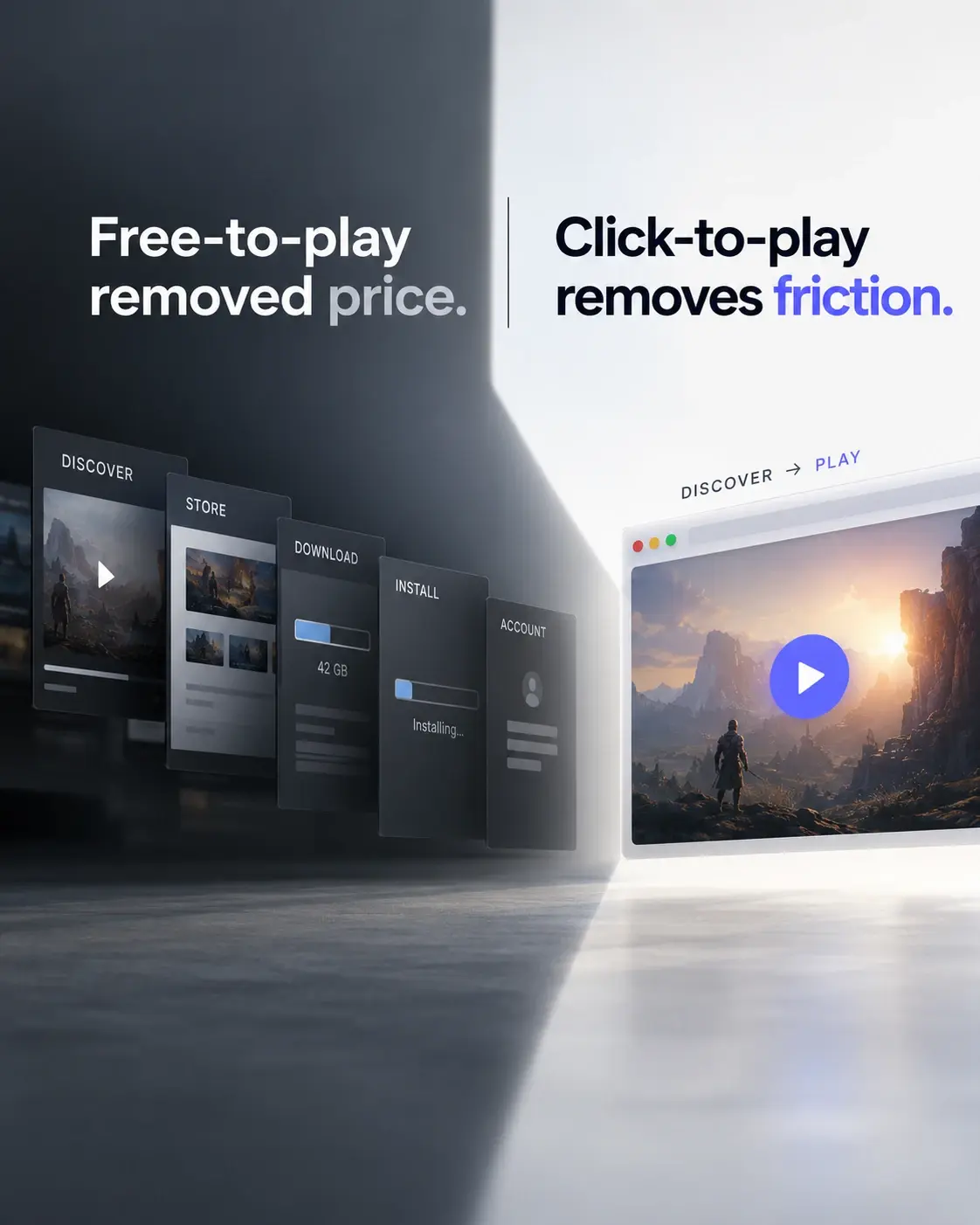
From the player's perspective: they click an ad, a fullscreen game session opens in their browser, and they're playing within seconds. No download. No account. No install.
From the publisher's perspective: the same build that ships to retail is the build that runs in the ad. No porting work. No separate HTML5 version. No creative agency needed to rebuild game mechanics. You deliver the game via Steam keys, Epic Games keys, Ubisoft Connect keys, or direct build upload, and the cloud platform handles the rest.
The technology that makes this possible is the same infrastructure that powers B2B cloud gaming for press previews and remote playtesting. The difference for playable ads is the deployment context: instead of giving journalists or testers controlled access to a build, you're giving potential buyers a limited, timed experience that's designed to convert.
Playruo's platform is built on VLC and FFmpeg technology, using QUIC as the transport protocol and supporting H.264, HEVC, VP9, and AV1 codecs with real-time adaptation to network conditions (Source: Playruo technology page, self-reported). The published latency benchmark is 8ms glass-to-glass, equivalent to one frame at 120Hz (Source: Playruo technology page, self-reported). That figure matters for playable ads because input responsiveness directly affects whether the player's first impression of the game is accurate. A laggy demo is not a demo of your game. It's a demo of a bad network.
| Dimension | Mobile playable ads (HTML5) | PC/console playable ads (cloud streaming) |
|---|---|---|
| Game representation | Simplified HTML5 recreation of core loop | The actual retail build, unmodified |
| Technical requirement | Rebuild mechanics in JavaScript | No dev work: upload existing build |
| Asset quality | Reduced: limited by browser performance | Full: server-rendered at up to 4K/240fps |
| Core loop fidelity | Approximation of gameplay feel | Identical to retail experience |
| Production cost | Creative agency rebuild (weeks, budget) | Platform configuration (hours, no agency) |
| Session analytics | Click-through, install rate, video completion | Session duration, completion, play patterns, input data |
| Deployment context | Mobile in-app ad networks | Web, social, livestream, publisher site, launcher |
| Supported genres | Casual and mid-core only | Any PC or console genre |
Playable ad formats and placements
Cloud-based playable ads for PC and console games can be deployed across five distinct contexts. The same uploaded build powers all of them without separate versions or additional dev work.
Display and programmatic banners
The player sees an ad banner on a gaming site, media outlet, or programmatic display placement. They click. A fullscreen gameplay session opens in their browser, running the actual game. A timer and call-to-action are visible. After the session ends, they're redirected to a Steam page, purchase page, or wishlist.
This is the closest equivalent to mobile playable ads. The difference is that the game running behind the click is the real build, not a HTML5 recreation.
Publisher websites and product pages
A "try now" button embedded on the publisher's website or game landing page opens an instant cloud session. Players who land on the page while researching the game can move from intention to experience in seconds. This is the highest-intent placement: anyone visiting the product page already knows the title exists.
Post-session data from this placement is particularly valuable. If a player visited the page, started a session, and played for four minutes, that's a different intent signal than a player who bounced after ten seconds of video. The analytics let you segment and act on that difference.
Livestreams and creator campaigns
A streamer or creator drops a unique link in their Twitch, YouTube, or Kick chat during a session about the game. Viewers who click the link open a gameplay session in their own browser while the stream continues. They're playing in parallel, not just watching.
This format converts passive viewership into active participation. The creator's audience self-selects into the experience, which produces stronger intent signals than standard affiliate or key-giveaway campaigns. Session data from the campaign shows how long viewers played, what content they reached, and how the play behavior compared across different creator audiences.
Game launchers and platform pages
A "try before you buy" experience embedded directly in a game launcher (Steam, Epic, GOG, publisher-owned) gives players on the purchase decision page a path to experience the game without leaving the platform. This addresses the friction gap that download demos have always had: a player who would try the game if they could do so instantly often won't start a 25GB download on spec.
Steam wishlist conversion data illustrates the stakes. The median conversion rate for games with 25,000 or more wishlists is 0.15x (Source: GameDiscoverCo 2025). A browser-based instant trial on the store page is a direct intervention on that conversion rate.
CRM, email, and social campaigns
A "try now" link in a newsletter, a limited-access link distributed as a contest prize, or an exclusive preview session offered to a Discord community all use the same cloud infrastructure. The link opens a game session with no friction. Post-click behavior is fully tracked: who played, for how long, what they reached, and whether they converted.
For back-catalog titles or relaunch campaigns, this format reaches an audience that's already opted into your communication. The conversion path from "click in email" to "playing the game" to "purchase" is trackable end-to-end.
Performance benchmarks: what to expect
The mobile playable ad market has generated several years of performance data. These benchmarks don't transfer directly to PC and console, because the audience, context, and intent differ. But they establish the directionality of what interactive formats accomplish over passive video.
| Metric | Video ads | Playable ads | Source |
|---|---|---|---|
| Spend allocation among top-spending games | Reference group | >35% more on playables | Liftoff 2025 |
| Impression-to-install conversion among non-top-spending apps | Non-playable baseline | 16x baseline | Liftoff 2025 |
| Performance score | 164 (2024) | 191 (2025) | AppAgent / Apptica |
| Creative guidance | Passive format | Interactive demo | Unity |
| What to validate | View-through and click | Interaction, drop-off, downstream conversion | Your campaign data |
These figures are from mobile. They represent what happens when players interact with a game before committing to install, across tens of millions of sessions. The underlying mechanism, trial generating stronger purchase intent than watching, is not specific to mobile.
For PC and console playable ads via cloud streaming, publishers gain an additional performance layer that mobile HTML5 ads don't have: the experience is the real game. The player isn't playing a simplified version; they're playing the actual product. That authenticity gap closes the difference between what the trailer promises and what the game delivers, which is where trailer-driven campaigns most often lose intent.
Industry estimates suggest that a "try now" session before purchase increases clicks on buy-now buttons by approximately 25% (industry estimate, not independently verified). That figure varies by genre, session length, and placement. The measurement framework that cloud streaming enables, session duration, completion rate, conversion path, and play pattern data per user, lets publishers move from estimates to observed data for their specific titles.
Use cases across the game lifecycle
Playable ads aren't just a launch-window format. The same cloud infrastructure supports interactive marketing at every stage of a game's commercial life.
Pre-launch: wishlist campaigns and demo access
In the months before release, a timed playable demo generates wishlist additions from players who've experienced the game rather than just seen it. Steam Next Fest is the canonical channel for this, but cloud-based playable demos extend the reach beyond Steam: a unique link works from any media placement, social campaign, or creator partnership without the platform dependency.
Players who wishlist after a play session are a different quality of lead than players who wishlist after a trailer. The play session is direct evidence of intent. That distinction matters when you're forecasting launch-week conversion against your wishlist count.
For publishers who want to cover Steam Next Fest strategy specifically, the Steam Next Fest cloud demo guide covers how to run off-platform distribution alongside your Steam demo.
Launch window: paid acquisition and conversion
During the launch window, when UA budgets and CPMs are at their highest, the conversion efficiency of every format matters. Do not inherit a mobile benchmark as a forecast for a PC or console campaign. Run playable and video creative against the same audience, then compare cost per qualified session, downstream purchase or wishlist conversion, and retention before scaling spend.
This is particularly relevant for mid-funnel audiences: players who've seen the trailer, might be interested, but haven't committed. A five-minute play session at that stage converts a significant portion who would otherwise have continued to scroll. The player who plays before buying also has significantly better retention, which matters for live-service titles and games with long tail revenue from DLC.
DLC and expansion campaigns
Existing owners who haven't engaged recently are a high-value segment for DLC or expansion launches. A playable preview of the new content, embedded in a CRM email or push notification, creates a path from "lapsed player" to "active buyer" that a trailer or discount alone often can't replicate.
The publisher already has permission to contact these players. Cloud streaming gives the contact an experiential payload: not a screenshot of the DLC, but a minutes of the DLC, playable from the email.
Back-catalog re-engagement
A sale event or platform inclusion (Game Pass, PS Plus) is an opportunity to push a new audience to the game. Instead of a price cut alone, a playable demo embedded on the sale landing page or in the campaign creative gives players a reason to take the next step that price alone doesn't provide.
For publishers like those working with Focus Entertainment who manage large catalogs across multiple active titles, a single cloud platform that handles interactive access for all of them reduces vendor overhead and gives a unified analytics view across the catalog.
Building a playable ad campaign: a step-by-step workflow
The operational workflow for a cloud-based playable ad campaign is simpler than most marketing teams expect, because the platform handles the technical infrastructure. The strategic decisions are yours; the setup is the platform's.
Step 1: Define the experience. What part of the game is the player experiencing? The opening sequence, a representative mission, a combat arena, a puzzle set? The session should represent the core loop accurately and be completable (or interestingly incomplete) in 90-180 seconds. Longer sessions generate stronger intent signals but require more confident players to start. Match session design to funnel stage: shorter for top-of-funnel awareness, longer for bottom-of-funnel conversion.
Step 2: Upload the build. No modification is needed. Deliver the build via Steam keys, Epic Games keys, Ubisoft Connect keys, or direct upload. Playruo creates a master Windows virtual machine with a locked kiosk environment, handling drivers, OS configuration, and build installation automatically.
Step 3: Configure the experience. Set session duration limits, the start point (using Playruo's AI auto-start feature to skip loading screens and place players directly in the action), the post-session redirect (Steam page, purchase page, wishlist, or newsletter signup), and any access controls appropriate for your campaign.
Step 4: Brand the landing page. The pre-session page carries your game's visual identity: key art, the game title, an optional pre-demo trailer, and instructions or context for the player. This is your first impression. It should feel like part of the campaign, not a technical handoff.
Step 5: Distribute across placements. The same session URL, or unique per-placement URLs for tracking, goes into your ad creative, social posts, email campaigns, and creator briefs. Each placement generates its own analytics stream. You can see which channels produced the most sessions, the longest play times, and the highest conversion rates.
Step 6: Monitor and optimize. During the campaign window, session data updates in real time. If one creator partnership is generating 90-second average sessions and another is generating 20-second sessions, you have data to reallocate. If a specific game segment is causing players to stop at a consistent point, you have feedback for creative adjustment.
Step 7: Attribute and report. Post-campaign, session data maps to conversion events: wishlist adds, purchase completions, newsletter signups. The attribution chain from playable session to revenue outcome is what separates cloud-based playable ads from any passive format. You're not estimating the value of reach; you're measuring the path from play to purchase.
From build to live playable ad: what the setup looks like
Publishers sometimes expect the cloud streaming setup to require engineering resources or extended timelines. The actual process is measured in hours, not weeks.
Build intake: You provide the game build via a supported launcher or direct upload. Playruo accepts the build as-is. No code changes, no SDK integration, no porting work.
VM configuration: Playruo creates a master Windows virtual machine running a locked kiosk environment. The kiosk mode means players can't access the file system, command line, or any application outside the game. The build is isolated inside the session. The platform handles driver installation, OS updates, and configuration automatically.
Session design: The AI auto-start feature is configured to place players at the desired point in the game, bypassing menus, loading screens, and introductory sequences that would consume session time before gameplay begins. For a 90-second playable ad session, every second before the core loop matters.
Deployment: The master VM is cloned onto cloud servers. Playruo's infrastructure is cloud-agnostic: deployments run on AWS, GCP, Scaleway, or a publisher's own infrastructure for those with data residency requirements. The cloning step takes minutes and scales on demand: if your campaign generates 10,000 concurrent sessions, the infrastructure scales to match.
Web integration: The game session is accessible via a white-label browser interface. The publisher controls the landing page design, in-session UI, timer display, controller input recognition, and the post-session redirect or call-to-action. The entire experience is served from a URL that works on any modern browser, on any device.
Analytics setup: Session tracking is automatic. Duration, completion rate, geographic distribution, input data, and play pattern information are available per session and in aggregate. No additional instrumentation of the game build is required.
The end-to-end timeline from build delivery to live session is typically one business day. For publishers running a coordinated launch campaign with multiple placements and creator partnerships, the setup happens once. Every placement draws from the same infrastructure.
For publishers managing press previews and remote playtesting alongside marketing campaigns, the same platform covers all three use cases without separate vendor relationships or separate analytics dashboards. The B2B cloud gaming guide covers how the infrastructure extends across the full game lifecycle.
My mind is racing with ideas on how to use Playruo to bring content to our fans!
The observation in that quote reflects a real pattern. When publishers see that the same cloud infrastructure handles press access, playtesting, and interactive marketing from a single uploaded build, the constraint that made playable ads feel out of reach for PC and console games disappears. It's the same build, the same platform, and a different campaign configuration.
Sources

Sources
| Source | Notes |
|---|---|
| Liftoff 2025 Mobile Ad Creative Index | Top-spending games allocate over 35% more spend to playables; non-top-spending apps saw 16x ITI conversion versus non-playable formats. |
| AppAgent / Apptica playable ads review 2025 | Performance score 191 in 2025, up from 164 in 2024; mobile benchmark. |
| Unity playable ad documentation | Official format definition and creative requirements; no universal CTR claim. |
| AppsFlyer Gaming App Marketing Report 2025 | UA costs up 12% YoY; $25B total spent on gaming UA in 2025 |
| SteamDB via Tweaktown 2025 | 18,965 games released on Steam in 2024, up 32% from 2023 |
| Kotaku 2024 | 79% of Steam 2024 releases went mostly unplayed |
| GameDiscoverCo 2025 | Median wishlist conversion 0.15x for games with 25K+ wishlists |
| Markletic 2024 | Virtual events reduce costs 35-75% vs in-person; 3,960 respondents |
| Playruo technology page | 8ms latency, QUIC protocol, codecs, 4K/240fps, VLC and FFmpeg base (self-reported) |
| Playruo marketing use case | Deployment contexts and marketing-specific platform features |
| Business of Apps: App Data Report 2025 | Current mobile app market and advertising context. |
| AppAgent playable ads strategy guide | Current format, testing, and campaign strategy guidance. |
| Liftoff playable ads best practices | Align playable creative with the post-install experience and player motivations. |
| Stratview Research: cloud gaming market | $6.4B in 2024, $7.7B in 2025, $19.7B by 2032 |
| TechCrunch: Playruo overview | Playruo product and founding context |
| Newzoo: Global Games Market Report 2025 | Global games market context; PC and console market size |
| Mordor Intelligence: online display advertising market | Current interactive and online display advertising market context. |
| Unity playable ad best practices | Official playable creative guidance and testing recommendations. |
| Parsec blog: B2B cloud streaming use cases | Context on cloud streaming for interactive game access |
| Playruo marketing | Playable marketing and campaign use cases. |
Related resources
More Playruo guidance connected to this topic.