How NACON simplified international remote PR previews without specific builds
 Playruo Editorial Team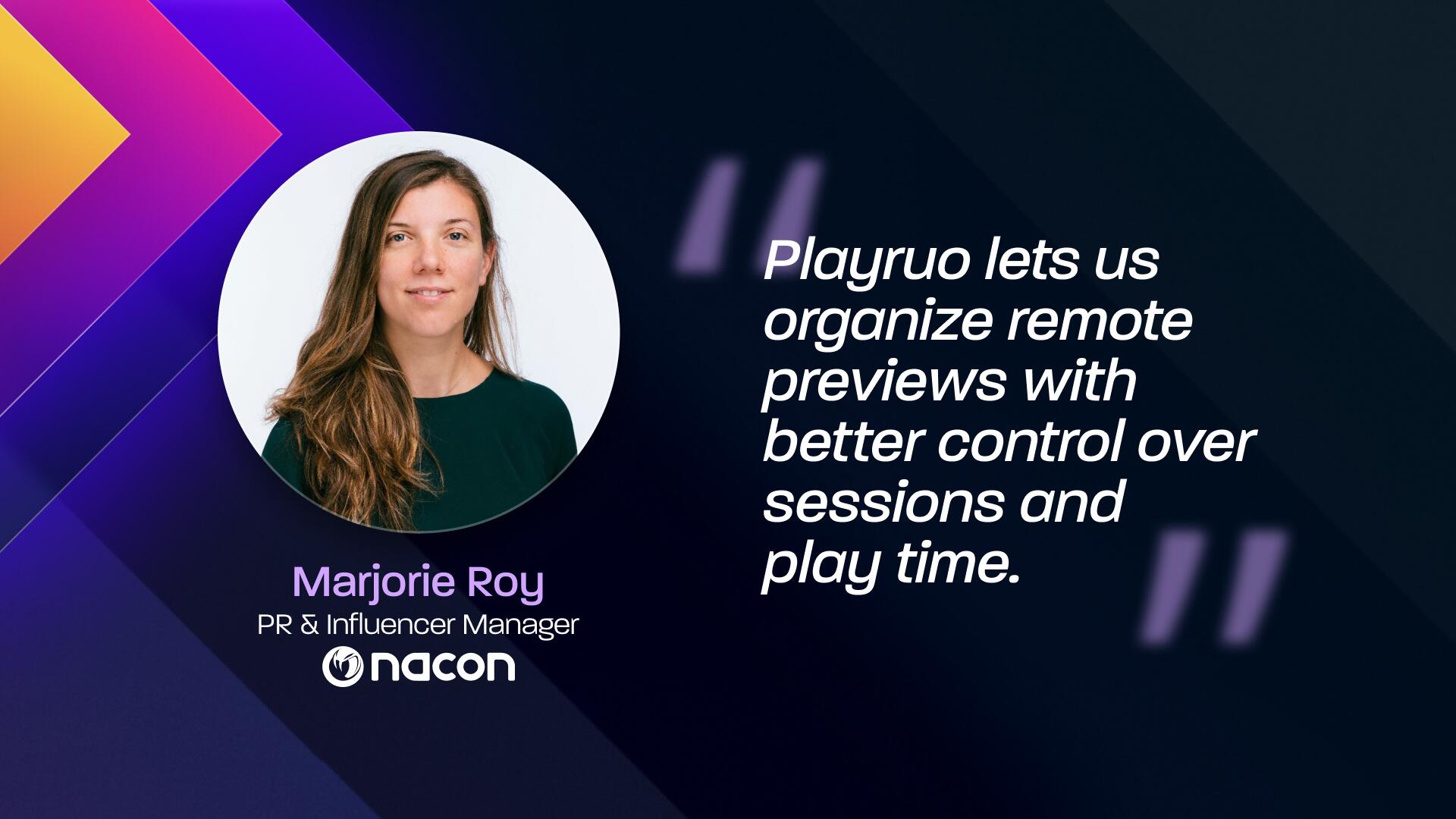
The challenge: scaling press coverage without locked builds
NACON is a French AA publisher with 16 studios and titles spanning action, RPG, and stealth games. When the press team needed to organize simultaneous previews for three games in the same window (Hell is Us, Styx: Blades of Greed, and GreedFall 2) reaching journalists across both EU and US markets, the logistical complexity grew fast.
Physical preview events remain the gold standard for high-impact coverage, but they don't scale. A physical press event typically costs €50,000 to €100,000 when you factor in venue, travel, catering, and staffing at a global scale (Source: Events Industry Council / Oxford Economics 2018; Eventbrite Event Budget Template). Running three events for three titles simultaneously isn't a realistic option for most teams.
The competitive attention landscape makes this harder. 62% of game journalists receive between 11 and 50 pitches per day (Source: Big Games Machine 2024). Getting coverage requires reducing friction at every step, including the friction of actually playing the game.
Before Playruo, NACON's default was physical previews. Studios would provide locked builds: contained, polished slices handed to journalists in a controlled environment. When a locked build wasn't ready, previews still happened, but the logistics became heavier and less precise.
The core friction wasn't access. It was control: controlling which part of the game was shown, and how long journalists spent in each section. For a publisher coordinating across multiple titles and multiple territories, that friction compounds quickly.
Remote press previews address part of this problem, but traditional approaches (build keys, download codes, VPN-gated builds) shift the control problem rather than solving it. NACON needed something that handled both reach and precision.
Our priority was to reach as many international media outlets as possible with simplified logistics.
The approach: remote previews with Playruo
NACON started using Playruo to organize remote press previews, either as a complement to physical sessions or as a full replacement when builds weren't locked. The platform handles access through browser-based game streaming: no download, no dedicated hardware, no VPN setup.
The internal workflow is straightforward. Marjorie Roy, as PR manager, coordinates directly with the Playruo team to set up and schedule sessions. The product manager responsible for each title validates the game segment to present, defining the slice of the game journalists will access. That handoff between editorial and operational doesn't require deep technical involvement on the publisher side.
Three criteria drove the decision to use Playruo: cost control, ease of organization, and time saved. All three track directly to the structural problem NACON faced when scaling coverage across simultaneous releases.
The fit is particularly strong for solo games where the studio doesn't have bandwidth to prepare a locked build. In that scenario, Playruo handles the access infrastructure entirely. The PR team defines what journalists see; Playruo delivers it. The studio can stay focused on finishing the game rather than packaging a preview build.
Playruo lets us organize remote previews with better control over sessions and play time.
The Playruo platform is designed specifically for this use case. Sessions run through an encrypted, kiosk-mode environment. Access is time-windowed and tied to specific journalists, not floating keys that can be passed around or leak. For publishers managing multiple titles across multiple territories, that operational precision matters.
If you're evaluating how to set up a remote press preview, the NACON workflow is a practical model: one contact on the publisher side, one contact at Playruo, and a product manager validation step that keeps the session definition close to the people who know the game best.
Security and control: the main advantage over keys
Ask Marjorie Roy to name the single biggest advantage Playruo has over sending traditional review keys, and the answer is immediate: security, and precise control over what's shown to press.
This isn't an abstract concern. The gaming industry has experienced high-profile breaches in recent years that illustrate exactly what's at stake. The 2023 Insomniac Games breach leaked 1.67 TB of data, including a playable build of the unannounced Wolverine game (Source: BleepingComputer 2023). In 2024, a breach at Game Freak exposed roughly 1 TB of files including source code and unreleased content (Source: BleepingComputer 2024). Both incidents happened outside the press preview context, but they demonstrate how quickly an unreleased build, once it exists on an external party's machine, is outside the publisher's control.
Keys don't have a kill switch. Once distributed, you have no visibility into who played, for how long, what they saw, or whether the build was copied or shared. A journalist who passes a key to a colleague, or whose machine is compromised, creates exposure you can't recover from.
Playruo's architecture eliminates that class of risk. The game never leaves the server. Journalists receive a video stream, not a file. There's no build to copy, screenshot-extract, or forward.
Each session carries per-session forensic watermarking, so if content does surface, it's traceable. Access controls are time-windowed, meaning a link that worked during preview week simply stops working afterwards. Sessions can be revoked instantly, and complete session logs are available to the publisher after the fact.
For NACON, with titles at different stages of completion and preview sessions running before final polish, that level of control removes a category of risk entirely.
The main advantage over sending keys is security and the precise control over exactly what's shown to press.
This maps directly to the operational workflow: the product manager defines the session scope (which level, which chapter, which features are accessible), and Playruo enforces it technically. Journalists can't wander into content that isn't ready, because it simply isn't accessible in the session.
For a deeper look at how this works at the technical level, the guide on securing unreleased game builds for press previews covers the threat model in detail. If you're comparing approaches, the press preview tools comparison breaks down how streaming-based access stacks up against keys and traditional remote access methods.
The journalist experience
One of the consistent failure modes in remote press access is the setup process on the journalist's end. A significant portion of coverage decisions happen before the first minute of gameplay, based purely on whether the access process was painless or painful.
67% of journalists want review copies at least 3 weeks before launch (Source: Big Games Machine 2024). That preference is partly about scheduling, but it's also about buffer time for technical issues. When access requires a download, an install, a VPN configuration, or an account creation, journalists factor that time cost into whether a preview is worth covering at all.
Playruo removes that overhead entirely. Journalists receive a link. They click it. They play in their browser. There's no download, no install, no account to create, no plugin to enable.
NACON's description of the onboarding experience is direct: ideal. It greatly simplifies session access and creates no barrier between the invitation and the actual gameplay. For international coverage, where you're coordinating with journalists across time zones and varying technical environments, that consistency matters.
The underlying specs support the experience. Playruo's platform delivers up to 4K resolution at up to 240fps, with 8 ms glass-to-glass latency (Source: Playruo). For previews where the publisher wants journalists experiencing the game at its best, those numbers remove the concern that a streaming session will feel like a downgrade compared to a local build.
On the journalist side, the experience is very smooth: they simply connect and play.
For publishers tracking how well their previews translate into coverage, session data is another advantage here. Playruo provides complete session logs: who connected, when, for how long, and which parts of the game they reached. That data is useful both for post-preview analysis and for following up with journalists who didn't complete a session. The guide on measuring press preview success covers how to build a reporting framework around this kind of data.
Results and takeaways
Across the titles NACON previewed using Playruo, coverage was comparable to what standard remote previews deliver. The simplicity was higher, and session data provided visibility that traditional key distribution doesn't offer.
Preparation effort didn't disappear. Organizing a Playruo preview requires roughly the same overall effort as a traditional remote preview, but the effort shifts. Less time is spent on access logistics and troubleshooting, allowing more focus on defining the right session scope, aligning with the product manager, and coordinating media invitations. It’s a better allocation: less effort on logistics, more attention on editorial decisions.
The collaboration with the Playruo team was a consistent positive in NACON's experience. The exchanges were good, and the team showed strong flexibility throughout each operation, adapting to the specific needs of each title and session.
The exchanges with the Playruo team were very good, with a lot of flexibility.
Ask Marjorie Roy why she'd recommend Playruo to another publisher, and the answer focuses on two things: ease of use, and the number of options surfaced through discussion with the Playruo team. The platform isn't a rigid tool. It's a configurable workflow that adapts to what each preview actually needs.
NACON's use of Playruo across three titles points to a structural shift in how AA publishers can approach international press access. The case for streaming-based previews isn't just about cost, though the cost comparison with physical events is significant. It's about precision: control over what journalists see, how long they play, and what happens to the build after the session ends.
For publishers who need to reach EU and US media simultaneously, who are working with studios that don't have capacity to prepare locked builds, or who want to run previews earlier in development without the security risks of distributing files, the workflow NACON describes is directly replicable.
If you're planning your next press campaign, contact Playruo to discuss how a session would work for your title.
Press access method comparison: keys and physical events vs. Playruo
| Criteria | Keys / Physical events | Playruo |
|---|---|---|
| Build security | Build leaves your infrastructure; no kill switch | Game stays on server; video stream only |
| Session control | No visibility once distributed | Time-windowed access, instant revocation |
| Journalist setup | Download, install, or travel required | Browser link, no install, no account |
| Play time management | Manual or untracked | Defined per session; full session logs |
| Content scope control | Requires a locked build | Product manager defines session scope |
| Post-session data | None | Complete session logs per journalist |
| Scalability (EU + US) | High cost and coordination overhead | One workflow, any geography |
Sources

Sources
| Source | Notes |
|---|---|
| Big Games Machine 2024 Games Journalist Survey | Source for journalist pitching volume and review-copy timing stats referenced in the article. |
| Ars Technica on the Insomniac Games breach | Public reporting referenced in the security section around build leaks and breach exposure. |
| Remote game press preview: complete guide | Background on remote press preview workflows and publisher use cases. |
| How to set up a remote press preview | Referenced for the practical setup model described in the article. |
| Securing unreleased game builds for press previews | Referenced in the security section for the underlying threat model. |
| Playruo technology overview | Public technical context for streaming specs and infrastructure cited in the article. |
Related resources
More Playruo resources connected to this story.