Game press preview tools compared: from Steam keys to cloud streaming
With 18,965 games on Steam in 2024 and journalists receiving 11-50 pitches daily, how you deliver preview access matters as much as what you're showing. This comparison breaks down six methods (Steam keys, downloadable builds, physical events, Parsec, Shadow, and Playruo) across the criteria PR directors actually care about: security, analytics, cost, setup time, and journalist experience.
 Playruo Editorial TeamUpdated July 10, 202614 min read
Why your preview method matters
The delivery method you choose for a press preview directly affects whether your game gets covered. With 18,965 games released on Steam in 2024, up 32% from 14,532 in 2023 (Source: SteamDB via Tweaktown 2025), journalists are buried. And 62% of game journalists receive 11-50 pitches per day (Source: Big Games Machine 2024).
That means friction kills coverage. If your preview requires downloading a 25 GB build, installing a dedicated app, or troubleshooting hardware compatibility, you've already lost time in a journalist's packed schedule. 67% of journalists want review copies 3+ weeks before launch (Source: Big Games Machine 2024). When a journalist receives your code early but spends half that lead time wrestling with the delivery format, the advantage evaporates.
The stakes are higher than a missed review. Nacon used Playruo for three titles (Hell is Us, Styx: Blades of Greed, GreedFall 2) across EU and US markets, running browser-based remote press previews that eliminated download friction entirely. The alternative was mailing Steam keys and hoping journalists had hardware that matched the build's requirements.
Your preview method is a PR decision, not just an tech decision. It determines how many journalists actually play your game, how much data you collect about those sessions, and how secure your unreleased build remains.
Six methods compared
There are six common approaches to delivering press preview builds. Each makes different tradeoffs between cost, security, analytics, and the journalist's experience. Here's how they break down.
Steam keys are free to generate and globally distributable. They're also the least secure and least informative option. Once a key is redeemed, you have zero play data, zero access controls, and no way to prevent redistribution. For post-announcement campaigns where security isn't critical, they work. For embargoed previews, they're a risk.
Downloadable builds give you slightly more control than Steam keys, since you choose who receives the file. But once downloaded, the build sits on a journalist's machine. You know the download happened. You don't know what happened next. Variable hardware means inconsistent experiences, and large file sizes (often 10-50 GB) create their own friction.
Physical events remain valuable for hands-on impressions and relationship building. They also cost EUR 50,000-100,000 per event (industry estimate), take months to organize, and reach a limited number of journalists. Geographic constraints mean your coverage skews toward whoever can attend.
Parsec (acquired by Unity for $320 million in 2021) is a remote desktop streaming tool adapted for gaming. It requires an app install, charges $30/user/month at the Teams tier (minimum 5 members, billed annually), and offers SAML SSO plus audit logs at the Enterprise level (Source: Parsec pricing). Parsec does not offer per-session forensic watermarking. Latency exceeds 35 ms based on Playruo internal benchmarks (self-reported; Parsec does not publish comparable figures). Ubisoft delivered 1,500+ remote demos across 30+ countries via Parsec in 2020 (Source: Parsec/Ubisoft case study), proving the model works at scale.
Shadow is a consumer cloud PC service that has been adapted for some B2B use cases. Shadow Business Solutions is now Shadow PC Pro, and Shadow Neo launched in June 2025 at $37.99/month per user (consumer pricing; B2B can be custom). Bandai Namco used Shadow for an Elden Ring press preview, but the setup relied on shared login credentials for 100+ journalists with no per-journalist accountability (Source: Shadow/Bandai Namco partnership). Latency exceeds 35 ms based on Playruo internal benchmarks (self-reported). Shadow requires an app install.
Playruo is a browser-based cloud gaming platform built for publishers. No app install, no account creation. Playruo reports 8 ms glass-to-glass latency (self-reported; Source: Playruo technology page) using a QUIC-based protocol with H.264, HEVC, VP9, and AV1 codec support, up to 4K at 240 fps.
Features include per-session forensic watermarking, full session analytics, password protection, time-window access, geo-blocking, and instant revocation. Pricing is usage-based (pay per session, not per seat).
Two newer entrants are worth noting. Amazon GameLift Streams, launched in March 2025, offers WebRTC-based streaming at 1080p/60 fps. Early adopters include Bandai Namco and Ludeo (Source: Amazon GameLift Streams). Xsolla Cloud Gaming Trials provides browser-based demo streaming with whitelisted access for press and partners (Source: Xsolla Cloud Gaming Trials). Both are still early in adoption for press preview workflows.
| Criterion | Steam keys | Downloadable builds | Physical events | Parsec | Shadow | Playruo |
|---|---|---|---|---|---|---|
| Latency | N/A (local) | N/A (local) | N/A (local) | >35 ms* | >35 ms* | 8 ms* |
| Browser-based (no install) | No (Steam client) | No | N/A | No (app required) | No (app required) | Yes |
| Per-session watermarking | No | No | No | No | No | Yes (forensic) |
| Session analytics | None | Download only | Headcount | Basic (Enterprise) | Limited | Full (per user + aggregate) |
| Access controls | None post-redemption | None post-download | Physical badge | SAML SSO (Enterprise) | Shared credentials | Password, time-window, geo-block, revocation |
| Setup time | Minutes | Hours (build + upload) | Months | Hours | Hours | Hours |
| Pricing model | Free | Hosting costs | EUR 50K-100K/event | $30/user/mo (Teams) | $37.99/mo (consumer) | Usage-based (per session) |
| Max resolution | Hardware-dependent | Hardware-dependent | Event hardware | 4K/60 fps | 4K/120 fps | 4K/240 fps |
| Scalability | Unlimited keys | Bandwidth-limited | Venue-limited | Per-seat scaling | Per-seat scaling | On-demand scaling |
| Built for publishers | No | No | Partially | Partially (dev tools) | No (consumer-first) | Yes |
* Competitor latency figures (>35 ms) come from Playruo internal benchmarks and are self-reported, same for the Playruo's 8 ms figure. Neither Parsec nor Shadow publish directly comparable glass-to-glass latency numbers.
Security and leak prevention
Security is the single biggest differentiator between these methods. Steam keys and downloadable builds leave playable files on a journalist's machine. Once distributed, you've lost physical control of the build.
The Insomniac Games breach in December 2023 leaked 1.67 TB of data, including a playable Wolverine build (Source: BleepingComputer 2023). That breach was a ransomware attack, not a press preview leak. But it illustrates the core problem: when builds exist as files on machines you don't control, you're one compromise away from exposure.
Cloud streaming platforms keep the build server-side. The journalist sees a video stream; the game files never leave your infrastructure. This is a fundamental architectural advantage that applies to Parsec, Shadow, and Playruo alike.
Where they diverge is in the controls layered on top of that streaming.
The Shadow/Bandai Namco Elden Ring preview used shared login credentials for 100+ journalists (Source: Shadow/Bandai Namco partnership). If footage had leaked, there would have been no way to identify which journalist was responsible. Shared credentials eliminate individual accountability, which is the entire point of controlled preview access.
Parsec offers SAML SSO and audit logs at the Enterprise tier, which provides identity verification and session logging. However, Parsec does not offer per-session forensic watermarking. You can see who connected. You can't trace leaked footage to a specific session without watermarking.
Playruo's security stack includes encrypted VMs, a kiosk environment (journalists can't access the underlying OS), forensic watermarking embedded in each session's video stream, password protection, time-window access, geo-blocking, instant revocation, and complete session logs. If footage leaks, the watermark traces it to the exact journalist and session.
For pre-announcement titles where a single leak can derail a marketing campaign, the difference between "we know who connected" and "we can trace the leaked footage" is significant.
Analytics and reporting
The data gap between methods is enormous, and it matters for more than just metrics dashboards. Preview analytics inform your launch strategy: which regions showed the most engagement, how long journalists played, whether they reached the content you wanted them to see.
Steam keys: zero play data. You don't know if a journalist redeemed the key, played for five minutes, or gave it to a friend. Steamworks provides aggregate data for released titles, but preview keys generate almost nothing actionable.
Downloadable builds: you know the download happened. That's it. You might get a confirmation email. You won't know play duration, completion, or whether the journalist encountered a bug that soured their impression.
Physical events: headcount and on-site observation. You can see journalists playing, talk to them in person, and gauge reactions. This qualitative data is valuable but not scalable and not quantifiable.
Parsec: basic session metrics. The Enterprise tier includes connection logs and audit trails. You can see who connected, when, and for how long. Session-level analytics beyond connection data are limited.
Shadow: limited per-user data. As a consumer-first platform, Shadow's analytics are geared toward end users, not publishers managing dozens of journalist sessions.
Playruo: full session analytics including session count, duration, completion rate, geographic distribution, timestamps, play patterns, device and connection data. Available per user and in aggregate.
This data feeds directly into campaign reporting: you can tell your team exactly how many journalists played, for how long, and from which regions (full analytics details). When you're presenting PR results to stakeholders, "42 journalists played for an average of 47 minutes across 12 countries" is a different conversation than "we sent 60 keys."
Cost and pricing models
Usage-based pricing fits press previews better than per-seat models because preview campaigns are inherently bursty: you might run 50 sessions in one week and zero the next month. The sticker price of any method rarely tells the full story; hidden costs in lost data, security exposure, and variable hardware support can dwarf the line item.
| Method | Pricing model | Typical cost | Hidden costs |
|---|---|---|---|
| Steam keys | Free | $0 | Zero analytics, zero security, uncontrolled redistribution |
| Downloadable builds | Hosting/bandwidth | Variable ($50-500/campaign) | Variable hardware issues, no tracking, large file management |
| Physical events | Per-event | EUR 50,000-100,000 | Months of logistics, travel, limited geographic reach |
| Parsec | Per-seat subscription | $30/user/mo (Teams, min 5 seats, annual); Enterprise custom | App install friction, no forensic watermarking |
| Shadow | Per-user subscription | $37.99/mo (Neo, consumer); B2B custom | Consumer-first platform, shared credentials in practice, app install |
| Playruo | Usage-based | Per session (varies by config) | None of the above; pay only for active sessions |
Virtual events reduce costs by 35-75% compared to in-person equivalents (Source: Markletic 2024, 3,960 respondents). For publishers running multiple preview campaigns per year, the economics of remote delivery compound quickly. A single physical event's budget can fund an entire year of cloud-streamed previews reaching far more journalists.
The per-seat model (Parsec, Shadow) works for teams with predictable, ongoing usage. It's less efficient for press previews, which spike around announcement cycles and go quiet in between. Steam keys are "free" in the narrowest sense. The cost of zero data, zero security, and no ability to trace redistribution is invisible on a budget spreadsheet but real in campaign outcomes.
Journalist experience
Journalists choose what to cover based on editorial fit, not your delivery method. 80% cover games that fit their audience (Source: Big Games Machine 2024). You can't change that. But when a journalist does decide to cover your game, the preview process either helps or gets in the way.
The friction spectrum runs from "click a link" to "fly to another city."
Browser-based access (Playruo): the journalist receives a link, clicks it, and plays in their browser. No download, no account creation, no app install. The session starts in seconds.
Every journalist plays on identical server-side hardware, so there are no "it crashed on my laptop" reports and no variable performance.
App-based access (Parsec, Shadow): download the app, create an account, configure the connection, then play. For journalists who already use Parsec for other work, this is minor friction. For those who don't, it's an extra 10-15 minutes of setup and another account to manage.
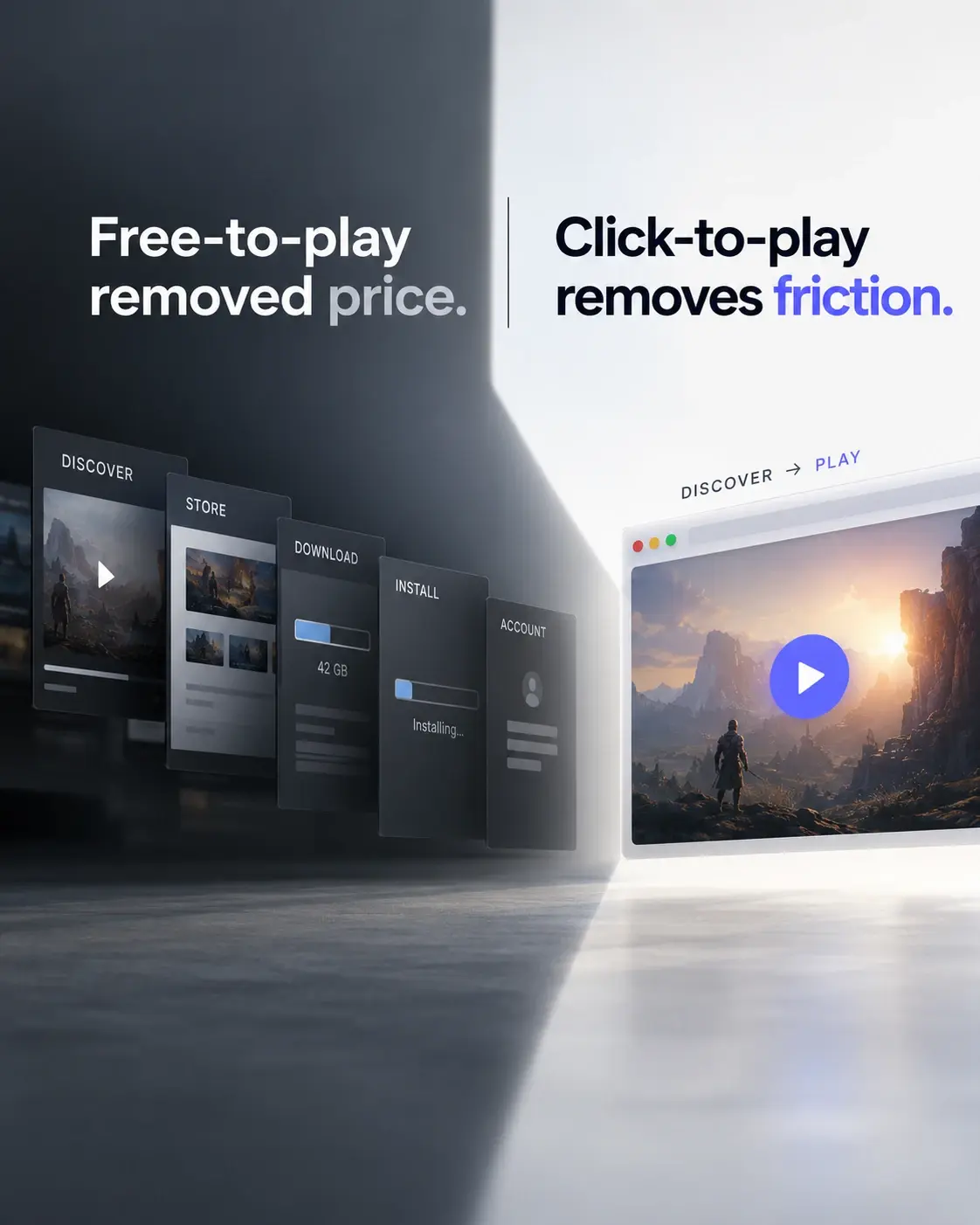
Download-based (Steam keys, builds): download 10-50 GB, hope the build runs on the journalist's hardware, troubleshoot if it doesn't. 40% of potential players are lost at the download step (Source: Xsolla). That data is consumer-facing, but the friction principle applies to anyone facing a large download before they can evaluate a game.
Physical events: travel, hotel, logistics, limited time slots. High-value for relationship building. Low efficiency for broad coverage.
The journalist's workflow from code to coverage typically spans receiving the pitch, playing the build, writing the piece, and publishing. Every friction point between "receiving the pitch" and "playing the build" is a potential drop-off. Browser-based access compresses that gap to a single click.
Standardized hardware matters too. When journalists play on their own machines, performance varies wildly. A journalist with an aging laptop gets a different impression of your game than one with a high-end desktop. Cloud streaming eliminates this variable entirely, because the game runs on the same server hardware for every session.
Which tool fits your situation
There's no single "best" tool. The right choice depends on your campaign phase, security requirements, budget, and scale. Here's a framework.
Pre-announcement (high security, small group): cloud streaming with forensic watermarking is the safest option. Playruo's per-session watermarking and time-window controls let you run a tightly controlled preview for select journalists without any files leaving your servers. If physical presence matters (for hands-on impressions with haptic feedback, for instance), a controlled in-person session works too, just at much higher cost and lower reach.
Embargo period (medium security, wider reach): cloud streaming with time-window access controls. Set a start and end time, restrict by geography if needed, and run sessions at scale. Parsec and Playruo both work here; the tradeoffs are app install (Parsec) vs. browser access (Playruo) and the presence or absence of forensic watermarking.
Post-announcement (lower security, maximum reach): Steam keys for broad distribution. At this stage, security is less critical and you want maximum coverage. Combine with cloud streaming for key media outlets who still benefit from a frictionless, controlled experience.
Event extension (hybrid): Microids used Playruo at Gamescom 2024 to extend their physical booth reach globally, sharing a 15-minute browser-based demo link on social media. This hybrid model lets you get the relationship value of a physical event while reaching a global audience digitally.
Large-scale remote campaign: Ubisoft delivered 1,500+ remote demos across 30+ countries via Parsec in 2020 (Source: Parsec/Ubisoft case study), proving that remote-first campaigns work at scale. Browser-based solutions eliminate the app install friction that Parsec requires, which matters when you're onboarding hundreds of journalists who may not have the app.
For a deeper dive into the operational side, see the guides on remote playtesting and demo distribution strategies.
Most publishers end up using a combination. Steam keys for broad post-launch distribution, cloud streaming for embargoed previews and high-priority media, and physical events for tentpole moments. The question isn't which tool to pick. It's which tool to pick for each phase of your campaign.
Sources

Sources
| Source | Notes |
|---|---|
| Big Games Machine 2024 Game Journalist Survey | Survey of 150+ game journalists |
| SteamDB via Tweaktown 2025 | SteamDB release count |
| Markletic: Virtual event statistics 2024 | 3,960 respondents |
| BleepingComputer: Insomniac Games breach | December 2023 |
| Shadow/Bandai Namco partnership | Elden Ring preview case |
| Parsec/Ubisoft Case Study | 1,500+ remote demos |
| Parsec pricing | Teams and Enterprise tiers |
| Amazon GameLift Streams | Launched March 2025 |
| Xsolla Cloud Gaming Trials | Browser-based demo streaming |
| Playruo technology page | Self-reported benchmarks |
Related resources
More Playruo guidance connected to this topic.