Game demo distribution: methods, platforms, and best practices for publishers
Steam demos cover 15% of releases and reach only Steam users. Physical events cost €50,000+. Private builds leak. This guide compares every demo distribution method on cost, reach, security, analytics, and scalability, so you can pick the right one for every stage of your game's lifecycle.
 Playruo Editorial TeamUpdated July 15, 202622 min read
- Why demo distribution is a strategy, not a checkbox
- Every method compared: the full landscape
- Steam demos: the default and its limits
- Beyond Steam: off-platform distribution methods
- Cloud streaming demos: the zero-friction alternative
- Matching the method to your goal
- How to build a multi-channel demo strategy
- Playruo vs alternatives for demo distribution
- Sources
Why demo distribution is a strategy, not a checkbox
Most publishers treat a game demo as a Steam checkbox. Upload a build, toggle the demo flag, move on. That approach misses the point entirely.
Demo distribution is a discipline that spans the entire game lifecycle, from pitching to investors before a build exists to re-engaging lapsed players two years after launch. Each stage has a different audience, a different goal, and a different method. Treating them all the same produces predictable results: demos that nobody plays, press that nobody covers, and wishlists that never materialize.
The scale of the problem is visible in the Steam data. In 2024, 18,965 games shipped on Steam, up 32% from 2023 (Source: SteamDB via Tweaktown 2025). Only about 15% of those shipped with a demo at all (Source: SteamDB tag data). Of those that did, 79% went mostly unplayed (Source: Kotaku).
Steam Next Fest in February 2026 featured over 3,500 demos (Source: GameDiscoverCo). Here's the counterintuitive finding that should reframe your entire strategy: 68% to 88% of Next Fest wishlists come from players who never played a demo (Source: Alinea Analytics 2025). The demo isn't the only lever. The distribution strategy is.
Think about the lifecycle in five discrete stages. Pre-production: you're pitching investors or publishers with a prototype build that needs to stay confidential. Development: you're running playtests where hardware consistency matters and IP protection is non-negotiable. Pre-launch: press and influencers need embargoed access without a build on their machines.
Launch: consumer acquisition requires reaching the widest possible audience with the lowest friction. Post-launch: re-engagement during sales or back-catalog promotions means players won't download a 50 GB build again. Each stage demands a different method. Understanding the full cloud gaming toolset available to publishers makes the lifecycle framing click into place.
Every method compared: the full landscape
No single distribution method wins across every dimension. The table below maps eight methods against seven criteria that actually matter for publisher decisions.
| Method | Cost | Reach | Security | Analytics | Setup time | Scalability |
|---|---|---|---|---|---|---|
| Steam demo | Free (platform revenue share) | Steam users only | Low (downloadable build) | Basic (Steam analytics) | Days | High |
| Epic / itch.io demo | Free to low | Platform users | Low (downloadable) | Minimal | Days | Medium |
| Physical Steam/Epic keys | Free (key generation) | Recipients only | Very low (redistributable) | None | Minutes | Low |
| Private builds (Drive/Dropbox) | Free | Recipients only | Very low (link sharing) | None | Minutes | Low |
| Remote streaming (Parsec) | Per-seat subscription | Recipients only | Medium (no files, app required) | Basic | Days to weeks | Low |
| Cloud streaming (Playruo) | Usage-based (per session) | Anyone with a link | High (build stays server-side) | Full | Hours | High |
| Physical event | $1,950+ booth; €50,000-€100,000+ all-in | Local attendees only | High (supervised) | Manual | Weeks to months | Very low |
| Playable ads | Ad network CPM | Ad network audience | High (cloud-streamed) | Full including ad metrics | Days | High |
No single method dominates. Each has a context where it's the right tool. The rest of this article breaks down when to reach for each one.
Steam demos: the default and its limits
Steam demos are the highest-reach free channel for consumer discovery. They cost nothing beyond the build work, and they unlock two marketing channels that are otherwise hard to access. But they have structural limits that publishers routinely underestimate.
The visibility flywheel
A Steam demo unlocks streamers and Steam Next Fest at the same time. Streamers need free, legal, publicly available content, and a demo provides exactly that. Next Fest requires a demo to participate. Both generate organic wishlists without paid media.
A game demo unlocks two essential marketing channels: Streamers and Festivals, which might increase both the game's visibility and wishlists.
The flywheel is real. The question is whether your demo is strong enough to survive first contact with an indifferent algorithm and an audience with 3,500 other demos to try.
Steam Next Fest by the numbers
Steam Next Fest in February 2026 featured over 3,500 demos, which means your game competes for attention the moment it goes live (Source: GameDiscoverCo). The upside is significant for top performers. Windrose accumulated 351,000 wishlists from a single Next Fest appearance (Source: GameDiscoverCo).
One documented case study shows a game jumping from 7,000 to 42,000 wishlists over a single Next Fest week (Source: How To Market A Game). Valve's July 2024 Great Demo Update introduced separate store pages for demos, wishlist notifications when a demo goes live, and improved discoverability in the Steam algorithm (Source: Valve Steamworks 2024).
The limits
Steam demos have four structural problems that no amount of optimization fixes. First, download friction: approximately 40% of potential players are lost at the install step (Source: Xsolla / Nothing2Install). A 25-50 GB demo install is a meaningful ask, especially on slower connections.
Second, Steam-only reach. Your demo is invisible to players who don't have Steam accounts or don't visit the platform. Press can't access it securely without a public build.
Third, there's no press security. A public Steam demo is a public file. Anyone can download it, extract assets, or share it before your embargo lifts.
Fourth, algorithm timing constraints mean your demo's visibility window is narrow and largely controlled by Valve, not you.
Beyond Steam: off-platform distribution methods
Steam isn't the right tool for every stage or audience. Private builds, platform keys, itch.io, physical events, and remote streaming each fill a specific gap, all with meaningful trade-offs.
Private builds via Drive or Dropbox
This is the default for press pitches and publisher outreach. Cost is zero, setup takes minutes, and it works with any file type. Those are the only advantages.
A shared Drive link can be forwarded to anyone, and the build can be redistributed with no controls. There are no session analytics, no way to know if the recipient opened the file, and no way to revoke access after you've sent it. For press and remote preview distribution, this approach creates an uncontrolled distribution chain that regularly results in pre-release leaks.
Physical Steam or Epic keys
Key generation is free. Setup takes minutes. For a small press list of 50 journalists, it's operationally simple.
The problems are the same as private builds, amplified. Keys can be redeemed, shared, resold, and there's no analytics trail. A journalist who redeems a key for a preview build now has a permanent license with no way to revoke access before or after your embargo date.
itch.io and other platforms
itch.io is developer-friendly and costs nothing to publish. The default revenue split is 90/10 in the developer's favor, with a developer-adjustable rate (Source: itch.io). Reach within the indie community is meaningful. Reach outside it is limited.
itch.io works well for early-stage feedback loops with a core indie audience. It's a poor fit for press distribution, investor pitches, or consumer acquisition campaigns that need to reach beyond existing indie gaming communities.
Physical events
A PAX East booth starts at $1,950 for a 100-square-foot space (Source: PAX exhibitor pricing). Total all-in costs can quickly reach €50,000 to €100,000 or more once you factor in venue, travel, hardware, booth build-out, shipping, and staffing at a global scale (Source: Events Industry Council / Oxford Economics 2018; Eventbrite Event Budget Template). For that investment, you get high-quality, face-to-face impressions from a motivated audience that came specifically to play games.
The trade-offs are obvious: geographic limitation, no digital analytics, and a one-time window. Physical events make sense as part of a multi-channel strategy, not as a standalone distribution method.
Remote streaming via Parsec
Parsec lets a developer share their own hardware remotely. A journalist or playtester connects via the Parsec application and streams directly from the developer's machine or server. The build never leaves the developer's control, which is a meaningful security improvement over Drive links.
The constraints are real. Scale is limited by developer hardware. Journalists need to install the Parsec application, which adds friction, and per-seat subscription pricing can become expensive at volume.
The Parsec / Ubisoft case from 2020 showed what's possible: over 1,500 demos across 30 or more countries (Source: Parsec case study 2020). But that required Ubisoft's own infrastructure at scale. Independent studios and mid-tier publishers rarely have that.
Cloud streaming demos: the zero-friction alternative
Cloud streaming solves the three biggest structural problems with every method described above: download friction, security, and analytics. The trade-off is cost, which is usage-based rather than free.
How cloud demos work
The publisher uploads a build. The cloud platform provisions a virtual machine, installs the game, and generates a shareable link. The player clicks the link, the game streams to their browser, and they play without downloading anything, creating an account, or configuring their hardware. The build never leaves the server, and access can be revoked instantly. The cloud gaming guide for publishers covers the underlying infrastructure in detail.
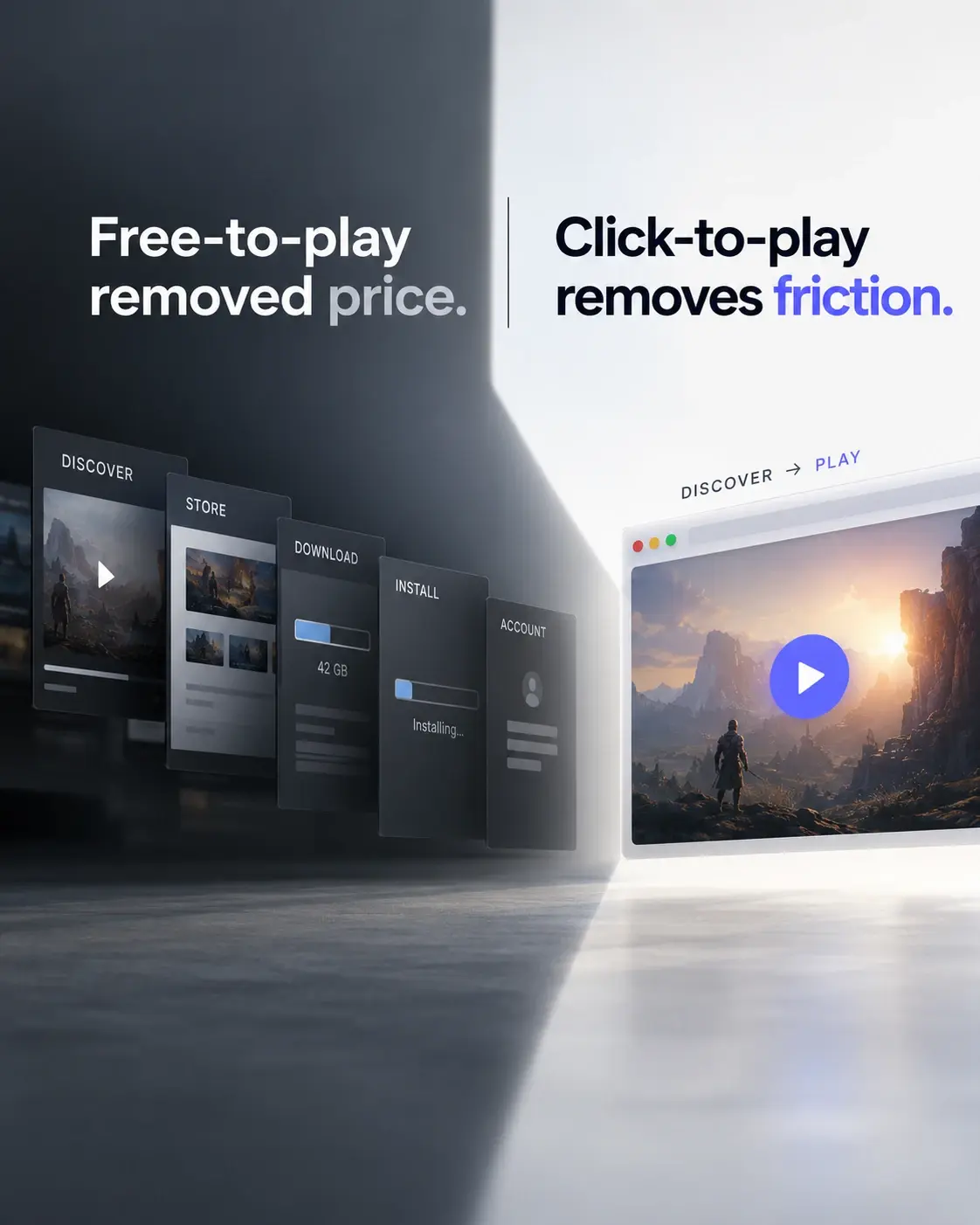
The friction math
Roughly 40% of potential players are lost at the download and install step (Source: Xsolla / Nothing2Install). Google Play data shows that every 6 MB increase in APK size reduces install conversion by 1% (Source: Google Play 2017). PC game demos routinely weigh 25 to 100 GB. Cloud demos load in seconds and require nothing except a browser.
This isn't a marginal improvement. It's a different category of conversion. Removing the install step changes who can access your demo, where they access it from, and how many of them complete a meaningful play session.
The landscape of cloud demo platforms
The market for cloud demo distribution has matured significantly in the past two years. Four platforms are worth understanding:
Xsolla Cloud Gaming Trials launched in August 2025. It offers timed sessions, pay-as-you-go pricing, and deep integration with Xsolla's commerce stack. The platform is best for publishers already using Xsolla for payments, key distribution, or web shop infrastructure.
Amazon GameLift Streams launched in March 2025. It's WebRTC-based, supports Windows, Linux, and Proton, and runs on AWS infrastructure. Ludeo reported a 5x engagement increase after integrating with the platform (Source: Amazon GameLift Streams launch materials 2025). The natural fit is studios that already have AWS infrastructure and technical teams comfortable with AWS SDKs.
Discord with GeForce NOW instant play is a pilot program for consumer discovery, not a publisher-controlled distribution tool. The underlying data is interesting: 40% of Discord users launch the same game within one hour of watching a friend stream (Source: Discord). But publishers don't control the distribution chain, which limits its use for press, playtests, or controlled campaigns.
Playruo is browser-based and purpose-built for publisher distribution workflows. It delivers 8 ms glass-to-glass latency (Source: playruo.com/technology, self-reported). Playruo requires no SDK integration, no porting, and no code changes. The same build can serve press previews, playtests, public demos, and playable ad campaigns from a single upload. Playruo supports white-label interfaces and charges usage-based pricing per session.
The Microids hybrid model
At Gamescom 2024, Microids ran a physical stand for Empire of the Ants while simultaneously distributing a 15-minute cloud demo link via social media. Players worldwide accessed the same build in their browser while the physical event ran in Cologne.
Local attendees played on-site hardware; global audiences played through a link. No additional build work, no second deployment, no incremental cost per player. This is the hybrid model in practice: physical presence for the high-value impression, global cloud reach for everyone who couldn't be there.
Matching the method to your goal
The right distribution method isn't about which platform is best in absolute terms. It's about which method fits your lifecycle stage, audience, and goal.
| Lifecycle stage | Goal | Best method(s) | Why |
|---|---|---|---|
| Pre-production | Pitch to investors or publishers | Cloud streaming (password-protected) | Analytics show whether the investor played and for how long. No build on their machine. |
| Development | Playtesting | Cloud streaming or Steam Playtest | Consistent hardware eliminates device bias. Cloud adds session analytics and IP protection. |
| Pre-launch | Press previews | Cloud streaming with forensic watermarking | Time-windowed access, instant revocation, no files on journalist machines. |
| Launch | Consumer acquisition | Steam demo + cloud demo + playable ads | Steam for wishlist velocity. Cloud for off-platform reach. Ads for UA conversion. |
| Post-launch | Re-engagement | Cloud demo on publisher website | No large download required. Reach players during sales or back-catalog promotions. |
The numbers back the broader shift. At October 2025 Next Fest, the top-performing game hit a 37.5% demo-player-to-wishlist conversion rate (Source: Alinea Analytics 2025). In mobile acquisition, Liftoff's 2025 index found that top-spending games allocated over 35% more spend to playables than other games, while results still varied by advertiser tier and campaign design (Source: Liftoff 2025).
For the development stage, the remote playtesting guide covers session structure and feedback methodology in detail. For pre-launch press, the press preview distribution guide goes deep on embargo management and watermarking. For launch UA, the playable ads guide covers campaign setup and creative strategy.
Nacon used this multi-stage approach across three titles: Hell is Us, Styx: Blades of Greed, and GreedFall 2. Playruo handled press previews across EU and US markets for all three, giving the communications team time-windowed, watermarked access for each outlet independently.
How to build a multi-channel demo strategy
The strongest strategies don't pick one method. They stack methods across the timeline, with each channel reinforcing the next. Here's a practical playbook built around a standard pre-launch window.
The timeline
Map channel activation to your launch date. The sequence below assumes a T-0 launch date and works backward:
T-12 to T-6 months: Cloud demo for investor and publisher pitches. Password-protected, session analytics enabled. You know whether your target investor played, for how long, and which build version they accessed. No file ever touches their machine.
T-6 to T-3 months: Cloud demo for press previews. Forensic watermarking active, access time-windowed to the embargo date, instant revocation enabled if an outlet breaks embargo. Journalists play in their browser; you see session completion rates by outlet.
T-3 months: Steam demo launch and Next Fest participation. Public, wishlist-focused, algorithm-optimized. The press coverage from T-6 to T-3 feeds traffic to the Steam page. The Steam demo drives wishlist velocity that improves Next Fest ranking.
T-1 month to launch: Playable ad campaigns. Cloud-streamed gameplay in ad units, targeting non-Steam audiences on social and gaming media. Conversion from playable ad to Steam page is direct and measurable.
Post-launch: Cloud demo on the publisher website. No download required. Runs during sales, events, and back-catalog promotions without asking players to commit to a 50 GB download before they know if they'll like the game.
Channel stacking
Each channel feeds the next. Press coverage from cloud-streamed previews drives organic traffic to the Steam page. Steam Next Fest performance improves algorithmic visibility within the platform. Playable ads convert audiences who would never organically discover the game on Steam.
The publisher who treats these as independent campaigns misses the compounding effect. Press coverage creates social proof that improves paid ad conversion. Steam wishlist velocity creates urgency that improves playable ad click-through.
Analytics consolidation
Cloud platforms provide session data: duration, completion rate, drop-off point, geography, and device type. Steam provides wishlist velocity and demo play counts. Playable ad platforms provide CTR and downstream conversion. The publisher who combines all three gets a closed-loop picture of how awareness becomes consideration becomes conversion.
My mind is racing with ideas on how to use Playruo to bring content to our fans!
Playruo serves all five lifecycle stages from a single upload. That shared infrastructure is where the analytics consolidation advantage comes from: one platform, one data model, five use cases.
Playruo vs alternatives for demo distribution
For publishers evaluating cloud demo distribution specifically, here's a direct comparison of the four main platforms across the criteria that matter most for a publisher workflow.
| Feature | Playruo | Parsec (Unity) | Xsolla Trials | Amazon GameLift Streams |
|---|---|---|---|---|
| Latency | 8 ms (self-reported) | >35 ms (self-reported) | Not disclosed | Not disclosed |
| Browser-based | Yes | No (app required) | Yes | Yes (WebRTC) |
| Forensic watermarking | Yes | No | No | No |
| Session analytics | Full (duration, completion, geography, device) | Basic | Purchase conversion focus | Basic |
| Dev work required | None (build upload or Steam keys) | Own hardware provisioning | Xsolla SDK integration | AWS SDK integration |
| Pricing | Usage-based (per session) | Per-seat subscription | Pay-as-you-go + commerce fees | AWS compute pricing |
| Multi-use (press + playtest + demo + ads) | Yes | Press and remote access only | Consumer trials only | Developer-managed |
| White-label | Yes | No | Partial | No |
Parsec is the legacy choice for AAA studios with their own server infrastructure and technical teams to manage hardware provisioning. It's proven at scale, but it requires internal resources that most independent publishers don't have.
Xsolla Trials works best for publishers already embedded in the Xsolla commerce ecosystem, where the trial experience flows directly into a web shop purchase. Amazon GameLift Streams is the natural fit for studios already on AWS, where an existing cloud bill absorbs the infrastructure cost and the technical team knows the SDK.
Playruo is purpose-built for publishers who want one platform for every demo distribution use case, from investor pitches through press previews to playable ad campaigns, without managing infrastructure. For the full B2B cloud platform comparison across a wider set of criteria, the cloud gaming platform comparison goes deeper.
Sources

Sources
| Source | Notes |
|---|---|
| SteamDB | Demo release statistics by year |
| Tweaktown | 18,965 games released on Steam in 2024, up 32% from 2023 |
| Kotaku | 79% of 2024 Steam releases went mostly unplayed |
| GameDiscoverCo | February 2026 Next Fest: Windrose 351K wishlists, 3,500+ demos |
| Alinea Analytics | 68-88% of Next Fest wishlists from non-demo-players; 37.5% top conversion |
| GameDiscoverCo | Wishlist-to-sales conversion ratios 2024-2025 |
| How To Market A Game | Demo effect: 7K to 42K wishlists case study |
| How To Market A Game | Steam Next Fest wishlist benchmarks |
| Valve Steamworks | Great Steam Demo Update, July 2024 |
| Xsolla | Cloud Gaming Trials launch; 40% of players lost at download step |
| Amazon GameLift Streams | Launched March 2025; Ludeo reported 5x engagement increase |
| Discord | 40% of users launch the same game within 1 hour of watching a friend stream |
| Parsec | Ubisoft delivered 1,500+ remote demos across 30+ countries using Parsec (2020) |
| Liftoff 2025 Mobile Ad Creative Index | Top-spending games allocate over 35% more spend to playables than other games. |
| Google Play | Every 6 MB APK size increase reduces install conversion by 1% |
| Playruo | 8 ms glass-to-glass latency (self-reported); QUIC protocol; H.264/HEVC/VP9/AV1 codecs |
| itch.io | Free publishing, developer-adjustable 90/10 revenue split |
| Game World Observer | Chris Zukowski analysis: demos unlock streamers and festivals |
Related resources
More Playruo guidance connected to this topic.