Cloud gaming architecture for publishers: no SDK, no porting, no installs
This guide explains the stack that lets publishers deliver existing PC builds in a browser, with zero code changes, controlled access, and cloud-scale distribution.
 Playruo Editorial TeamUpdated July 15, 202610 min read
Key takeaways
- The right publisher stack starts from the existing build, not a special cloud-native rewrite.
- Browser delivery reduces friction for testers, journalists, and players while keeping access control centralized.
- Remote desktop tools, consumer cloud catalogs, and publisher distribution platforms solve different problems.
- A serious evaluation should cover build ingestion, server runtime, transport, browser UX, security, and analytics together.
What publishers actually need from cloud gaming architecture
Most cloud gaming content is written for consumers. That is not the problem publishers need to solve.
A publisher does not start with a subscription catalog, a controller pairing flow, or a living room device matrix. A publisher starts with a build that already exists, a launch timeline that is already tight, and a distribution problem that keeps repeating across press previews, playtests, demos, and marketing activations.
That changes the architecture question completely.
The real goal is not "how do we stream games?" It is "how do we make an existing build instantly accessible, securely controlled, and easy to run at scale without asking the game team to rework the product?"
For most studios, the non-negotiables are simple:
- no SDK added to the game
- no web port or engine rewrite
- no app install for the end user
- strict session control for unreleased builds
- infrastructure that can scale up and down on demand
- enough analytics and access control to support business decisions
Browser-first B2B cloud gaming matters because it removes friction exactly when a publisher needs someone to access a build quickly and safely.
Architecture decisions also need to stay tied to the job. A team running confidential sessions with external testers will evaluate the stack differently from a team trying to expand consumer reach on a subscription platform. If your priority is controlled research or prerelease access, the buying criteria look much closer to remote game playtesting than to consumer cloud gaming.
The strongest architecture usually starts with the build you already have. Microsoft makes this point explicitly for Project xCloud with its promise of cloud deployment with "no need to change your code" (Source: Project xCloud).
Playruo applies the same logic to browser-based publisher distribution. Existing builds can be shared through launcher integration or direct upload, then delivered through a white-label browser experience with no app, no account, and no download required (Source: Playruo technology).
The four architecture models that matter
When teams say "cloud gaming architecture," they often mix together very different technical models. That leads to bad vendor comparisons and the wrong integration assumptions.
There are four models that matter most in practice.
The first is full-machine or full-VM streaming. The game runs inside a cloud machine that already contains the operating system, drivers, and runtime environment needed by the build. This is the fastest path to distribution because the game team does not have to rewrite rendering, input, or packaging logic.
The second is engine-level integration, usually through an SDK, plugin, or specialized rendering path in Unity, Unreal, or a custom engine. This can unlock deep platform-specific control, but it shifts work back onto the product and engine teams. That may be acceptable for a long-lived platform strategy. It is usually a poor fit for teams that need to ship sessions next month.
The third is framebuffer capture or remote desktop streaming. This is close to full-VM streaming technically, but the workflow is usually optimized for operator access, internal collaboration, or workstation remoting rather than for browser-native external distribution. Tools in this category often shine for internal QA, creative review, or remote workstation use.
The fourth is consumer cloud catalog distribution. Here, the platform owns a large part of the customer environment: account system, entitlement model, device support surface, and library UX. This can massively increase reach, but it is a different business and architectural problem from publisher-controlled build distribution.
| Model | What runs in the cloud | Engineering effort | End-user access | Best fit |
|---|---|---|---|---|
| Full VM or full machine | Existing game build plus full runtime environment | Low | Browser or controlled session link | Press previews, playtests, demos, secure external access |
| Engine-level SDK or plugin | Game integrated with platform-specific rendering or session logic | Medium to high | Depends on platform | Longer-term platform strategy, specialized integrations |
| Framebuffer or remote desktop | Desktop session or workstation image | Low to medium | Often desktop client or invited remote access | Internal QA, remote workstations, supervised research |
| Consumer cloud catalog | Platform-managed game instances and entitlement layer | Medium | Consumer-facing app, browser, or device ecosystem | Reach and catalog distribution at consumer scale |
This distinction matters because technical tradeoffs follow directly from the model.
Full-VM architectures usually win on compatibility. They let you preserve the existing build path, existing launchers, and existing toolchain. AWS makes a version of this case in its cloud game development guidance, which frames low-latency virtual workstations, build farms, source control, and CI/CD as part of the same cloud operating model (Source: AWS Games Industry Lens: Cloud game development).
Engine-level approaches can be elegant, but they are rarely "zero dev." Remote desktop tools can be very good at low-latency collaboration, but they are not automatically optimized for branded browser access, session windows, or publisher-facing controls. Consumer platforms can generate reach, but they usually come with their own content model, device assumptions, and platform priorities.
For a publisher evaluating architecture, one rule helps: compare systems by workflow, not by buzzword.
How a no-SDK deployment works in practice
A no-SDK architecture is not magic. It is a stack with the right layers.
The first layer is build ingestion. In Playruo's model, that can happen through a supported launcher such as Steam, Ubisoft Connect, or Epic Games Store, or through direct build upload. The important part is that the game is used as-is. You are not rebuilding the product for a browser runtime or embedding a streaming SDK into the executable (Source: Playruo technology).
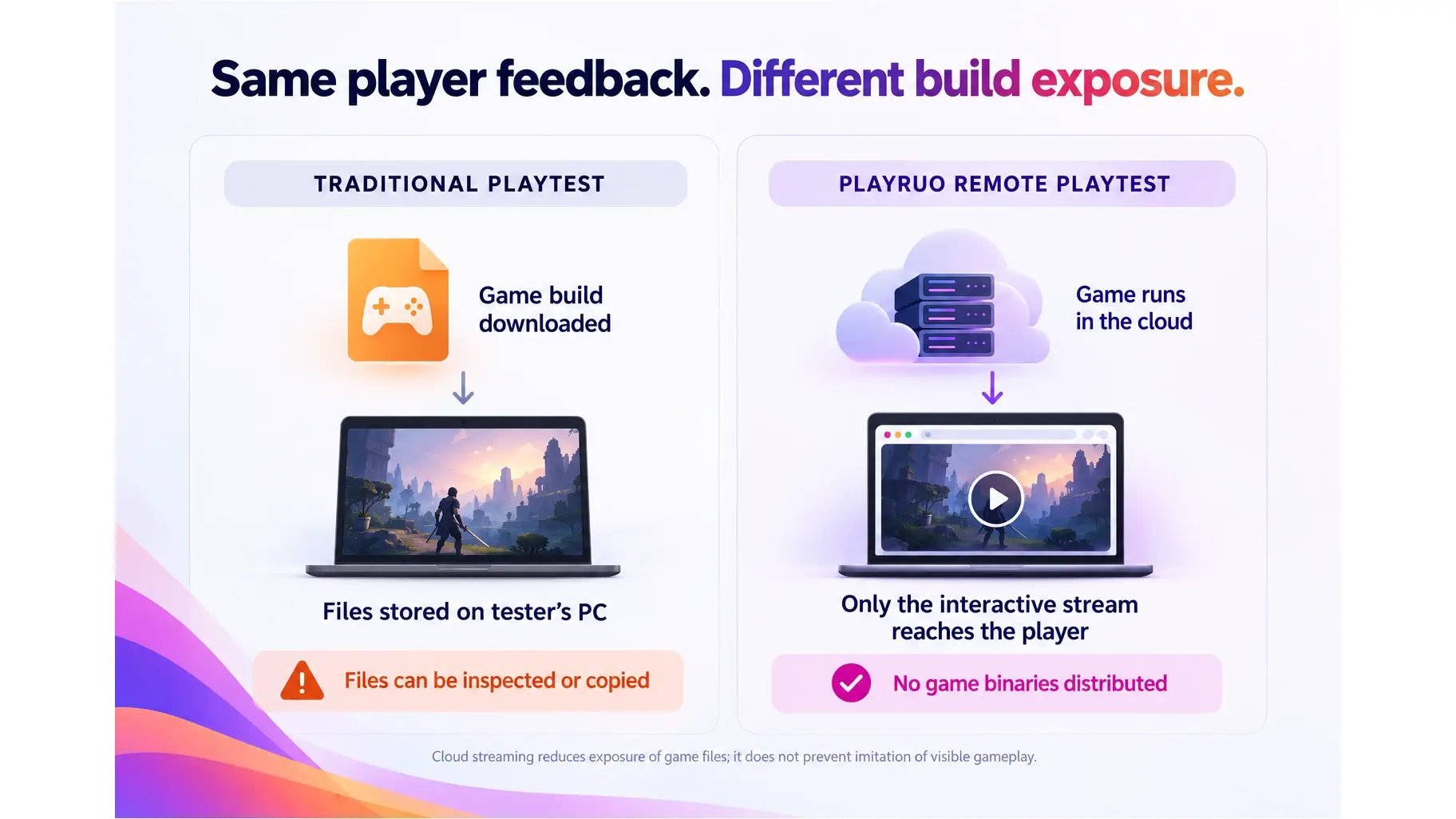
The second layer is the runtime environment. This is where many architecture discussions become too abstract. In practice, publishers want a predictable runtime image that mirrors the conditions needed by the game. Playruo creates a master Windows virtual machine in a locked kiosk environment, then handles drivers and OS updates centrally. That matters because it keeps the player inside the game session instead of exposing a desktop, file browser, clipboard, or command line (Source: Playruo technology).
The third layer is orchestration and deployment. Once the master image is validated, it is cloned onto cloud hardware that matches the title's needs. Teams usually weigh geography, pricing, GPU availability, and compliance before choosing cloud regions and providers. For Playruo specifically, the verified deployment claim is cloud-agnostic support across AWS, GCP, Scaleway, or customer-owned infrastructure (Source: Playruo technology).
The fourth layer is transport and encoding. This is where the streaming experience is won or lost. Codec choice determines how much quality you can preserve within real bandwidth constraints. NVIDIA reports that AV1 can deliver roughly 40% bitrate savings versus H.264 at equivalent quality, which is exactly why modern codec support matters for cloud gaming at scale (Source: NVIDIA AV1 and Ada Lovelace). Playruo's verified codec stack includes H.264, HEVC, VP9, and AV1, with real-time adaptation to network and client decoding conditions, and QUIC as the transport foundation (Source: Playruo technology).
The fifth layer is the browser control plane. This is the part that many technical evaluations underweight. The stream is only half the product. Publishers also need the page, the timer, the access logic, the controller recognition, the watermarking, the feedback layer, and the session rules that sit around the stream. Playruo's browser layer includes a white-label interface, timer, controller recognition, and rating modals served from a shareable landing page. The product detail on /technology is useful here because it shows how the transport and the browser surface are designed together (Source: Playruo technology).
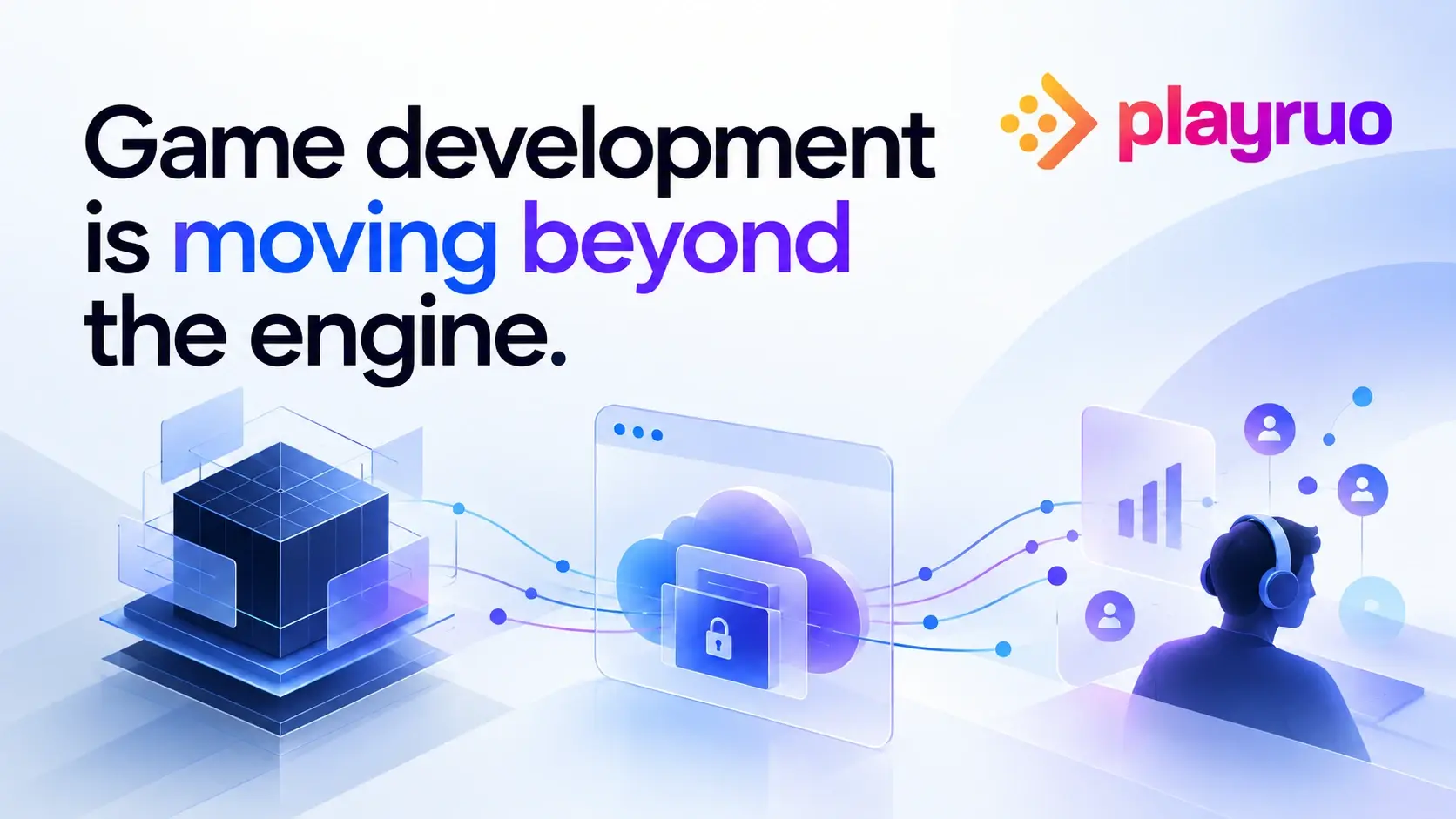
Put together, that stack turns a shipping-style PC build into a controlled browser session. That is why "no SDK" can work. The logic lives around the build, not inside it.
Where browser delivery changes the economics
Browser delivery is often framed as a convenience feature. It is much more than that.
Every extra install step creates drop-off, support overhead, and scheduling friction. That hurts almost every publisher workflow. Journalists miss windows. Testers bounce before session start. Marketing demos lose people at the exact moment curiosity is highest. Internal teams end up coordinating setup problems instead of learning from actual gameplay.
A browser-first architecture removes that operational tax. That is why it changes the business case, not just UX.
For press and prerelease access, it means a build can be gated by password, time window, geography, or concurrency rules without ever leaving the cloud machine. That is the same operating model behind remote game press previews, the publisher flow on /pr, and the playtesting workflows we covered in cloud playtesting vs lab testing.
Microids used Playruo to present Empire of the Ants to journalists worldwide during Gamescom 2024, which shows how the same browser delivery stack can support both live event activity and remote access at the same time (Source: Playruo PR).
For marketing and demo distribution, browser delivery changes how quickly a user can move from interest to play. That is a fundamentally different funnel from download-first demo distribution. It also lets publishers reuse the same core infrastructure across multiple teams instead of buying one solution for press, another for playtesting, and a third for demand generation. The same architecture can serve teams focused on /playtests or /marketing without forcing a separate delivery stack for each use case.
This is where a B2B architecture diverges sharply from both remote desktop tools and consumer cloud platforms. Consumer platforms optimize for persistent account experience and large-scale player reach. Browser-first publisher stacks optimize for fast access, controlled scope, and repeatable campaign operations.
The market data supports how important this distinction is becoming. Microsoft said Xbox Cloud Gaming streamed 140 million hours between October and December 2024 and is now available across 28 major markets, with Direct Capture reducing input latency by 16-72 milliseconds depending on the game (Source: Xbox Cloud Gaming at GDC 2025). That does not prove every publisher needs a consumer cloud strategy. It does show that streaming is no longer a side experiment.
Meta's engineering team made a related point from the infrastructure side: traditional data centers alone struggle to meet latency goals across every screen, which is why edge-aware design matters in cloud gaming architecture (Source: Meta cloud gaming infrastructure). In other words, the streaming problem is real enough that architecture quality directly affects business viability.
Playruo vs remote desktop vs consumer cloud gaming
This is where most comparisons go wrong.
Parsec is not "bad Playruo." Xbox Cloud Gaming is not "big Playruo." These products solve different problems.
Parsec is strongest when the goal is low-latency remote access. Its technology positioning is built around fast host-to-client interaction, and its QA and user research pages make clear that it is useful for remote testing and usability workflows (Source: Parsec technology; Parsec user research and QA). That is valuable. It is also a different operational shape from publisher-controlled browser distribution. The core mental model is remote access first.
Xbox Cloud Gaming solves a consumer reach problem. Microsoft's current positioning is about getting games onto more screens with less friction, while still supporting developer adoption with no code changes in the cloud deployment path (Source: Project xCloud; Xbox Cloud Gaming at GDC 2025). That is strategically important, but the platform logic, customer ownership, and deployment goals are different from running a secure external demo or press preview under publisher control.
Playruo sits in a different lane. Its architecture is built for publisher workflows where the build must stay controlled, the session must start in a browser, and the business team needs a white-label experience rather than a third-party platform wrapper. That is why the product pages emphasize no app, no account, no download, direct build or launcher intake, locked Windows VMs, and publisher-grade access controls (Source: Playruo technology). If you want the broader product rationale, that logic also shows up on why Playruo.
There is also a credibility angle here. Playruo was founded by the team behind Shadow, with technical leadership shaped by Jean-Baptiste Kempf's work on VLC and years in video streaming infrastructure. That does not replace proof. It does explain why the architecture focus is so explicit: the founders have already lived through the operational realities of cloud-delivered computing at scale (Source: Playruo our story).
The better buying question is not "which one streams games?" It is "which architecture fits the job you actually need to run?"
How to evaluate a cloud gaming stack before you buy
If you are evaluating vendors, do not start with the homepage. Start with the migration cost.
Ask whether the platform can run your current build without code changes. Ask what OS image the game runs in. Ask whether the stream opens in a browser or requires a client. Ask where access control lives. Ask how the system handles GPU scaling, geography, session concurrency, and codec adaptation.
Then go one layer deeper.
Check whether the stack gives you control over session duration, password protection, geographic restrictions, watermarking, and revocation. Check whether analytics are per session, per user, and aggregated. Check whether the deployment model can support more than one team. A good B2B cloud gaming architecture should not force PR, user research, and marketing onto separate delivery systems.
You should also test the codec and latency story in realistic conditions. A claim about raw encoding performance is not enough. What matters is the full path from input to display, under actual network variability, with real browser decoding constraints. That is why codec breadth, adaptive transport, and deployment geography matter more than isolated benchmark screenshots.
Finally, ask what the platform is really optimized for. If the answer sounds like remote workstation access, judge it as a remote workstation tool. If it sounds like consumer distribution, judge it as a consumer platform. If it is truly designed for publisher distribution, you should see that in every layer: ingestion, VM control, session policy, browser UX, analytics, and cloud operations.
For most publishers, the winning architecture is not the one with the flashiest diagram. It is the one that gets an existing build into a controlled browser session quickly, securely, and repeatedly, without asking the game team to stop what it is doing.
That is the practical meaning of cloud gaming architecture for publishers. No SDK. No porting. No install. Just a build, a controlled runtime, and a delivery stack designed for the way game teams actually work.

FAQ
Sources
| Source | Notes |
|---|---|
| Playruo technology | Official product and architecture page |
| Playruo our story | Founders and company background |
| Playruo PR | Official press preview use case and Microids example |
| AWS GameLift Streams | Official browser delivery and managed streaming reference |
| AWS Games Industry Lens: Cloud game development | Cloud game development architecture guidance |
| Project xCloud | Official Microsoft developer positioning |
| Xbox Cloud Gaming at GDC 2025 | Reach, markets, and latency improvements |
| Meta cloud gaming infrastructure | Edge and latency architecture perspective |
| Parsec technology | Remote streaming technology reference |
| Parsec user research and QA | Official Parsec use case positioning |
| NVIDIA AV1 and Ada Lovelace | Codec efficiency and bitrate savings reference |
Related resources
More Playruo guidance connected to this topic.