10 ways to turn a one-click game demo into a marketing channel
A one-click playable demo can do more than show a game. Use it to capture wishlists, emails, purchase intent, media engagement, and sponsored activations.
 Playruo Editorial TeamUpdated July 15, 202615 min read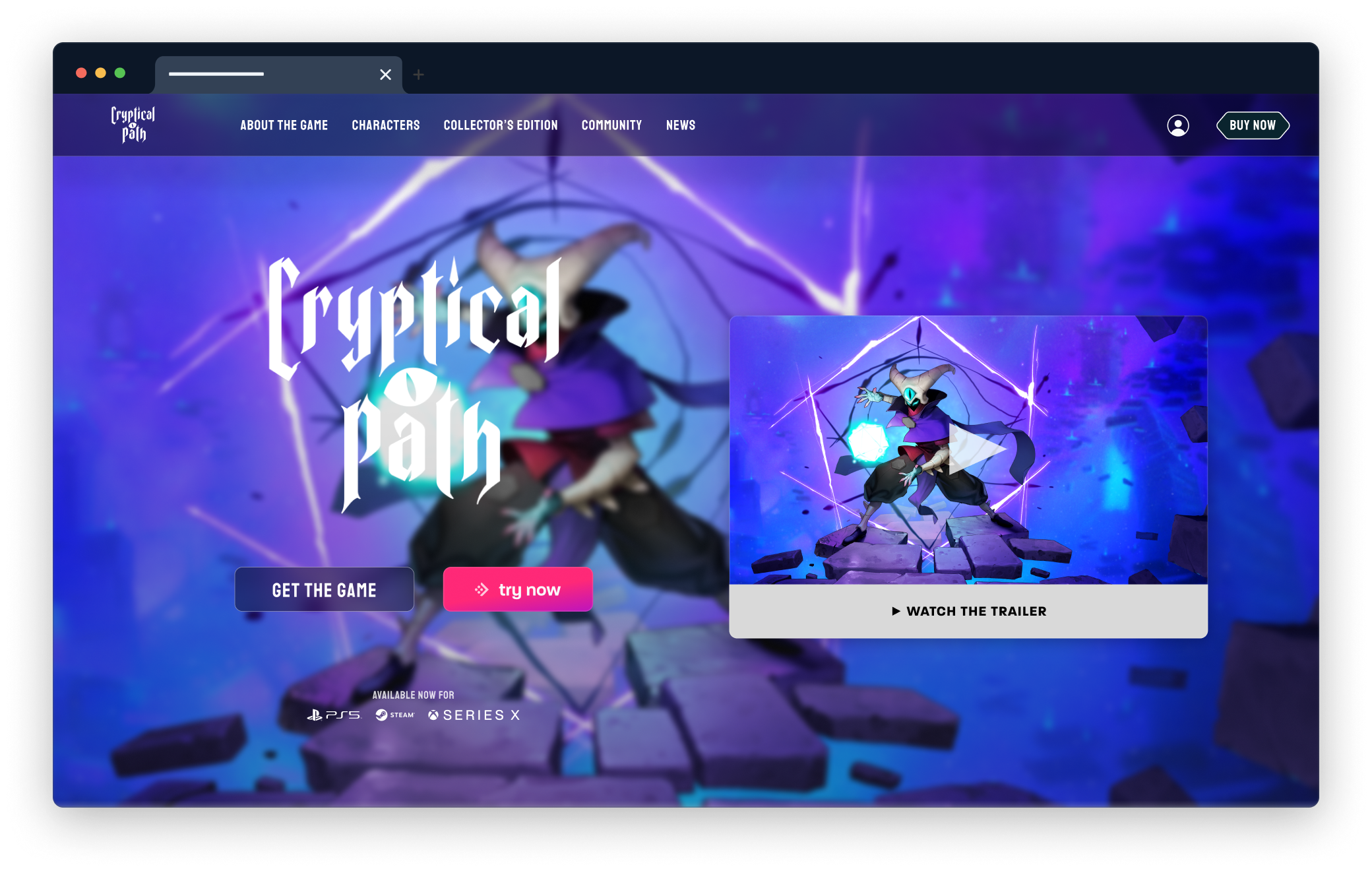
Key takeaways
- A one-click playable demo turns passive discovery into measurable gameplay behavior.
- The strongest placements are high-intent surfaces: launchers, product pages, publisher sites, newsletters, livestreams, media pages, and event campaigns.
- Post-demo routing matters as much as the embed: wishlists, email capture, purchase links, community joins, and sponsor actions should depend on session behavior.
- Playable access can become premium media inventory when a brand sponsors the moment a player wants to unlock a demo.
A one-click playable demo changes what a marketing asset can do. A trailer can show the fantasy. A store page can explain the features. A playable embed lets the player test the promise immediately, inside the page where the campaign already has their attention.
That matters because most game marketing funnels leak between curiosity and action. The player sees a trailer, clicks a landing page, maybe opens a store tab, maybe downloads a demo later, maybe forgets. The more steps between "this looks interesting" and "I am playing", the more intent you lose.
With a browser-based demo, the demo becomes part of the acquisition surface itself. It can sit inside a launcher, a product page, a publisher site, a media article, a creator campaign, a newsletter, an event landing page, or a sponsored brand experience. The question is no longer only "where do we host the demo?" It becomes "where can gameplay create the most useful next action?"
Why one-click playable demos change the funnel
A one-click playable demo is not just a lighter download. It is a different conversion step.
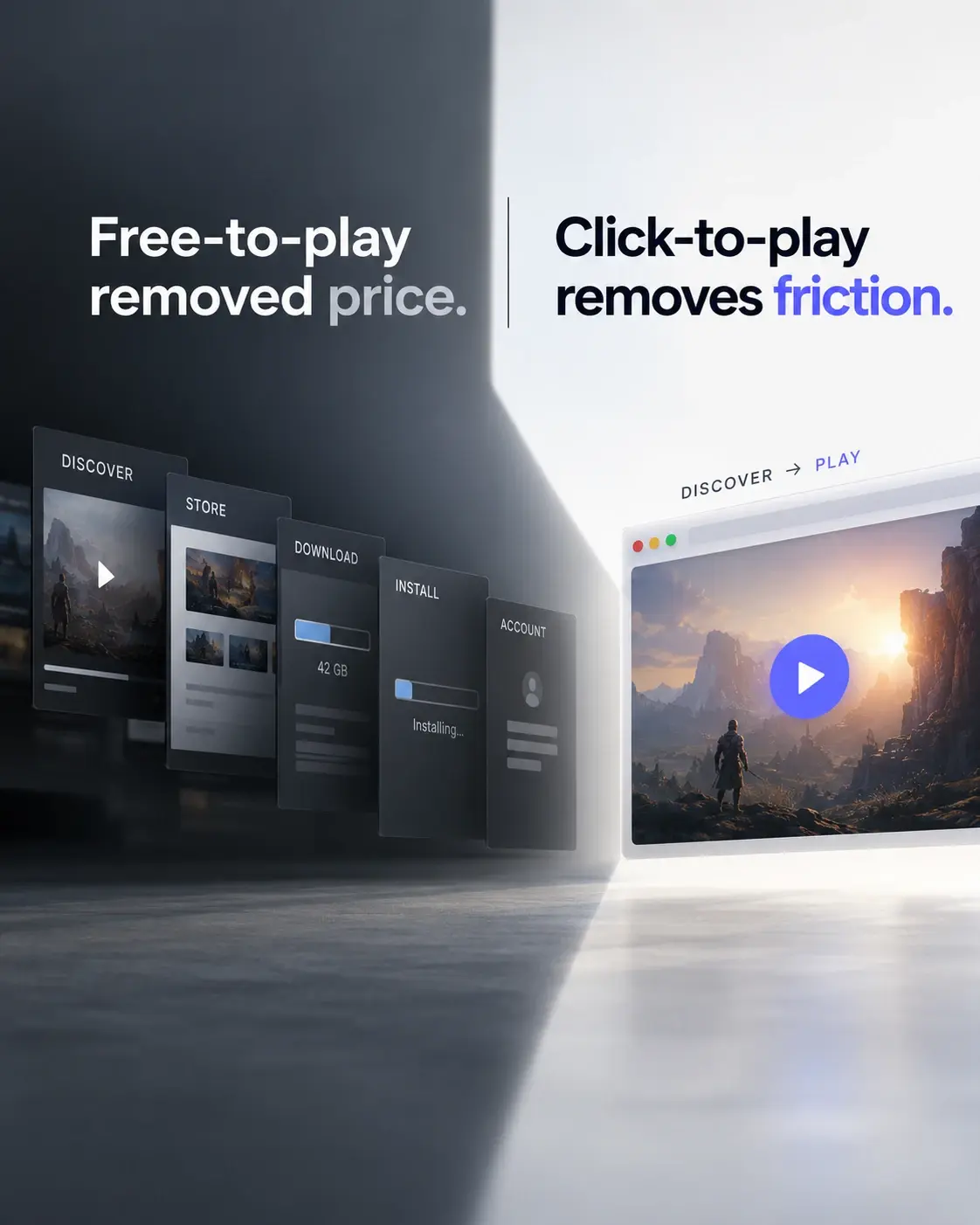
In a classic funnel, the first playable moment often arrives late. A player needs to reach a store, install a build, create an account, check hardware requirements, and commit time before they know whether the game feels right. That makes sense for a full public demo, but it is heavy for discovery.
Playruo changes that by streaming the game from the cloud into a browser session. The player does not install the build locally, and the studio can send a link or embed the experience into an existing campaign surface (Source: Playruo Marketing). The Playruo marketing page shows where this fits in campaign workflows, while why Playruo explains the broader platform position. TechCrunch described the product as a way for publishers to turn a game demo into a shareable browser link (Source: TechCrunch 2024).
The marketing value is simple: the first playable moment moves closer to the first moment of attention.
That has three practical effects:
- It reduces the gap between seeing a game and trying it.
- It creates behavioral signals that a trailer cannot capture: session count, duration, completion, geography, timestamps, play patterns, device data, and connection data. Campaign instrumentation can then connect those signals to site, store, ad, and CRM events around the embed.
- It lets teams route players to the right next action while the gameplay memory is fresh.
The mobile market has already shown why interactive creative matters. Liftoff's 2025 Mobile Ad Creative Index analyzed more than 4.7 trillion impressions, 263 billion clicks, and 1.1 billion installs, and reported that playable ads generated higher impression-to-install rates than non-playable formats in mobile gaming campaigns (Source: Liftoff 2025). This is a mobile advertising benchmark, not a direct PC or console forecast, but it points to the same strategic idea: players respond differently when the ad becomes interactive. PC and console teams cannot solve that by rebuilding an AAA demo in HTML5.
That is where a cloud-streamed embed fits. Konvoy has argued that cloud-streamed playable ads are one of the strongest uses of cloud gaming because the format reduces the friction to try new games without asking players to switch platforms or install a separate client (Source: Konvoy Ventures 2023).
We realized Playruo unlocks limitless possibilities for maximizing player engagement
Where to embed a playable demo
The best placement is rarely "everywhere". It is the point in the journey where the player has enough intent to try the game, but not enough certainty to buy, wishlist, register, or join the community.
For most studios and publishers, the strongest placements are:
- A launcher where players already browse games.
- A product page where the visitor is comparing screenshots, trailers, reviews, editions, or prices.
- A publisher website where several titles can be discovered from one catalogue.
- A launch campaign page that needs to turn paid traffic into wishlists or accounts.
- A newsletter or CRM journey where the audience already knows the brand.
- A press or creator page where the demo makes coverage easier to produce.
- An event landing page where physical queues and hardware capacity limit reach.
- A sponsored activation where a brand wants attention that is earned through interaction.
The same demo can serve each placement, but the surrounding flow should change. A launcher needs a compact "Try now" module. A product page needs proof before the wishlist or purchase CTA.
A newsletter needs a clear identity match and a reason to come back. A sponsored page needs clean consent, measurement, and brand safety.
The table below is the operating view: pick the surface, define the next action, then design the demo session around it.
| Placement | Main actor | Best next action | What the embed should prove |
|---|---|---|---|
| Launcher | Launcher, publisher, platform | Wishlist, install, buy, follow | The game feels worth trying before download |
| Product page | Studio, publisher, retailer | Wishlist, buy, download, join beta | The trailer promise matches gameplay |
| Publisher site | Publisher, label, portfolio studio | Explore more titles, create account | The catalogue is playable, not just browsable |
| Landing page | Studio, publisher, UA team | Email, wishlist, paid conversion | Paid traffic can become qualified intent |
| Newsletter | CRM, community, publisher | Click back, play, register | Existing audience can be reactivated |
| Creator campaign | Influencer, media network, publisher | Play from stream, wishlist, share | Viewers can move from watching to playing |
| Event page | Event team, platform, salon, publisher | Book slot, play remotely, follow up | The event demo can scale beyond booth PCs |
| Sponsored activation | Brand, media, publisher | Sponsor-qualified session, wishlist, email | The brand funds a valuable playable moment |
10 use cases for embedded game demos
The most useful way to plan a playable embed is to treat it as a campaign module. Each module has an audience, a benefit, an implementation pattern, and a reason the browser embed is better than sending the player somewhere else.
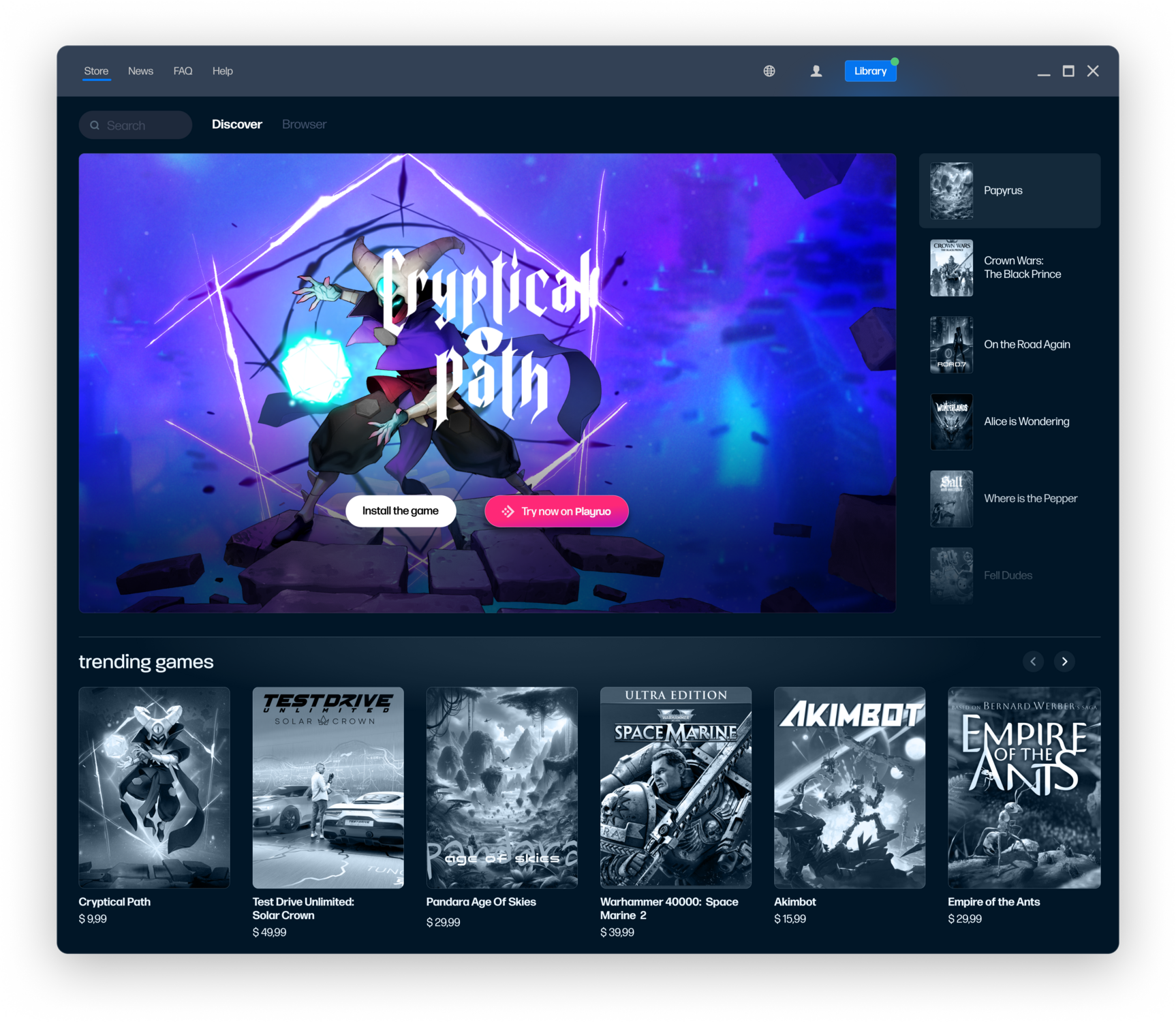
1. Add a "Try now" module inside a launcher
Use case: A launcher lets players test a game instantly before they install, buy, or add it to a list.
Actor: Publisher launcher, platform, retail launcher, subscription service.
Main benefit: Discovery becomes playable inside the launcher, instead of sending users to a store page or trailer.
Implementation example: A launcher home page promotes a new indie title with a "Playable demo" button next to "Wishlist" and "Buy". The player clicks, the Playruo session opens in fullscreen, and the post-demo screen routes them back to the same launcher offer.
Why Playruo fits: Playruo can be embedded into a launcher or opened from a link, and the game runs from the cloud rather than the user's machine (Source: Playruo Marketing). That means the launcher can test demand before asking players to commit to an install.
The strongest version is not a generic demo carousel. It is a curated try-before-you-install shelf: new releases, hidden gems, premium games on discount, seasonal collections, or "games you may like" recommendations.
2. Turn a product page into a playable page
Use case: The official game page adds a playable demo beside the trailer, screenshots, features, editions, and store buttons.
Actor: Studio, publisher, retailer, direct-to-consumer store.
Main benefit: The page can answer the most important question, "Does it feel good?", without relying only on video.
Implementation example: A game website shows the trailer at the top, then a "Play the first 8 minutes" module above the Steam, Epic Games Store, console store, and newsletter buttons. After the session, the player sees a dynamic CTA: wishlist if pre-launch, buy if released, join beta if the build is private.
Why Playruo fits: Playruo can run a browser preview from a standard web page with no local install for the player (Source: Playruo Marketing). For teams comparing demo distribution options, this extends the classic game demo distribution playbook into the web page itself.
The product page is where a playable demo can outperform a trailer structurally. A trailer is still needed for emotion and pacing. The embed is the proof layer. It lets the player test controls, readability, performance feel, onboarding, and tone.
3. Build a playable publisher catalogue
Use case: A publisher website becomes a playable showcase for multiple titles instead of a static catalogue.
Actor: Publisher, label, platform, accelerator, portfolio studio.
Main benefit: Users can browse by playing, not only by reading.
Implementation example: A publisher creates a "Playable catalogue" page for an indie label. Each game has a compact tile with trailer, tags, release window, and "Try now". Sessions are capped to 5-10 minutes, and the post-demo screen recommends the next title in the same genre or campaign.
Why Playruo fits: A Playruo preview can be shared as a landing page or embedded into a broader marketing context (Source: Playruo Marketing). The publisher can use one technical model across several titles while keeping each title's branding, CTA, and access rules distinct.
This is especially useful for publishers with a long tail of catalogue games. The catalogue stops being an archive. It becomes a discovery surface that can be refreshed for seasonal sales, event weeks, portfolio announcements, or influencer campaigns.
4. Make the demo the reason to wishlist
Use case: The player plays first, then receives the wishlist CTA at the moment of highest intent.
Actor: Studio, publisher, growth team, Steam marketing team.
Main benefit: The wishlist request comes after proof, not before it.
Implementation example: A pre-launch landing page starts with a playable slice. When the session ends, the page shows "Wishlist now" with Steam and Epic Games Store buttons, plus a short reminder of what the player just completed: boss beaten, puzzle solved, lap finished, match won, or time survived.
Why Playruo fits: The embed gives the studio a controlled pre-wishlist experience. Playruo session analytics can show duration and completion, while site and store tracking can measure the post-demo click path.
Steam still matters enormously. Steamworks tells teams to submit Next Fest demo builds for review ahead of event deadlines, and it encourages teams to consider leaving demos live beyond the event when it fits their release strategy (Source: Steamworks documentation). Chris Zukowski's demo marketing advice, reported by Game World Observer, frames demos as a way to unlock streamers and festivals, which can increase visibility and wishlists (Source: Game World Observer 2023).
The Playruo angle is not to replace a Steam demo. It is to create more moments that can drive qualified players toward the store page, as part of a broader game launch marketing plan.
5. Use gameplay as the email capture incentive
Use case: A landing page offers immediate demo access in exchange for an email, account creation, beta registration, or newsletter opt-in.
Actor: Studio, publisher, CRM team, community team.
Main benefit: The form has a real reward. The player is not only trading an email for future news, they are unlocking gameplay now.
Implementation example: Paid social traffic lands on a page with a short value prop and one field: work email for B2B events, consumer email for community campaigns, or platform login for a publisher account. After the form, the Playruo demo launches. After three minutes or after level completion, the player receives a second CTA: wishlist, join Discord, complete a survey, or invite a friend.
Why Playruo fits: The playable session can feed a CRM segmentation model when Playruo session analytics are combined with consented site, email, and CRM events. Instead of treating all signups equally, the team can separate people who launched the demo, played more than a threshold, finished the slice, or responded to a follow-up CTA.
This is where a playable embed becomes more than acquisition. It becomes lead qualification. A player who played seven minutes and clicked "Wishlist" is not the same as a player who only watched the hero trailer.
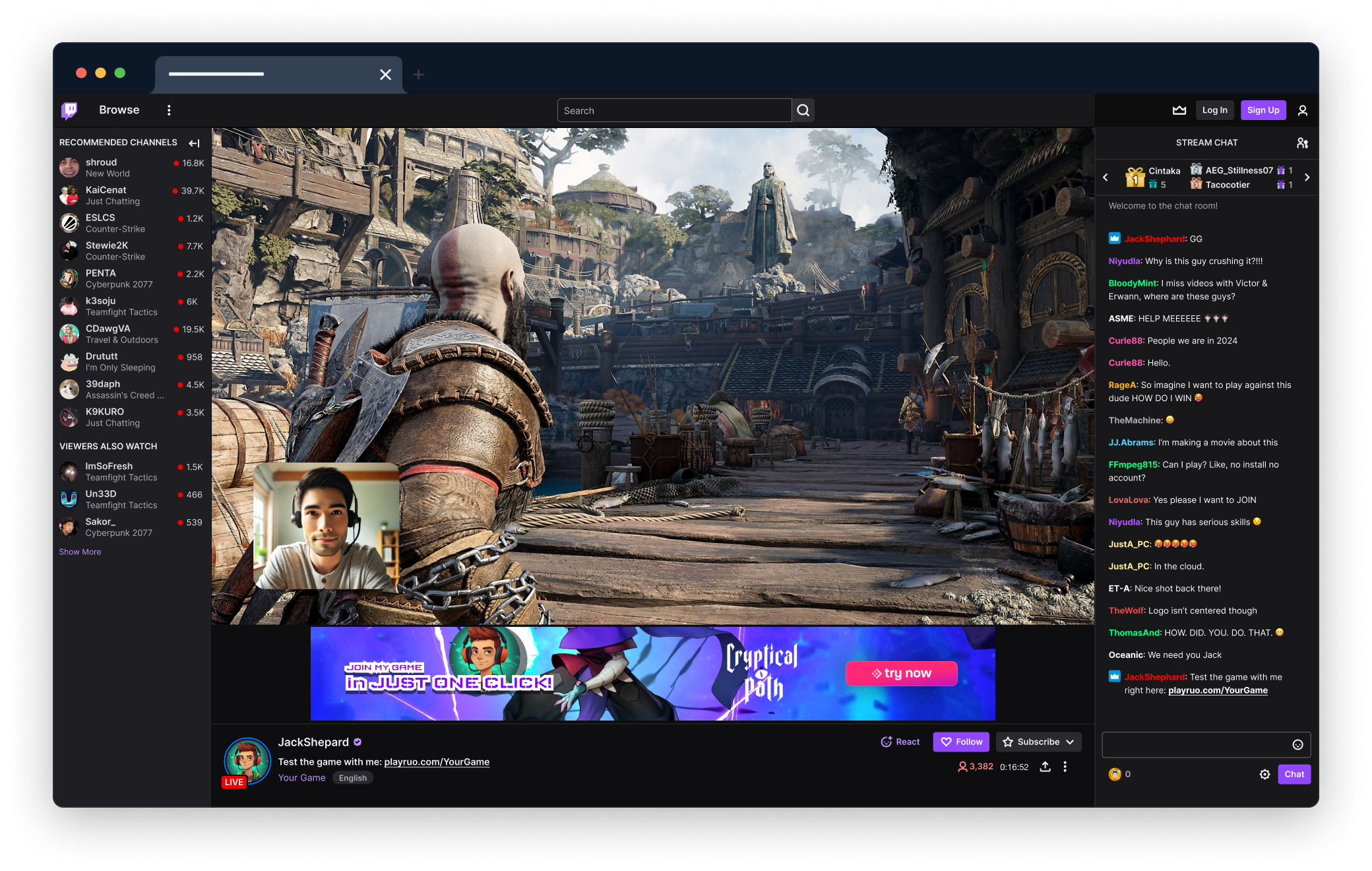
6. Turn livestream viewers into players
Use case: A creator shares a trackable demo link during a stream, video, or sponsored content campaign.
Actor: Influencer, streamer, media network, publisher, creator agency.
Main benefit: Viewers can move from watching gameplay to playing the same build while the creator's content is still fresh.
Implementation example: During a sponsored livestream, the creator drops a Playruo link in chat. The first 1,000 viewers can play a timed demo after the segment. Each creator gets a tagged link, and the post-demo page routes viewers to wishlist, buy, or join a Discord event.
Why Playruo fits: Webedia's Click & Play partnership with Playruo describes a similar model across ads, influence, articles, and newsletters, including traceable demo links shared by streamers during sponsored livestreams (Source: Webedia 2025).
This is the part a normal trailer cannot do. A trailer can create desire. A one-click demo lets the campaign catch that desire before it cools down.
7. Give press and media a playable article angle
Use case: A gaming media article embeds or links to a playable preview, so readers can test the game after reading.
Actor: Gaming media, publisher PR team, platform, editorial partnership team.
Main benefit: Coverage becomes interactive without asking readers to install a separate build.
Implementation example: A media partner publishes a preview article with a "Try the demo" module at the end of the piece. The session is time-limited, geo-controlled if needed, and routes to a store or newsletter CTA. For embargoed campaigns, the same access model can be used privately with journalists before public coverage.
Why Playruo fits: Playruo already supports remote press preview workflows where access, schedule, and security matter. The marketing version reuses the same idea for public or semi-public reader access.
This can also help smaller games compete for attention. A written preview plus playable proof gives the journalist, creator, or media brand a stronger editorial object than another asset pack.
8. Scale event demos beyond the booth
Use case: A physical event, festival, award show, or trade fair extends its playable demos to people who cannot reach the booth.
Actor: Event organizer, publisher, platform, salon, awards program.
Main benefit: Demo capacity is no longer limited only by booth hardware, venue hours, or local attendance.
Implementation example: A publisher runs a Gamescom booth with local machines and a parallel web demo page for press, VIPs, and community members at home. QR codes at the booth reopen the demo later. After the event, the same page becomes a follow-up campaign with fresh CTA copy and retargeting audiences.
Why Playruo fits: The same cloud build can support controlled access windows, session duration caps, and browser-based sessions. That makes it useful for hybrid activations where the physical demo matters, but the audience is larger than the venue.
Webedia also notes that Click & Play was used at the Pegasus Awards so jury members could test games in advance and vote accordingly (Source: Webedia 2025). That is the event logic in miniature: gameplay access can support a decision, not only a marketing impression.
9. Make crowdfunding pages more credible
Use case: A Kickstarter, Republic/Fig, publisher pitch, or community funding page adds a playable proof point next to the trailer and pledge tiers.
Actor: Indie studio, crowdfunding team, publisher scout, platform.
Main benefit: Backers can test the game before they fund it.
Implementation example: A campaign page gates a 6-minute demo behind email or pledge intent. Non-backers can play a short public slice. Backers unlock a longer private slice, a survey, or a time-limited build during campaign milestones.
Why Playruo fits: The build does not need to be distributed as a downloadable file, and access can be time-windowed or revoked. That is useful when the game is still in development and the team wants proof without uncontrolled build circulation.
For crowdfunding, the embed is not only a conversion tool. It is a trust tool. The team is saying, "This exists, it runs, and you can feel it now."
10. Turn a highly anticipated demo into premium ad inventory
Use case: A non-endemic brand sponsors access to a playable demo that players actively want to unlock.
Actor: Brand, media network, publisher, platform, agency, studio.
Main benefit: The brand is attached to a valuable interactive moment, not only a passive impression.
Implementation example: An energy drink, hardware brand, telecom company, fintech, lifestyle brand, car brand, fashion label, streaming platform, or subscription service sponsors early access to a web demo. The player lands on a co-branded page, watches a short rewarded ad, then launches the Playruo demo immediately. After the session, the page can route to wishlist, email signup, store click, community join, or a brand offer.
Why Playruo fits: The reward is not a coupon or a download later. It is immediate gameplay in the browser. That makes the ad exchange easier to understand: watch the sponsor message, unlock the demo, play now.
This is the most media-native version of the idea. The demo becomes inventory. The brand buys attention at the moment the user is motivated to continue, and the studio funds part of the campaign without reducing the game to a static ad.
Design the conversion path around the demo
A playable embed is only as strong as the path around it. The demo should answer one campaign question, then move the player to one next action.
For wishlist campaigns, the post-demo screen should focus on the store CTA and preserve source attribution. For email capture, it should ask for the smallest useful identity field before or after the session. For creator campaigns, it should keep the creator tag through the whole flow.
For events, it should support scheduled windows, caps, and follow-up messaging. For sponsored campaigns, it should separate brand metrics from studio metrics while keeping the player experience clean.
Useful segments can combine Playruo session analytics with consented site, store, email, ad, and CRM instrumentation. Start with segments like:
- Opened the page but did not launch the demo.
- Launched the demo but left before one minute.
- Played more than three minutes.
- Completed the slice.
- Clicked wishlist or buy, measured by the surrounding site or store flow.
- Joined Discord or newsletter, measured by the surrounding site or CRM flow.
- Shared the demo link, when the campaign page supports share tracking.
- Returned for another session, when the campaign stack records returning visitors.
These segments matter because they let marketing teams stop treating demo traffic as a single blob. A high-intent player can receive a different follow-up than a curious viewer.
A short session during onboarding may point to a product issue, not a media issue. A creator link that drives long sessions but low wishlist clicks may need a better post-demo CTA, not a new creator.
Xsolla's 2025 Cloud Gaming Trials announcement points in the same direction: instant browser trials are presented not only as access, but as a way to connect demos with performance tracking, referrals, purchases, and attribution (Source: Xsolla 2025). The strategic lesson is clear: playable access becomes more valuable when it is connected to the commercial journey.
What if demo access became an ad format?
The most interesting shift is that playable access can become media inventory in its own right.
For years, brands have sponsored trailers, influencer videos, esports segments, homepage takeovers, and event booths. A one-click playable demo creates another option: sponsor the moment where the user is actively trying to get into the game.
That format can take several shapes:
- Rewarded access: "Watch 60 seconds to unlock the playable demo."
- Demo sponsorship: A brand becomes the official partner of early demo access.
- Temporary exclusivity: The demo is available only during a sponsored campaign window.
- Co-branded landing page: The studio, publisher, Playruo, media partner, and sponsor share one campaign surface.
- Creator extension: A streamer promotes the brand, then sends viewers into the playable demo.
- Event extension: A sponsor funds remote demo access during a festival or award show.
The measurement model is also more concrete than a standard video sponsorship. The campaign stack can report sponsor-video completion, demo session count, session duration, completion rate, wishlist clicks, email signups, store clicks, and brand offer clicks when those events are instrumented around the Playruo session.
For the brand, the value is attention in a high-desire context. For the studio, the value is subsidized distribution and more qualified intent. For the player, the value is simple: the ad unlocks something they actually want.
This does not mean every demo should be sponsored. It works best when the game already has demand, the brand fit is natural, and the access mechanic feels honest. A snack, energy drink, hardware, accessories, telecom, young banking, lifestyle, automotive, streetwear, streaming, or subscription brand can make sense if the audience overlap is real.
Campaign checklist for playable demo embeds
Before shipping a playable embed campaign, align the team on the basics.
First, define the campaign job. Is the demo supposed to drive wishlists, purchases, emails, account creation, community joins, creator engagement, press coverage, event participation, or sponsor metrics? One primary goal is enough.
Second, pick the surface. A launcher, product page, publisher site, newsletter, media article, creator link, event page, crowdfunding page, and sponsored activation all need different surrounding copy and CTAs.
Third, design the session. Decide duration, start point, tutorial state, save state, input method, language, geo, concurrent capacity, and what happens when time ends. The Playruo technology model packages the preview with a start button, timer, controller input recognition, and rating modals (Source: Playruo Technology).
Fourth, design the post-demo route. The most common mistake is to stop after the session. The post-demo screen is where the player should wishlist, buy, register, answer a short survey, join the community, share the demo, or claim a sponsor offer.
Fifth, separate creative testing from product testing. A low launch rate may be a campaign problem. A high launch rate with short sessions may be an onboarding or game-fit problem.
A long session with low wishlist clicks may be a CTA or store-page problem. The embed gives you better signals, but the team still needs to interpret them.
Finally, decide how public the access should be. Public demos, private beta pages, press previews, sponsor unlocks, and event windows all carry different security, capacity, and communication requirements. If the build is sensitive, start from the security model used in secure press previews and adapt it to the marketing goal.
A one-click demo does not replace trailers, store pages, festivals, creator campaigns, or community work. It makes each of them more actionable. When someone is already curious, the best next step is often not another asset. It is the game.

FAQ
Sources
| Source | Notes |
|---|---|
| Playruo Marketing | Official marketing page: one-click in-browser previews, ad banners, livestreams, publisher sites, launchers, quote. |
| Playruo Technology | Official technology page: build upload, launcher options, cloud deployment, and browser interface packaging. |
| Webedia Click & Play 2025 | Webedia and Playruo partnership announcement for playable 4K browser demos across ads, influence, articles, and newsletters. |
| Liftoff Mobile Ad Creative Index 2025 | Interactive and playable ad performance data based on Liftoff's mobile advertising dataset. |
| Steamworks Next Fest documentation | Steam demo review timing and post-event demo guidance. |
| Xsolla Cloud Gaming Trials 2025 | Cloud trial positioning around instant access, tracking, referrals, and purchases. |
| Game World Observer 2023 | Coverage of Chris Zukowski's argument that demos unlock streamers and festivals as marketing channels. |
| Konvoy Ventures 2023 | Analysis of cloud-streamed playable ads as a use case for cloud gaming. |
| TechCrunch 2024 | Coverage of Playruo's browser-based game demo model. |
Related resources
More Playruo guidance connected to this topic.