State of game discovery marketing 2026
A game launch can generate trailers, press, wishlists, and store traffic without proving real demand. In 2026, publishers need player behavior data before they scale.
 Playruo Editorial TeamUpdated July 10, 202610 min read
- The market is growing, but launch risk is rising
- Old games are winning new attention
- Steam is full, but visibility is thin
- Wishlists are useful, but not enough
- What launch de-risking really means
- The four-signal loop for game launches
- Why playable access changes the signal
- How to build a 2026 launch rhythm
- Where Playruo fits
Key takeaways
- Visibility is not launch readiness: trailers, press, traffic, and wishlists need to be tied to player behavior.
- A new launch is a reallocation bet: it has to win time away from games players already understand and revisit.
- Game launch risk in 2026 is not caused by a shrinking market; it is caused by scarce player attention.
- The strongest pre-launch loop measures playtime, replay, D1/D7 retention, and play-to-action conversion before spend scales.
- Playruo works as a decision layer: it helps publishers learn earlier which audiences, channels, and playable moments deserve amplification.
Most launch plans still start with visibility: trailers, press, festivals, creator beats, wishlists, and store traffic. Those signals matter. They just do not answer the question that decides whether a launch is ready: what happens when real players start playing?
In 2026, the better sequence is simpler and harder to fake: build, expose, measure, adapt, then amplify.
That is the core shift. Game launches should no longer be piloted by visibility alone. They should be piloted by player behavior.
The market is growing, but launch risk is rising
The global market is not the problem. Newzoo's Global Games Market Report 2025 lists 3.6 billion players and $188.8 billion in 2025 revenues, with the market expected to reach $206.5 billion by 2028 (Source: Newzoo Global Games Market Report 2025). There is still money in games. There are still players.
The problem is that growth does not automatically create launch confidence.
Newzoo's 2026 PC and console analysis makes the tension clearer. PC and console revenue returned to notable growth in 2025, increasing 7% year over year, but overall playtime stayed broadly stable at -1% versus 2024 (Source: Newzoo PC & Console Gaming Report 2026). In other words, the market is growing more through monetization, pricing strategy, platform economics, and catalog dynamics than through a broad expansion of available player time.
That is the sentence every publishing team should sit with. If revenue grows while time does not, a new launch is not simply entering a bigger market. It is asking players to reallocate time.
A new launch is a reallocation bet.
It has to win time away from games players already understand, games their friends already play, games already installed, games that already survived onboarding, and games whose live teams are still feeding the habit loop.
That is why a good campaign can still be a weak launch plan. Visibility can prove that people noticed the game. It cannot prove that they will stay.
Old games are winning new attention
The market is not rejecting new games. It is rejecting incomplete launch cases.
Newzoo's 2026 report shows how much player time still sits with older titles. Across PC, PlayStation, and Xbox in 2025, games aged six years or more represented the largest share of yearly playtime by age group, while new releases represented a much smaller share (Source: Newzoo PC & Console Gaming Report 2026). On PC specifically, the share of yearly playtime from games aged six years or more reached 66% in 2025, while new releases represented 10% (Source: Newzoo PC & Console Gaming Report 2026).
That does not mean new games cannot break through. It means they have to earn replacement time before teams assume a launch is ready.
This is where launch thinking often gets too soft. A publisher can point to a trailer with strong completion, a Steam page with momentum, a creator plan, and a growing wishlist count. All of that is useful. None of it proves that the game can pull time away from the player's current routine.
Imagine two hypothetical pre-launch readouts.
Game A has 80,000 wishlists and a 9-minute median playable session. Game B has 20,000 wishlists, a 32-minute median playable session, and 18% replay within 72 hours. Game A may have more visibility. Game B may be more launch-ready.
That is the difference between passive intent and behavioral evidence.
Steam is full, but visibility is thin
Steam is still one of the strongest discovery surfaces in games. It is also crowded enough that visibility without behavior can disappear quickly.
PC Gamer, citing SteamDB, reported that 19,112 games launched on Steam in 2025. Of those, 9,327 had fewer than 10 reviews, and 2,229 had no reviews at all (Source: PC Gamer / SteamDB 2025 releases). The point is not that Steam is broken. The point is that most launches arrive with very little public signal density.
A store page can receive traffic. A demo can get a festival slot. A wishlist count can climb. But if the team cannot connect those signals to actual play, it is still forecasting with partial instruments.
Steam Next Fest remains useful because it gives teams a structured demo moment and a known discovery window (Source: Steamworks Next Fest documentation). But in a crowded festival, the question is not only whether the demo was shown. It is whether the demo created measurable behavior worth scaling.
Did players start quickly? Did they stay past the first meaningful friction point? Did they replay? Did they wishlist after play, not only before play? Did creators or press keep playing long enough to form a view?
Those questions move a launch from visibility reporting to launch readiness.
Wishlists are useful, but not enough
Wishlists are not dead. They are still one of the cleanest pre-launch intent signals for PC games. They help teams understand momentum, festival lift, store interest, and internal forecast direction.
The mistake is treating wishlist volume as hard demand.
GameDiscoverCo's wishlist conversion work has repeatedly shown that conversion from wishlist to first-week sales varies widely, even among games with meaningful pre-launch counts (Source: GameDiscoverCo wishlist conversions). Alinea has made the same point in sharper terms: raw wishlist volume can become a vanity metric when teams ignore quality and downstream behavior (Source: Alinea wishlist-to-buyer conversions).
Wishlists are rapidly entering vanity-metric territory.
That line should not be read as anti-wishlist. It should be read as anti-laziness.
A wishlist is useful when it is part of a chain. Who wishlisted? What did they play? How long did they stay? Did they come back? Did the same cohort convert after a playable moment? Did high-volume channels also produce high-quality sessions?
| Visibility signal | What it can tell you | What it cannot prove | Behavior signal to pair with it |
|---|---|---|---|
| Trailer views | Creative reach and basic interest | Whether players will enjoy the game loop | Playable session start and completion |
| Press or creator mentions | Awareness and narrative momentum | Whether the coverage creates qualified intent | Press or creator session length and follow-up action |
| Store traffic | Discovery surface activity | Whether the audience is ready to buy or play | Store visit after play, wishlist after play, repeat session |
| Wishlists | Low-friction intent | Launch-week demand quality | Playtime, replay, D1/D7 retention, play-to-action conversion |
The rule is simple: if a metric cannot be tied to session quality within a short window, cap its decision weight.
What launch de-risking really means
De-risking a launch is not about lowering ambition. It is about moving uncertainty earlier, while the team can still change the plan.
A good launch de-risking loop answers four questions before the big spend scales:
- Who starts playing when access is easy?
- Who stays after the first meaningful moment?
- Who comes back without being chased?
- Who takes an action after play?
FirstLook's 2026 Signals of Success research, based on a survey of 250+ senior AA and AAA industry leaders, is useful here, with one caveat: it is an industry study from a market participant, not academic ground truth. Still, the pattern is directionally important. The study reports that 93% of senior AA and AAA studio leaders said they could not reliably predict commercial success or failure from today's pre-launch metrics, while only 11% trusted wishlists as a standalone success indicator (Source: FirstLook / Atomik Research 2026).
The same research puts behavioral indicators at the center of the forecasting problem: hours played, replay rate, and D1/D7 retention are treated as more commercially meaningful early signals than passive visibility (Source: FirstLook / Atomik Research 2026).
That is the Playruo-compatible thesis in one line: visibility is useful, but behavior is what turns launch planning into evidence.
The four-signal loop for game launches
A launch team does not need 40 metrics to make better decisions. It needs a small number of signals that are hard to fake and easy to compare by cohort.
The four-signal loop is playtime, replay, retention, and play-to-action conversion.
| Signal | What it proves | What to decide earlier |
|---|---|---|
| Playtime | Players engage beyond curiosity | Whether the audience and creative promise deserve more budget |
| Replay | The game loop pulls players back | Which features, modes, or moments should lead messaging |
| D1/D7 retention | Interest survives the first novelty window | Whether launch pacing and channel expansion are safe |
| Play-to-action conversion | Play creates intent, not only attention | Which cohorts should receive wishlist, email, preorder, creator, or press follow-up |
Read together, these signals are much more useful than any single KPI.
Strong playtime without replay may mean curiosity without fit. Strong replay without conversion may point to offer or positioning friction. Strong conversion without retention may indicate expectation mismatch. Weak playtime across every segment may mean the campaign promise is ahead of the build.
This is where a launch team should make decisions earlier: change the onboarding beat, adjust the creative promise, narrow the audience, delay a spend increase, or double down on a cohort that is already showing repeat behavior.
That is the business value of behavior. It does not merely describe the player. It changes the next decision.
Why playable access changes the signal
A trailer can explain fantasy. A stream can create excitement. A press preview can create urgency. Only play can validate fit.
Playable access changes the signal because it removes one layer of imagination from the forecast. Instead of asking whether people liked the idea of the game, the team can ask what happened when people touched the game.
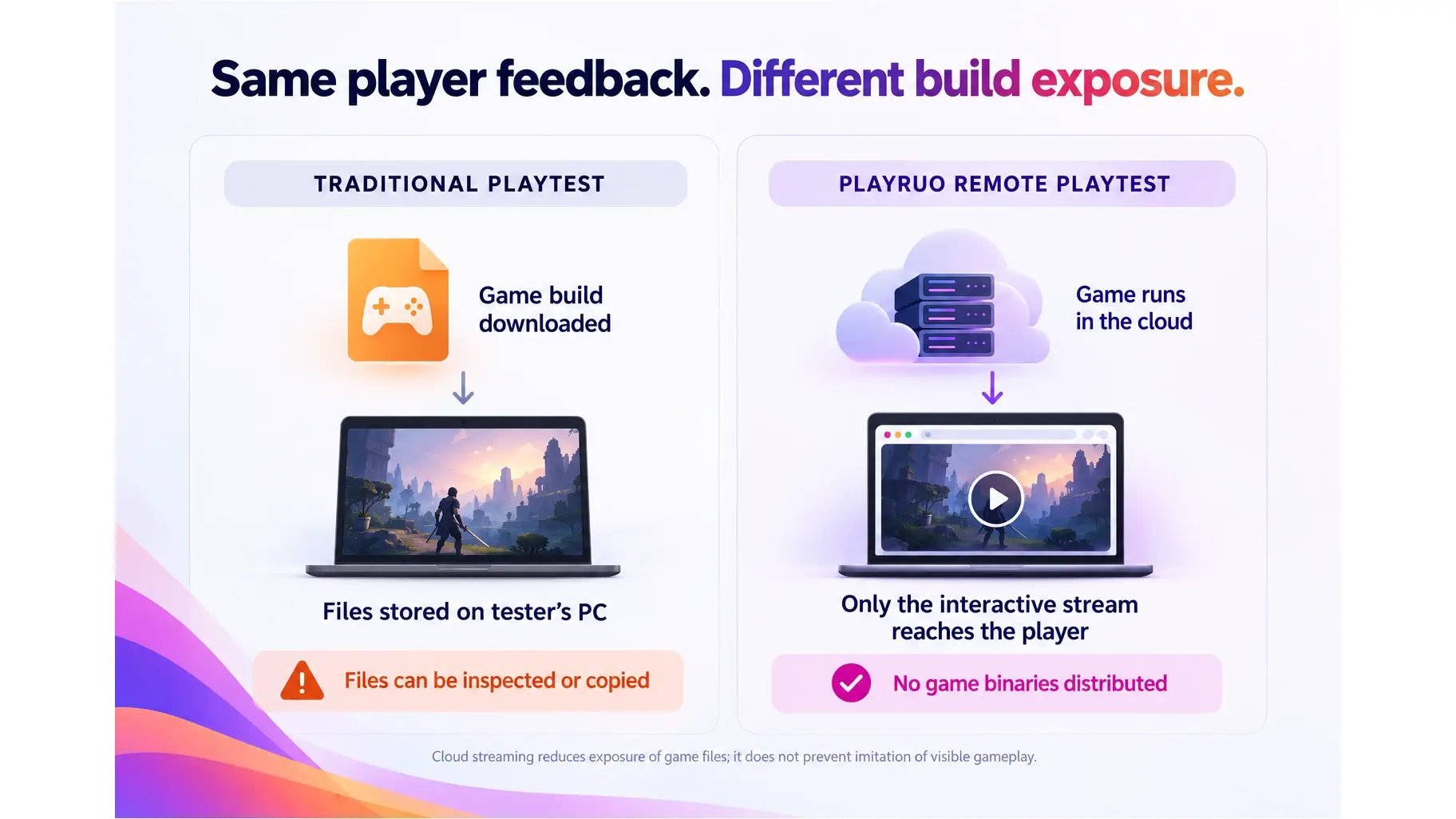
That matters especially when access friction distorts the sample. Downloads, accounts, launchers, hardware uncertainty, platform-specific setup, and build-security constraints can all filter the audience before the team sees behavior. Sometimes that makes demand look weaker than it is. Sometimes it makes the sample look more committed than the real audience will be.
Browser-based playable access reduces that distortion. In the Playruo model, players can access a build through the browser with no app, no account, and no download. Publishers can use direct build upload or launcher-based access without SDKs, porting, or code changes, while keeping the game server-side (Source: Playruo marketing; Source: Playruo technology).
The technical details matter, but they should not become the story. Playruo's product materials mention controlled server-side sessions, access windows, session logs, watermarking, and self-stated streaming specs such as 4K/240fps and an 8 ms glass-to-glass benchmark (Source: Playruo technology). Those capabilities are useful because of what they let a publisher decide earlier.
Can we open this preview to more press without losing control? Can we compare two audience cohorts without building a separate demo? Can we let creators try the game before a public beat? Can we see whether a campaign click becomes a real session? Can we stop spending into a channel that produces shallow play?
That is the point. Playruo is not just a way to show a game. It is a way to turn access into a decision layer.
How to build a 2026 launch rhythm
A 2026 launch should be built as a sequence of evidence windows, not a sequence of announcements.
Start narrow. Give access to core fans, selected creators, trusted press, or a known community cluster. Measure playtime, replay, retention, and play-to-action conversion before expanding.
Then widen. Compare cohorts instead of averaging everything into one dashboard. The point is to learn which channel produces qualified behavior, not only which channel produces traffic.
Then amplify. Spend should follow evidence, not seniority, habit, or calendar pressure.
A simple rhythm works:
- Week 1 to 2: expose the build to controlled cohorts and identify whether the core promise survives first contact.
- Week 3 to 4: widen to adjacent audiences and compare behavior by channel, creator, geography, and message.
- Week 5 to 6: adapt the launch plan, cut weak channels, strengthen the strongest playable moments, and prepare the public beat.
- Week 7 onward: amplify only where the behavior supports the spend.
This is not a replacement for press, Steam, creators, paid media, or wishlists. It is the layer that tells you which of those channels deserve more confidence.
There is a useful analogy from mobile, used carefully. AppsFlyer's 2026 State of Gaming for Marketers analyzed 9.6K gaming apps and 24.8 billion installs across 2025, in a market where paid pressure and creative volume keep rising (Source: AppsFlyer State of Gaming for Marketers 2026). PC and console economics are different, but the lesson carries: more media does not solve weak signal discipline.
Where Playruo fits
Playruo fits after the strategic shift is clear: launches should be piloted by behavior, not visibility.
For publishers, that means turning the game itself into a pre-launch signal. The build can be used for playtests, press previews, creator access, publisher-site demos, playable campaigns, and event extensions without forcing the player through a download or account setup (Source: Playruo marketing; Source: Why Playruo).
The value is not a longer feature list. The value is earlier decisions.
A publishing team can learn whether a press cohort actually played. A marketing team can see whether an ad click became a session. A producer can compare cohorts on consistent hardware. A comms team can share access while keeping the build controlled. A growth team can stop treating the demo as a content asset and start treating it as a measurement surface.
For an applied playtest example, How Tara Gaming reduced its AAA playtest costs by 3x with Playruo shows how secure remote access can change testing logistics (Source: Playruo Tara Gaming case study). For tactical marketing patterns, 10 ways to turn a one-click game demo into a marketing channel shows where one-click demos can sit across ads, livestreams, websites, and launchers.
The next advantage in publishing will not come from louder launches. It will come from teams that know, before launch week, which audiences are already behaving like future players.
No platform alone can make a weak game-to-market fit disappear. But a platform that produces behavioral evidence earlier can reduce how many high-variance decisions are made under uncertainty.
That is the new launch rule: build the announcement around the evidence, not the other way around.

FAQ
Sources
| Source | Notes |
|---|---|
| Newzoo Global Games Market Report 2025 | Official 2025 global revenue and player-base figures. |
| Newzoo PC & Console Gaming Report 2026 | 2026 PC/console growth, playtime, and monetization context. |
| PC Gamer / SteamDB 2025 releases | SteamDB release and review-count context for 2025. |
| FirstLook / Atomik Research 2026 | Industry survey of 250+ senior AA/AAA product and marketing leaders. |
| GameDiscoverCo wishlist conversions | Wishlist-to-first-week-sales conversion benchmark context. |
| Alinea wishlist-to-buyer conversions | Wishlist quality and vanity-metric warning. |
| Steamworks Next Fest documentation | Official demo and Next Fest participation context. |
| AppsFlyer State of Gaming for Marketers 2026 | Mobile gaming marketing dataset and paid pressure analogy. |
| Playruo marketing | Browser-based playable demo marketing workflow. |
| Playruo technology | Browser streaming, access control, security, and technical product specs. |
| Playruo technology | Playruo infrastructure and platform positioning. |
| Playruo Tara Gaming case study | Internal case study source for a concrete playtesting workflow. |
Related resources
More Playruo guidance connected to this topic.