Free-to-play removed price. Click-to-play removes friction.
A trailer, an ad, a store page or a review can become the starting point for a playable PC game experience. Browser streaming connects discovery with a hands-on trial, then a route to wishlist, buy or download on the player’s chosen store.
 Playruo Editorial TeamUpdated October 7, 20267 min read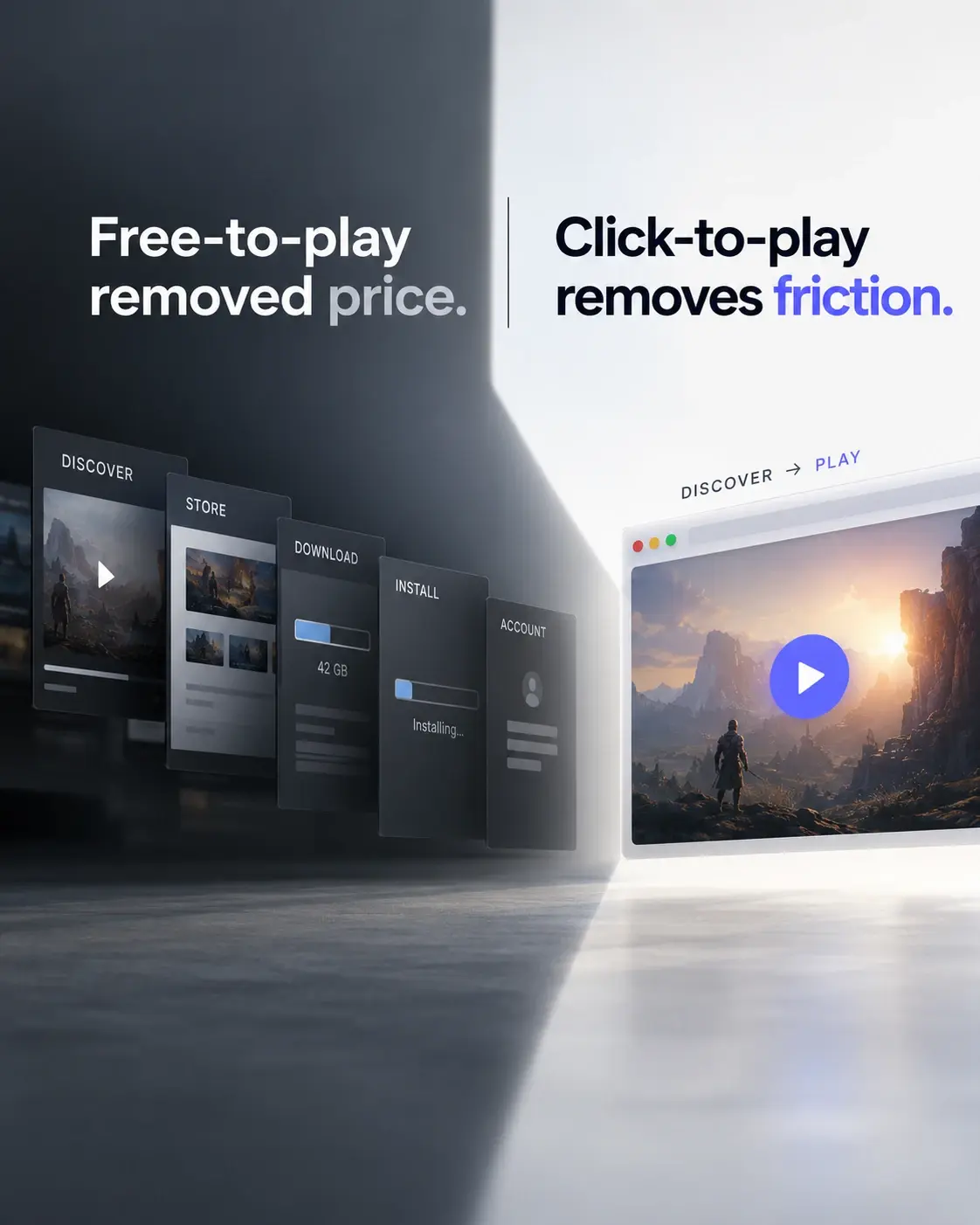
- Free is not frictionless
- H5 proved the behavior
- Native PC games can become playable marketing
- From YouTube discovery to a playable first impression
- Stores, reviews and communities can become playable entry points
- Try first, then choose where to wishlist or buy
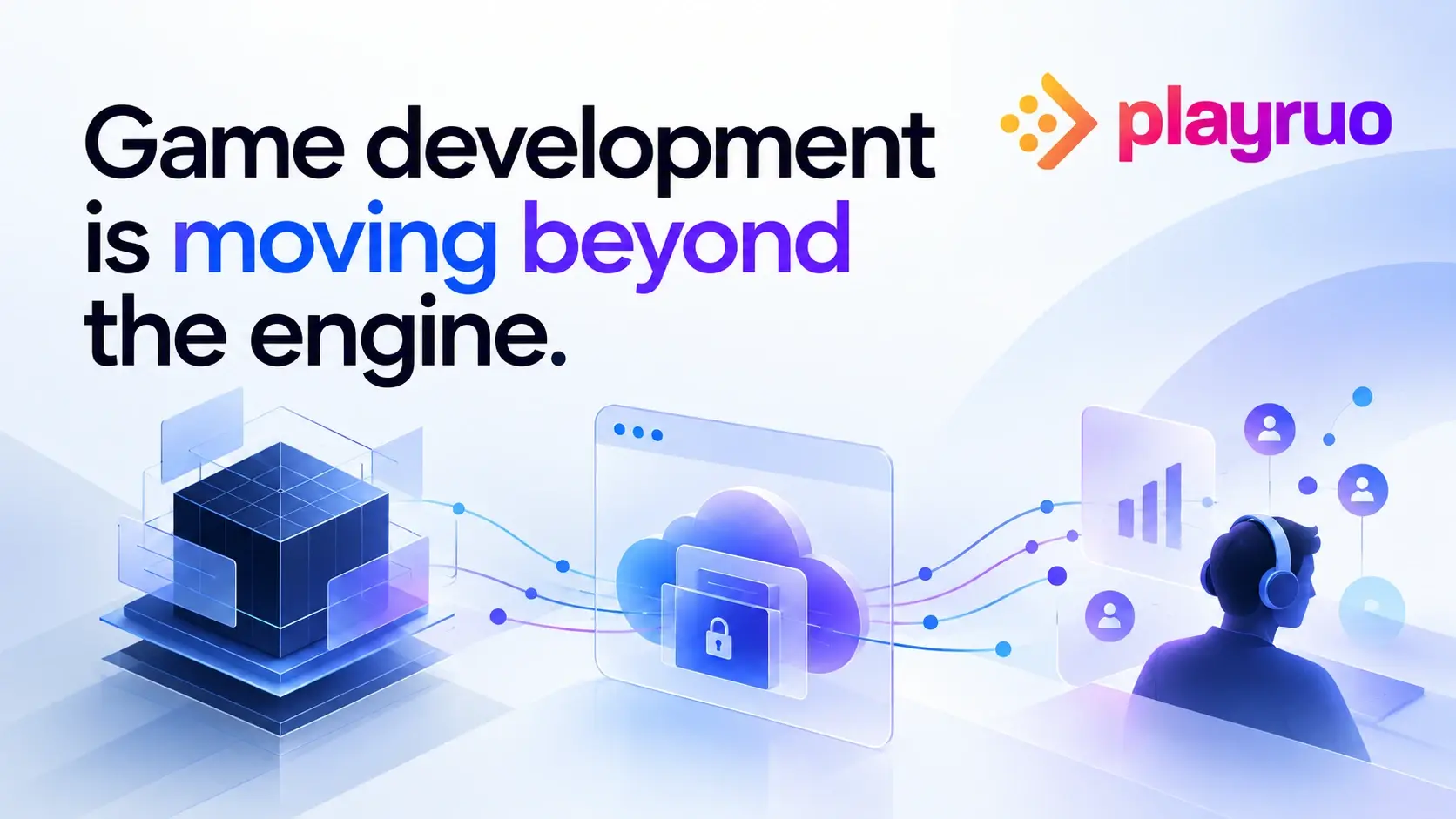
- The browser is becoming a new access layer for games
Key takeaways
- Free-to-play removes price, while click-to-play reduces the download and installation steps before a first game experience.
- Google and Newzoo found monthly H5 gaming among 46% of online consumers aged 13–55 across the regions surveyed.
- Playruo streams supported native PC builds to a browser, enabling playable marketing without an HTML5 port.
- Ads, videos, stores, editorial coverage and community links are potential entry points for a trial followed by a wishlist, purchase or download.
H5 proved the behavior. Native PC is next.
The browser is becoming a new access layer for games: a way to move from discovering a title to trying it, before deciding where to wishlist, download or buy it. For playable marketing, that changes what an ad, a video, a store page or an article can offer.
For years, one of gaming’s biggest growth levers was simple: remove the price barrier. Free-to-play did exactly that. But being free does not remove every barrier between curiosity and a first play session.
Free is not frictionless
A player discovers a PC game, watches a trailer and visits a store page. Then come the download, installation and sometimes an account or additional setup. The decision to try the game happens before they know how it feels.
Newzoo’s 2026 analysis puts that challenge in context. Free-to-play playtime remained broadly stable between 2021 and 2025 across the PC and console markets tracked, although the platforms followed different trajectories. Its analysis treats Call of Duty, Roblox, Fortnite and Minecraft separately.
The lesson is not that free-to-play has stopped working. It is that removing price alone does not solve the competition for attention. Every step between “this looks interesting” and “I’m playing it” gives a potential player another reason to move on.
H5 proved the behavior
Google and Newzoo’s research shows that HTML5 (H5) browser games already reach a substantial audience. Across the regions surveyed, 46% of online consumers aged 13–55 played H5 games monthly. Among 13–20-year-olds, the figure was around 60%.
The study was conducted in February 2026, screening more than 7,000 monthly H5 gamers from a representative sample of online consumers across seven regions: the US and Canada, Brazil, the UK, Germany, South Korea, Japan and India. Those figures describe the surveyed markets, rather than every internet user worldwide.
GameDev Reports’ summary of the research adds another important finding: 96% of surveyed H5 players also play native games on mobile, PC or console. Browser players and traditional players are largely the same people, choosing different ways to access games.
H5 is the signal. It does not have to be the destination for every studio. The opportunity we see is to bring that click-to-play experience to native PC games, without asking studios to rebuild them as H5 games.
Native PC games can become playable marketing
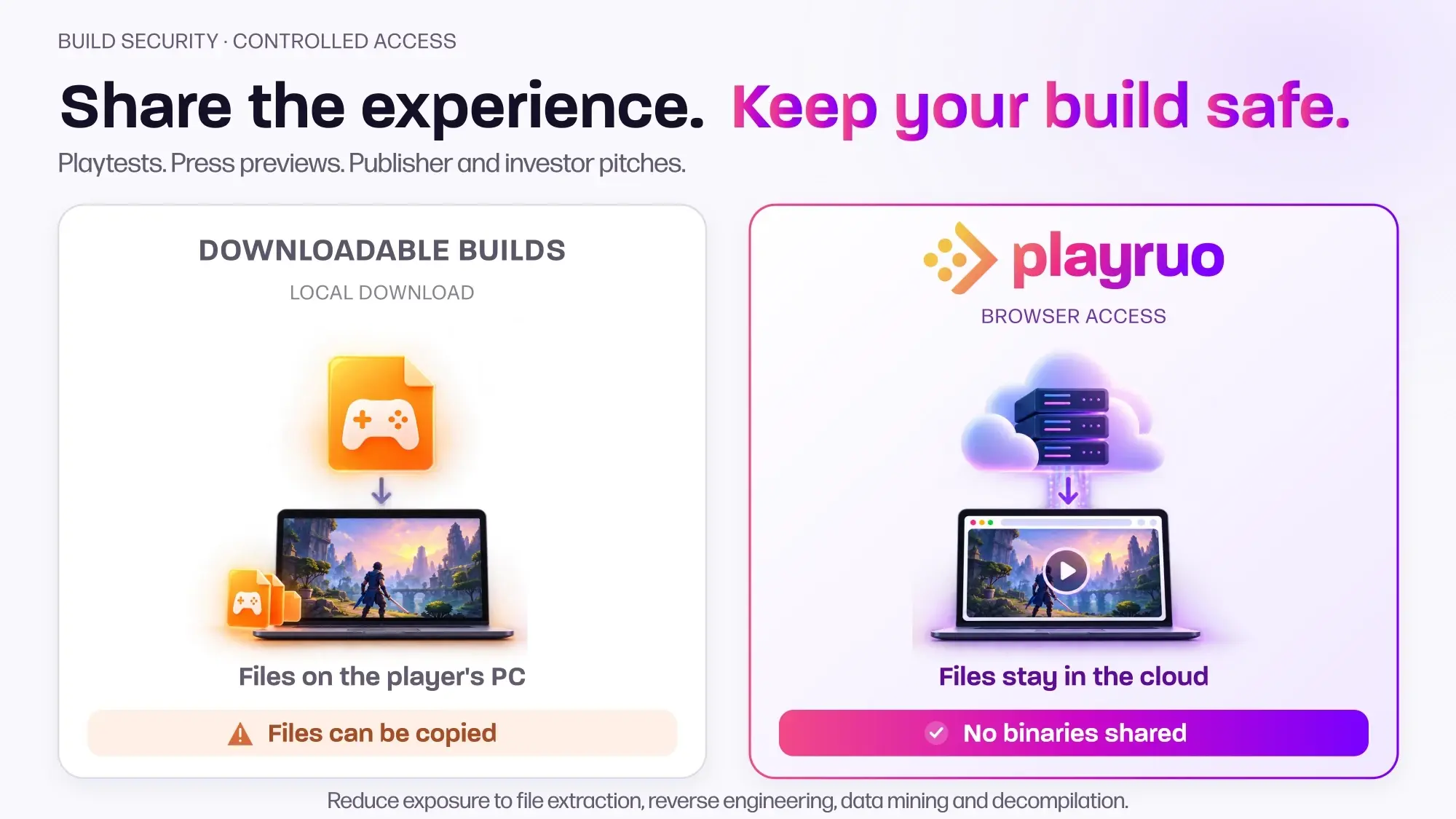
With Playruo’s cloud streaming technology, a supported PC build runs on remote hardware and streams to a modern browser. The player can try the game without downloading or installing it locally, and the studio does not need to create a separate HTML5 version.
That opens a practical path to playable marketing: let someone experience the game at the moment a campaign earns their interest. A trailer can still establish the world and the promise. A “Try now” call to action can then let the player discover how the game feels.
Playruo provides a white-label experience that can be reached through a link or embedded in a compatible environment. Publishers control the build and the session, while the surrounding campaign can guide players toward an available wishlist, purchase or download destination. A suitable connection, supported browser and compatible controls remain part of the experience.
The same technology supports playtests and press previews. For marketing and distribution, its value is the ability to put a real game experience within reach of an interested audience.
From YouTube discovery to a playable first impression
Imagine watching a game trailer or a creator’s video on YouTube and having the option to try the game immediately through a browser demo. The video creates interest; the playable session gives that interest somewhere to go.
The same idea could inform PC game campaigns across Google’s advertising ecosystem: an eligible placement could lead to a playable landing page, with deeper integration considered where the format supports it. For platforms and advertisers, the opportunity is to connect discovery with hands-on experience.
Google is already exploring ways to make trying games easier. In March 2026, it announced Game Trials for selected paid games, with a future extension to Google Play Games on PC. Separately, YouTube Playables provides web-based games inside YouTube. These initiatives have their own formats and requirements; they do not establish support for cloud-streamed PC advertising.
They do make the broader question timely: how could players try a supported native PC game before committing to a download or purchase? A browser trial could complement a destination such as Google Play Games on PC, connecting “Try now” with the next step in that store’s journey.
Stores, reviews and communities can become playable entry points
The idea extends to any business helping players decide what to play. A distributor, media publisher or community platform could add a playable experience beside the content it already provides. For a site such as IGN or Fandom, a review, guide or feature could become a starting point for a hands-on trial.
The following examples illustrate potential applications, not announced Playruo partnerships or integrations. Each would depend on the game publisher’s participation and the platform’s available placements and requirements.
| Discovery context | A possible playable journey |
|---|---|
| Epic Games Store, GOG or another game storefront | Try an authorised preview before deciding whether to wishlist or buy the game. |
| IGN, Fandom, OpenCritic, Metacritic or another gaming media site | Read a review, guide or article, follow a “Try now” link and form a first-hand impression. |
| A YouTube video, livestream or eligible advertising placement | Move from watching the game to trying a browser session, then choose an available store destination. |
| A Discord community or a Reddit discussion or campaign | Follow a permitted demo link, play in the browser and return with something concrete to discuss. |
A simple link can make the experience accessible without requiring every discovery surface to host the game itself. An embedded experience is another option where the platform supports it.
There are already signs of this direction. Discord documents experimental Cloud Play Quests that stream games without a game installation, currently completed in its desktop app. That is a different implementation, but it shows why bringing play closer to discovery matters beyond traditional storefronts.
Try first, then choose where to wishlist or buy
Consider a player reading a review of a PC game. They understand the premise, but they are unsure whether the controls or pacing will suit them. A playable call to action gives them a way to answer that question for themselves.
After a short session, the campaign can offer links to the stores where the game is available. The player chooses a destination to wishlist, buy or download it. The storefront still handles its own account, transaction and installation experience.
The journey becomes:
Discover → try → choose a store → wishlist, buy or download.
For publishers, the opportunity is to make a first session easier to start and the next action easier to find. Its commercial value should be tested through session starts, play duration, completion and onward store visits, with wishlist or purchase outcomes measured where attribution is available.
The browser is becoming a new access layer for games
The objective is not to move every hour of gameplay into the cloud. Players can continue enjoying full games locally on their preferred hardware. Cloud delivery can make the first minutes easier to access, at the moment they are most useful.
That is the opportunity Playruo is building for: helping publishers, distributors, media and advertising platforms make native PC games playable wherever interest begins. The audience, editorial voice and commercial destination can remain with the business that brought the player to the game.
Free-to-play removed price. Click-to-play removes friction. H5 proved the behavior. Native PC is next.
For teams exploring that next step, Playruo’s playable marketing offers a starting point: put the game behind the call to action, then give the player a clear route forward.

FAQ
Sources
| Source | Notes |
|---|---|
| Google and Newzoo: A playbook for winning with H5 gamers | 24 August 2026. February 2026 study of 7,000+ monthly H5 gamers screened from online consumers in seven regions; primary confirmation of 46% and approximately 60%. |
| Newzoo: Free-to-play is redistributing | 1 October 2026. First-party analysis across 37 engagement markets, 2021–2025; Call of Duty, Roblox, Fortnite and Minecraft tracked separately. |
| GameDev Reports: The H5 gaming audience in 2026 | 28 September 2026. Secondary summary supplied with the article; source of the 96% native-game overlap figure, not independently verified in the publicly accessible Newzoo summary. |
| Playruo technology | First-party description of supported unmodified builds, server-side execution and browser delivery. |
| Playruo for marketing | First-party description of shareable and embedded browser demos for advertising, livestreams, publisher sites and launchers. |
| Playruo: Playable ads for PC and console games | First-party workflow reference for timed browser sessions and onward wishlist or purchase calls to action. Performance benchmarks from this guide are not reused here. |
| Google: New ways to try, buy and master paid games | 11 March 2026 announcement. Game Trials for selected paid games, with PC described as a future extension; not evidence of browser streaming or a Playruo integration. |
| YouTube Playables developer documentation | Web-based games within YouTube. This is distinct from an announced cloud-streamed PC advertising format. |
| Discord Cloud Play Quests | Official documentation of an experimental cloud-streamed trial format. Completion currently requires the desktop app; not presented as a Playruo integration. |
Related resources
More Playruo guidance connected to this topic.